Free Coaching Printables for Baseball and Softball
Everything a coach needs on paper. Scorecards, pitch trackers, lineup cards, evaluation forms, skills assessments, and scorebooks. Browse by category or filter below.
Scorebooks
Custom scorebook with cover, roster, and game cards
Scorecards
Diamond-grid and simple scorekeeping cards
Lineup Cards
Tee ball, Little League, tournament, and more
Baseball Field Diagram
Blank, labeled, and numbered diamonds to print
Softball Field Diagram
Blank, labeled, and numbered diamonds to print
Practice Plans
Ready-made plans organized by age and focus
Tryouts & Evaluations
Player evaluation forms with scoring rubrics
Pitch Tracking
Pitch count charts, trackers, and bullpen logs
Player Development
Skills assessments, stat tracking, and white-to-black-belt skill rubrics
Game Day
Pitch-call wristbands, offensive sign wristbands, bunt coverage, and shift cards
All Printables
Game Day
Scorekeeping and pitch tracking forms for games.
Simple Scorecards
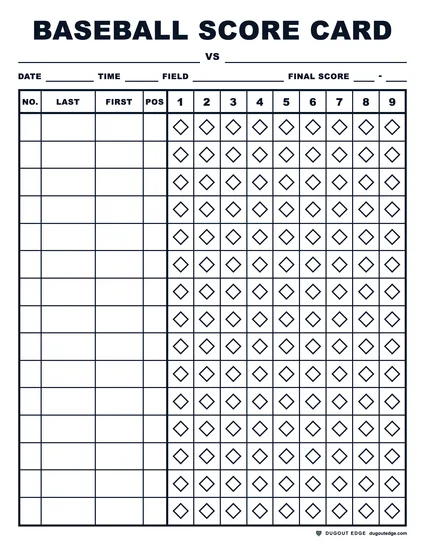
Bold Baseball Score Card (9-Inning)
One team, one page, drawn with heavy lines and big boxes so it is easy to read and write on in the dugout. 9 innings and 15 batting spots with a diamond in every box, plus number, name, and position columns. No legend, no stat tables.
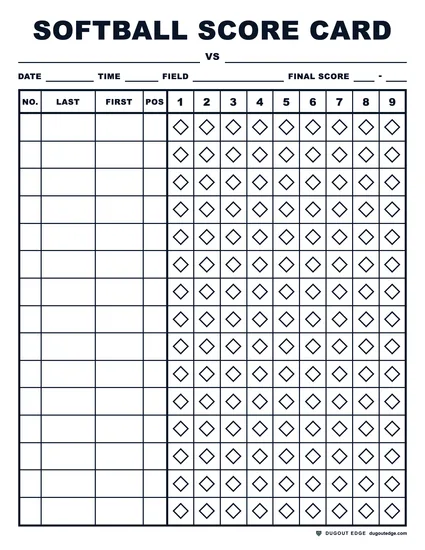
Bold Softball Score Card (7 Innings + Extras)
One team, one page, drawn with heavy lines and big boxes so it is easy to read and write on in the dugout. A regulation 7 innings plus 2 extra-inning columns, and 15 batting spots with a diamond in every box, plus number, name, and position columns. No legend, no stat tables.
Simple Baseball Scorecard (3-Inning)
Both teams on one page. 3-inning format for tee ball and coach pitch (ages 4-6). Just track the outcome, no diamonds. Includes scoring legend.
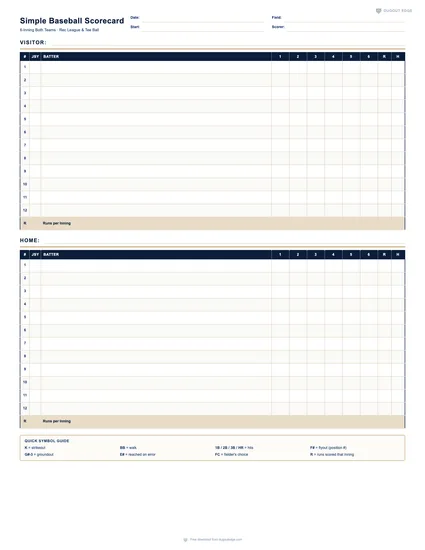
Simple Baseball Scorecard (6-Inning)
Both teams on one page. 6-inning format for youth rec leagues (ages 7-10). Track hits, outs, and runs without diamond notation. Includes scoring legend.
Simple Softball Scorecard (3-Inning)
Both teams on one page. 3-inning format for tee ball and coach pitch softball (ages 4-6). Just track the outcome, no diamonds. Includes scoring legend.
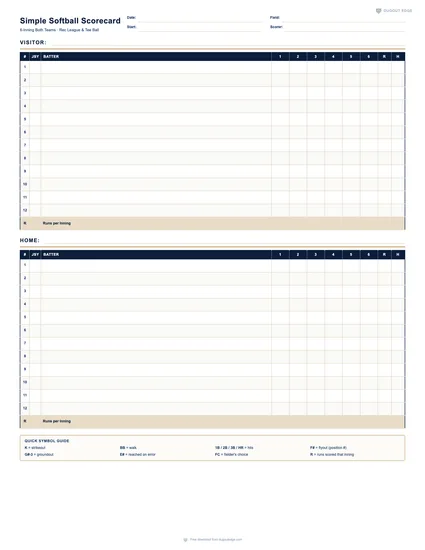
Simple Softball Scorecard (6-Inning)
Both teams on one page. 6-inning format for youth rec softball (ages 7-10). Track hits, outs, and runs without diamond notation. Includes scoring legend.
Scorekeeping Cards
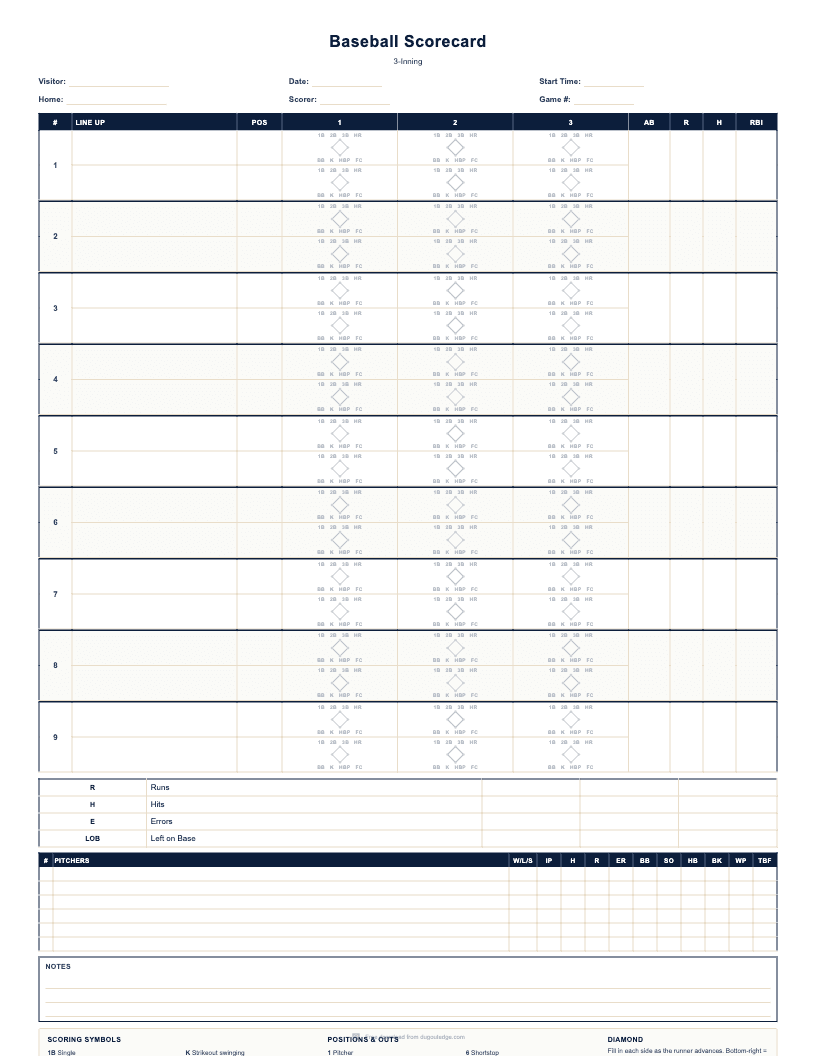
Baseball Scorecard (3-Inning)
Diamond-grid scorecard for short-format games. 3 innings with baserunner tracking, pitcher log, and scoring legend. Great for introducing scorekeeping to young players.
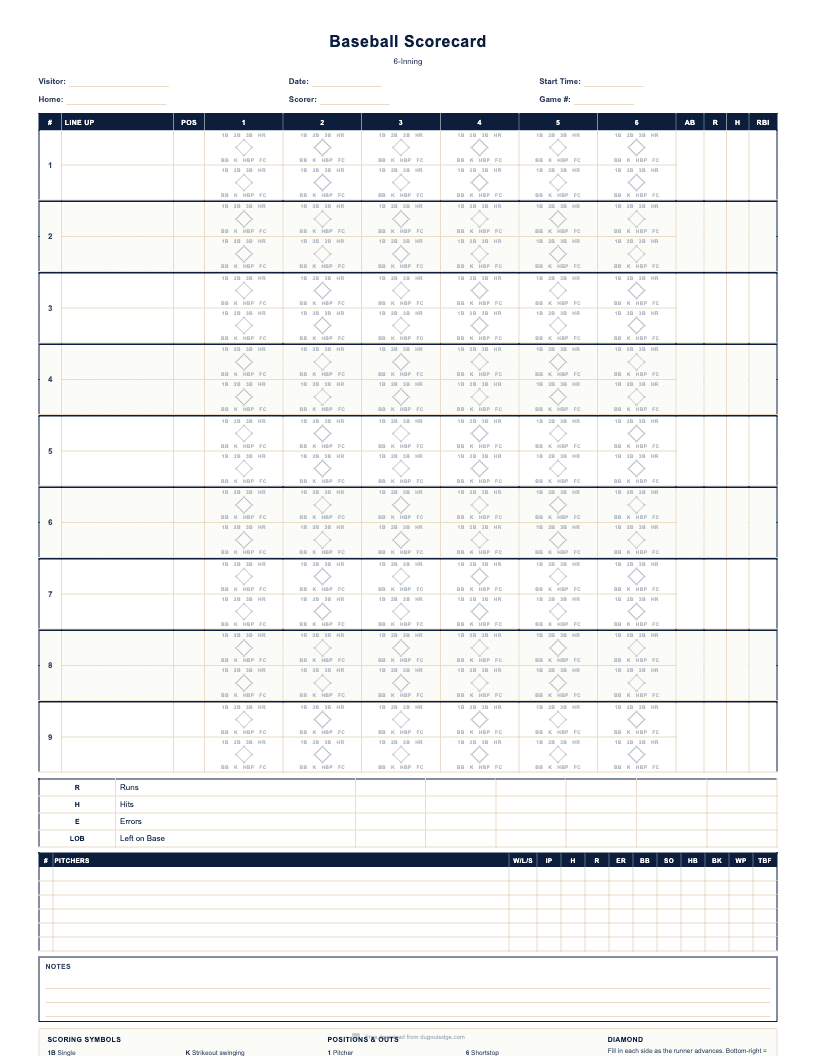
Baseball Scorecard (6-Inning)
Diamond-grid scorecard for 6-inning youth games. Full baserunner tracking, pitcher log, and scoring legend. Standard format for ages 9-12.
Baseball Scorecard (7-Inning)
Standard 7-inning scorecard with diamond symbols for each at-bat. Track baserunning, AB, R, H, RBI plus pitcher and catcher stats. Includes scoring legend.
Baseball Scorecard (9-Inning)
Full 9-inning scorecard with diamond symbols for each at-bat. Tracks baserunning, stats, pitching, and umpires. For travel ball, high school, and competitive leagues.
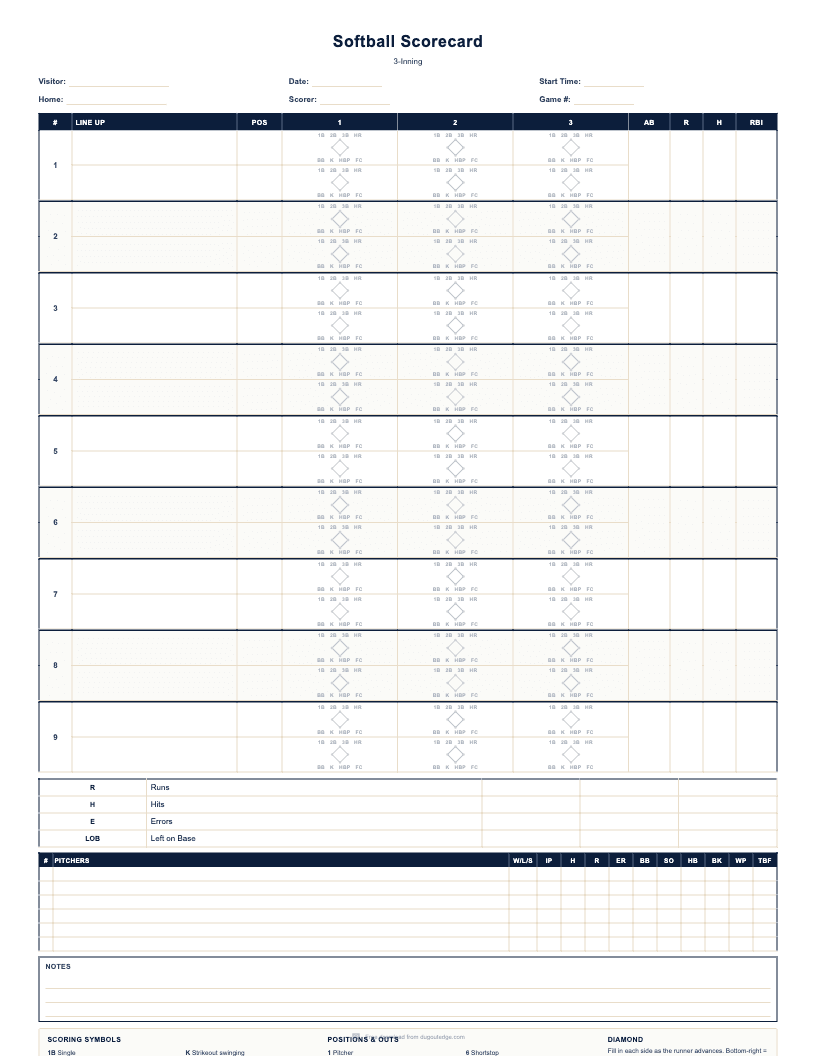
Softball Scorecard (3-Inning)
Diamond-grid scorecard for short-format softball games. 3 innings with baserunner tracking, pitcher log, and scoring legend.
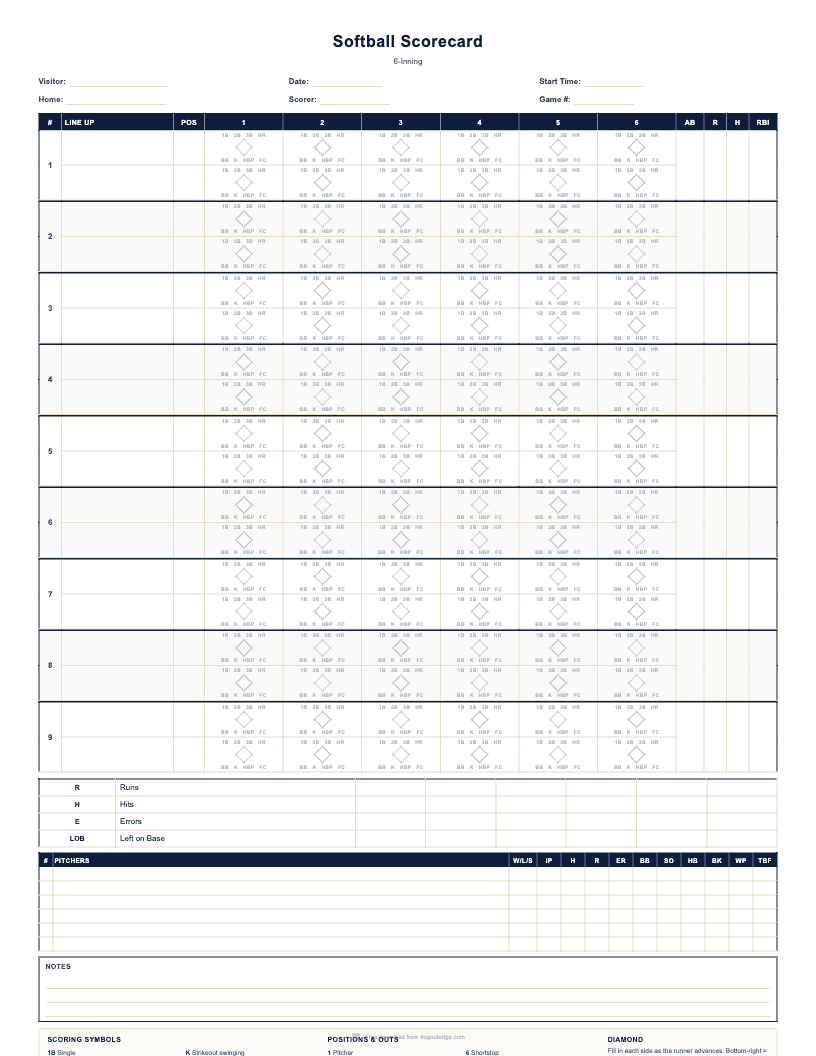
Softball Scorecard (6-Inning)
Diamond-grid scorecard for 6-inning youth softball. Full baserunner tracking, pitcher log, and scoring legend.
Softball Scorecard (7-Inning)
Standard 7-inning softball scorecard with diamond symbols. Track baserunning, AB, R, H, RBI plus pitcher and catcher stats. Includes scoring legend.
Softball Scorecard (9-Inning)
Full 9-inning softball scorecard with diamond symbols. For travel ball and competitive fastpitch leagues. Includes scoring legend.
Baseball Scorekeeping Cheat Sheet (Symbols & Notation)
One-page printable cheat sheet with every baseball scorekeeping symbol you need: position numbers, hit and out notation, base-running marks, diamond fill convention, and Little League pitch count quick reference. Print and tuck in the back of your scorebook.
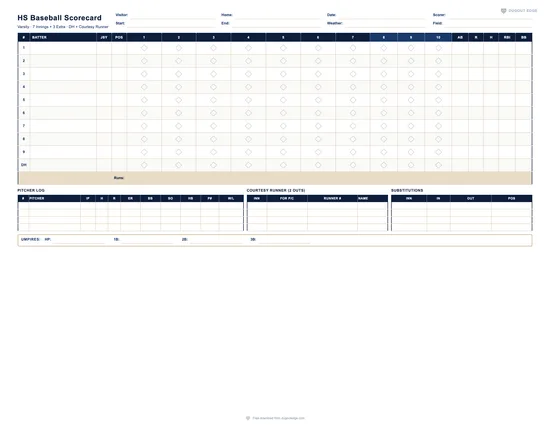
High School Baseball Scorecard
Premium7-inning varsity format with DH line, 3 extra-inning columns, courtesy runner log, and full substitution tracker. Built for NFHS and state federation play.
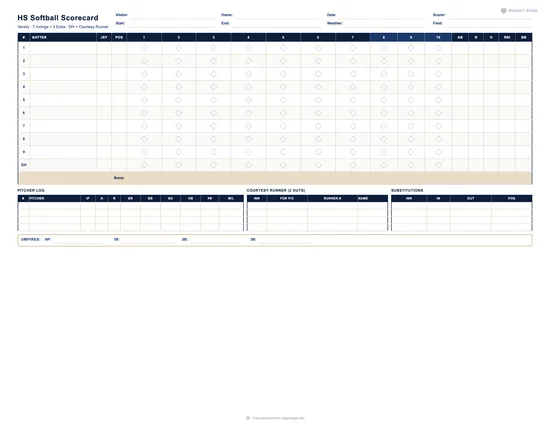
High School Softball Scorecard
Premium7-inning varsity softball format with DP/FLEX rows, extra innings, courtesy runner, and substitution tracker. For NFHS and state association play.
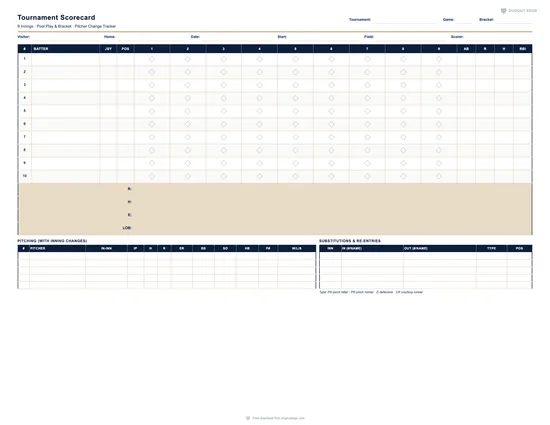
Tournament Scorecard (9-Inning)
PremiumChampionship-grade 9-inning scorecard with tournament header (pool, bracket, seed), pitcher-change inning tracking, and a 5-row substitution + re-entry log.
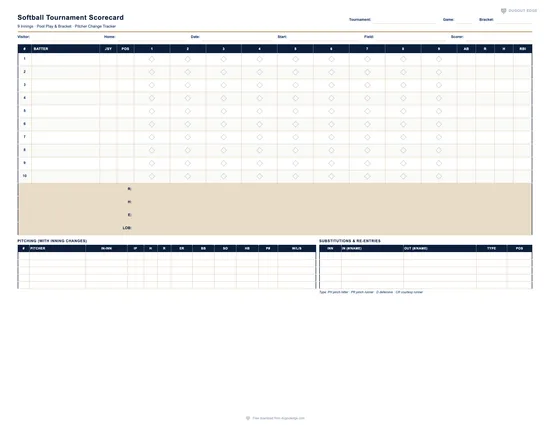
Softball Tournament Scorecard (9-Inning)
PremiumFastpitch tournament scorecard with 9-inning grid, pool/bracket header, pitcher-change tracking, and substitution + re-entry log for tournament weekends.
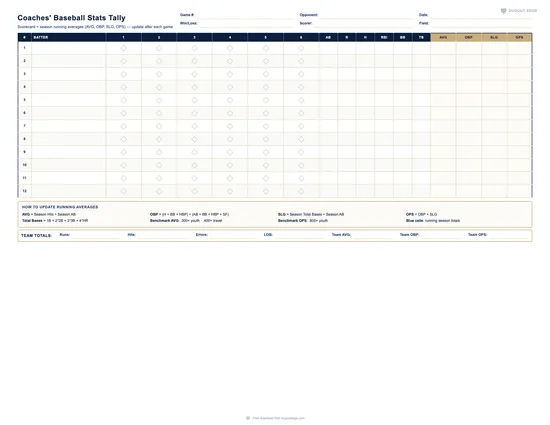
Coaches' Baseball Stats Tally Scorecard
PremiumScorecard with running season average columns (AVG, OBP, SLG, OPS) alongside the batting grid. Update after each game — no spreadsheet needed.
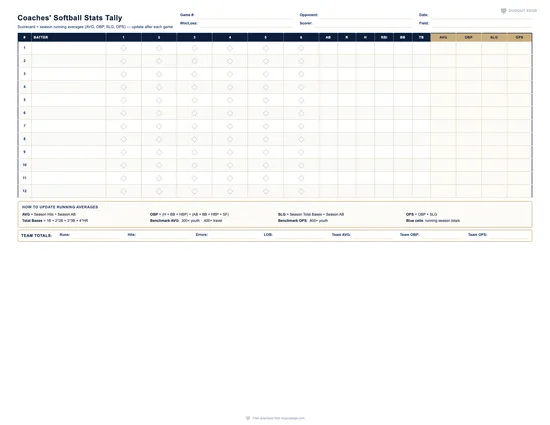
Coaches' Softball Stats Tally Scorecard
PremiumSoftball scorecard with running season-stat columns (AVG, OBP, SLG, OPS). Track season performance from the dugout without a separate spreadsheet.
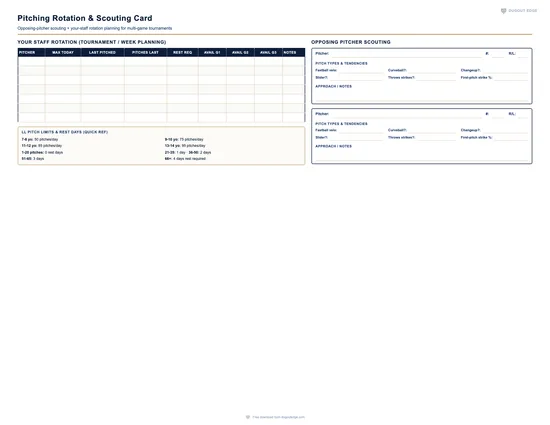
Pitching Rotation & Scouting Card
PremiumPlan your staff across a multi-game weekend (rest days, availability) AND scout opposing pitchers (velocity, pitch types, tendencies) on one page.
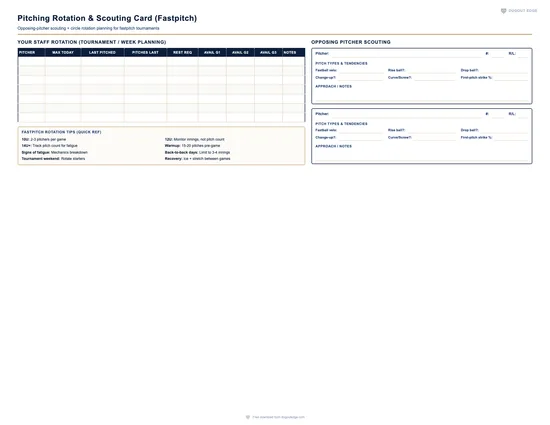
Fastpitch Pitching Rotation & Scouting Card
PremiumPlan your circle rotation across a tournament weekend AND scout opposing pitchers (rise ball, drop, change-up tendencies) on one page. Fastpitch-specific tips.
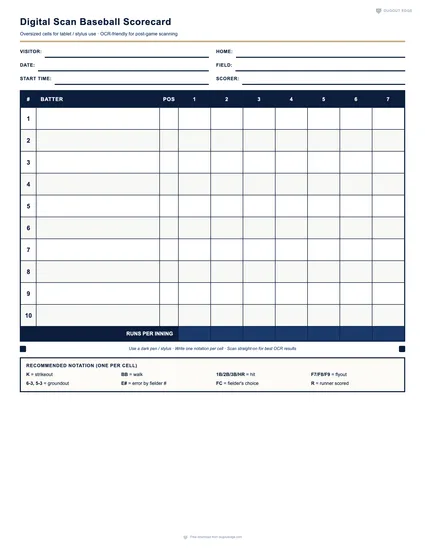
Digital Scan Baseball Scorecard
PremiumOversized-cell scorecard designed for iPad + stylus use OR for post-game OCR scanning. Corner markers help OCR tools align the grid automatically.
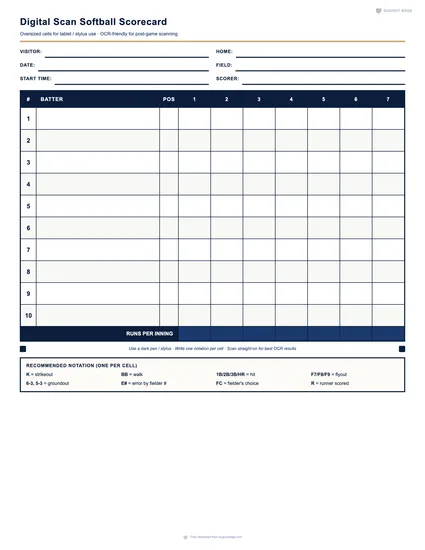
Digital Scan Softball Scorecard
PremiumTablet-friendly softball scorecard with oversized cells. Write with Apple Pencil / stylus on iPad or Remarkable, or scan into OCR tools after the game.
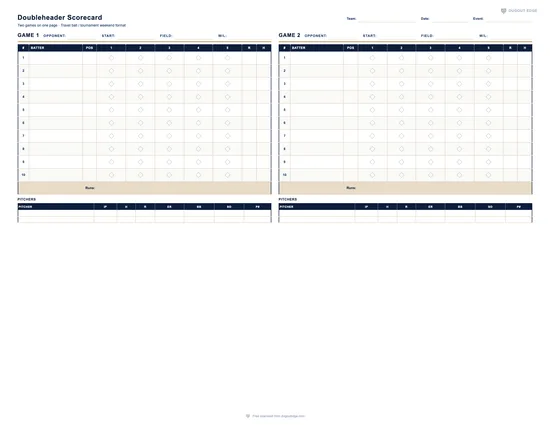
Doubleheader Scorecard (2 Games, 1 Page)
PremiumTwo 5-inning scorecards on one landscape page. Perfect for travel-ball weekends and tournament Saturdays where you play back-to-back games.
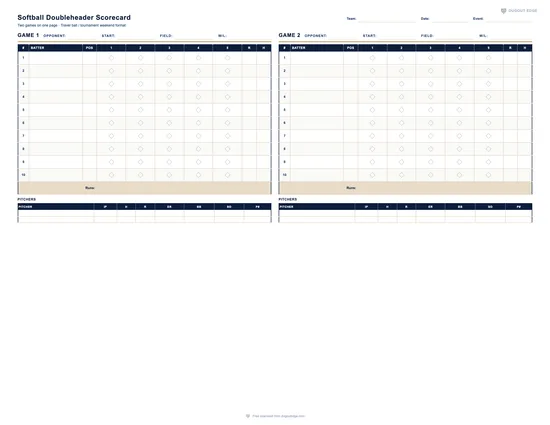
Softball Doubleheader Scorecard (2 Games, 1 Page)
PremiumTwo 5-inning softball scorecards on one landscape page. Built for fastpitch tournament weekends with back-to-back games.
Pitch Tracking
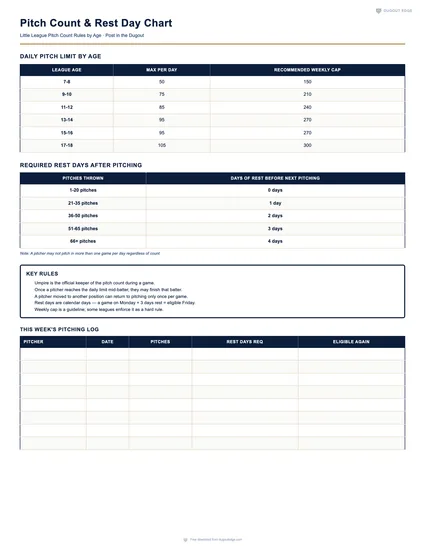
Pitch Count & Rest Day Chart (Little League)
One-page reference printable with Little League pitch count limits by age and required rest days. Post in the dugout or clip inside your scorebook.

Baseball Pitch Tracker (Youth)
Chart every pitch as a ball or strike for 2 pitchers (50 pitches each). Includes rest day reference chart.

Softball Pitch Tracker (Youth)
Chart every pitch as a ball or strike for 2 pitchers (50 pitches each). Includes rest day reference chart.

Baseball Pitch Tracker (Full 100)
PremiumTrack 100 pitches for a single pitcher. 10 rows of 10 numbered pitches with ball/strike and row totals.

Softball Pitch Tracker (Full 100)
PremiumTrack 100 pitches for a single pitcher. 10 rows of 10 numbered pitches with ball/strike and row totals.

Baseball Pitch Tracker (Advanced)
PremiumLog pitch type (FB, CB, SL, CH, CT, 2S), ball/strike, and location on a strike zone grid. 25 pitches per page.

Softball Pitch Tracker (Advanced)
PremiumLog pitch type (Rise, Drop, Curve, Change, Screw, DC), ball/strike, and location on a strike zone grid. 25 pitches per page.
Lineups & Defense
Blank batting orders and field position charts, in the same format the lineup generator prints.
Batting Order
Blank Batting Order Sheet
Just the batting order, on its own page. 15 numbered slots in one column, each sized to write a name into by hand.
Field Position Charts
Blank Baseball Field Position Chart
One blank diamond with a write-in space at all nine positions plus a bench. Single page, no batting order attached.
Blank Field Position Chart (6 Innings)
Six blank diamonds, one per inning, for planning defensive rotations on their own.
Blank Field Position Chart (7 Innings)
Seven blank diamonds, one per inning. For older youth and travel ball.
Field Sheets
Blank Field Sheet (Single Field)
The field view the lineup generator prints, blank. One diamond, nine write-in positions, plus a blank batting order and bench.
Blank Field Sheet (6 Innings)
A blank diamond for each of 6 innings, plus a blank batting order page. Nine write-in positions per inning and a bench.
Blank Field Sheet (7 Innings)
A blank diamond for each of 7 innings, plus a blank batting order page. For older youth and travel ball.
Field Sheet + Batting Order, Side by Side (6 Innings)
Every page carries the diamond and the batting order together, one page per inning, order running down the side.
Field Sheet + Batting Order, Side by Side (7 Innings)
The diamond and the batting order on every page, one page per inning, order down the side.
Field Sheet + Batting Order, Stacked (6 Innings)
Diamond on top, batting order across the full page width underneath. Roomier rows for long rosters.
Field Sheet + Batting Order, Stacked (7 Innings)
Diamond on top, batting order underneath, one page per inning through the 7th.
In-Game Tools
Wristband signs, bunt coverage diagrams, defensive shift cards, and situational hitting references for the dugout binder.
In-Game Reference Cards
Situational Hitting Card (Baseball)
12-cell dugout reference: rows = outs, columns = base situation. Each cell tells the hitter the default approach. Pair with the offensive sign wristband.
Situational Hitting Card (Softball)
12-cell fastpitch reference: rows = outs, columns = base situation. Each cell explains the default approach (move the runner, two-strike, big inning, etc.).
Bunt Coverage Card (Baseball)
Defensive bunt coverage diagrams for sacrifice bunt, squeeze, and slug bunt situations. Shows fielder rotations and throwing priorities. Tape it inside the dugout.
Bunt Coverage Card (Softball)
Fastpitch bunt coverage diagrams for sacrifice and slap-bunt situations. Shows pitcher, catcher, corner, and middle infielder rotations.
Defensive Shift Card
Quick-reference card for the most common defensive shifts: bunt, infield-in, no-doubles, double-play depth, and shaded outfield. Tape it inside the dugout.
First-and-Third Defense Card
Quick-reference for the most-asked-about defensive situation in youth baseball: runners on first and third with the runner on first stealing. Coverage options for catcher, middle infielders, and pitcher.
Pickoff Plays Reference
Catcher and pitcher pickoff plays for first, second, and third base. Includes timing keys, signal codes, and middle-infielder responsibilities.
Wristband Signs
Pitch-Calling Wristband (Printable PDF)
Printable wristband insert for catchers and pitchers. Coach yells a 2-digit number from the dugout; the wristband decodes it to a pitch type and zone. Generate yours with our wristband signs tool when it ships.
Offensive Sign Wristband (Printable PDF)
Printable wristband insert for hitters and baserunners. 3-digit live-digit system with decoy numbers so opposing dugouts can’t crack the code. Generated from our wristband signs tool when it ships.
Bullpen & Practice
Structured pitch tracking for bullpen sessions and practice.

Baseball Bullpen Session Log
Track pitch type, zone location, velocity, and result for each pitch in a bullpen session. Includes summary by pitch type.

Softball Bullpen Session Log
Track pitch type, zone location, velocity, and result for each pitch in a bullpen session. Includes summary by pitch type.
Tryouts & Evaluations
Player evaluation forms for tryouts and pre-season assessments.
Baseball Player Evaluations
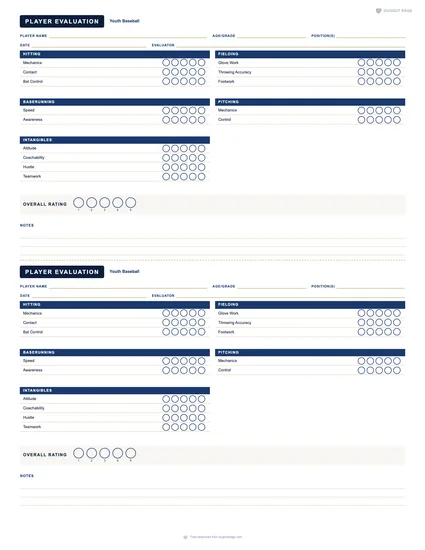
Youth Baseball Player Evaluation
Tryout evaluation form for ages 8-12. Skill ratings for hitting, fielding, baserunning, and pitching. Includes scoring rubric.
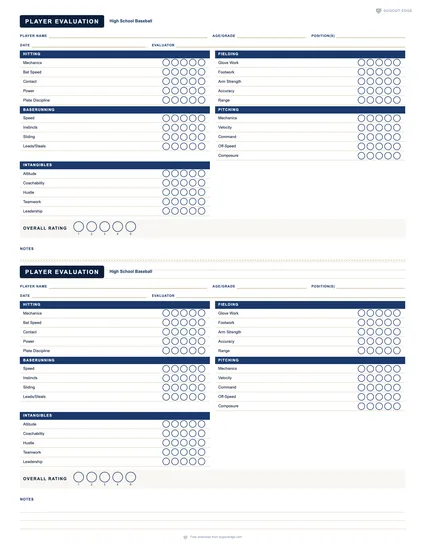
High School Baseball Evaluation
PremiumAdvanced evaluation form for ages 14-18. Detailed skill ratings including velocity, command, plate discipline. Includes scoring rubric.
Softball Player Evaluations
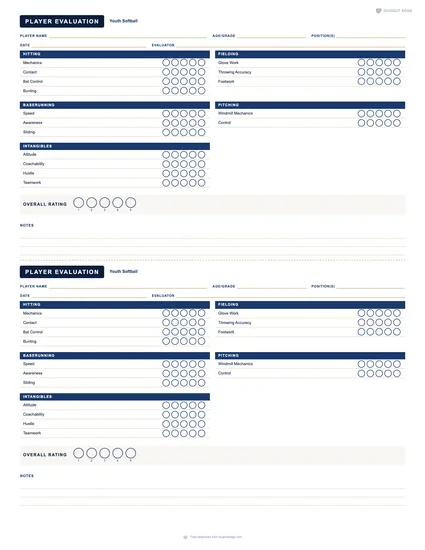
Youth Softball Player Evaluation
Tryout evaluation form for ages 8-12. Softball-specific skills including bunting and windmill pitching. Includes scoring rubric.
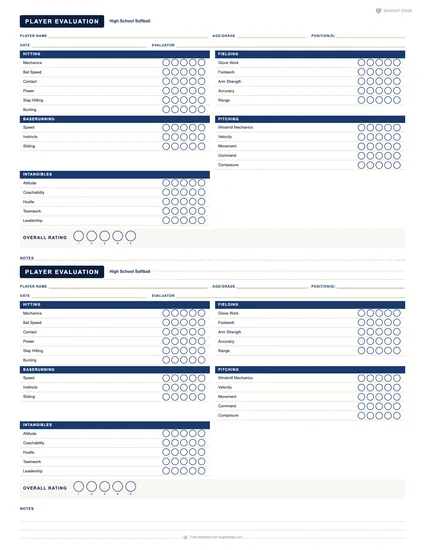
High School Softball Evaluation
PremiumAdvanced evaluation form for ages 14-18. Softball-specific skills including slap hitting and windmill mechanics. Includes scoring rubric.
Player Development
Skills assessments, stat tracking, belt progression rubrics, and individualized training plans to track and improve every player on your roster.
Baseball
Baseball Skills Assessment (Ages 4-6)
Measurable skills test for ages 4-6. Throwing, hitting, fielding, and baserunning drills with pre/post season columns.
Baseball Skills Assessment (Ages 7-8)
Measurable skills test for ages 7-8. Throwing, hitting, fielding, and baserunning drills with pre/post season columns.
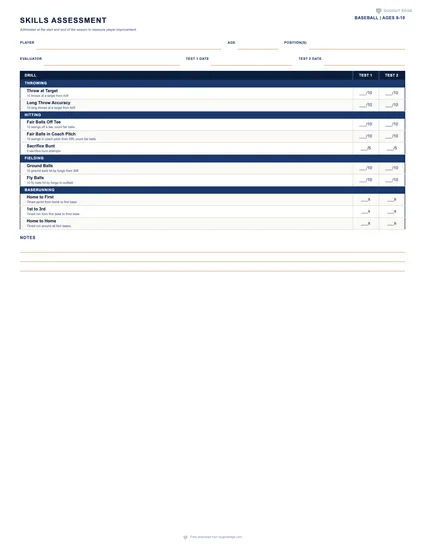
Baseball Skills Assessment (Ages 9-10)
Measurable skills test for ages 9-10. Throwing, hitting, fielding, and baserunning drills with pre/post season columns.
Baseball Skills Assessment (Ages 11-12)
Measurable skills test for ages 11-12. Throwing, hitting, fielding, and baserunning drills with pre/post season columns.
Baseball Skills Assessment (Ages 13-14)
PremiumMeasurable skills test for ages 13-14. Throwing, hitting, fielding, and baserunning drills with pre/post season columns.
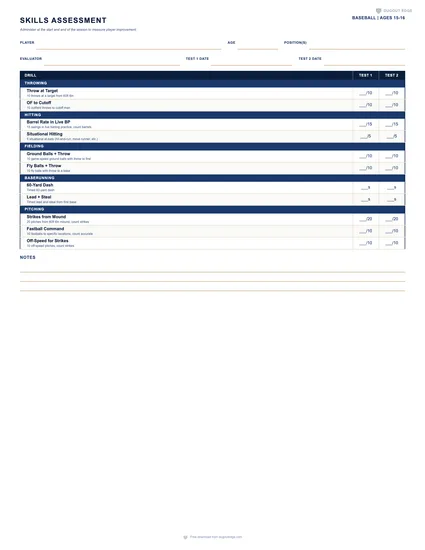
Baseball Skills Assessment (Ages 15-16)
PremiumMeasurable skills test for ages 15-16. Throwing, hitting, fielding, and baserunning drills with pre/post season columns.
Baseball Skills Assessment (Ages 17-18)
PremiumMeasurable skills test for ages 17-18. Throwing, hitting, fielding, and baserunning drills with pre/post season columns.
Baseball Skills Assessment (Ages 18+)
PremiumMeasurable skills test for ages 18+. Throwing, hitting, fielding, and baserunning drills with pre/post season columns.
Softball
Softball Skills Assessment (Ages 4-6)
Measurable skills test for ages 4-6. Throwing, hitting, fielding, and baserunning drills with pre/post season columns.
Softball Skills Assessment (Ages 7-8)
Measurable skills test for ages 7-8. Throwing, hitting, fielding, and baserunning drills with pre/post season columns.
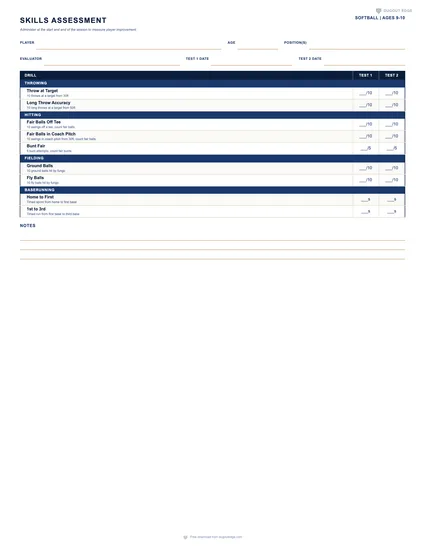
Softball Skills Assessment (Ages 9-10)
Measurable skills test for ages 9-10. Throwing, hitting, fielding, and baserunning drills with pre/post season columns.
Softball Skills Assessment (Ages 11-12)
Measurable skills test for ages 11-12. Throwing, hitting, fielding, and baserunning drills with pre/post season columns.
Softball Skills Assessment (Ages 13-14)
PremiumMeasurable skills test for ages 13-14. Throwing, hitting, fielding, and baserunning drills with pre/post season columns.
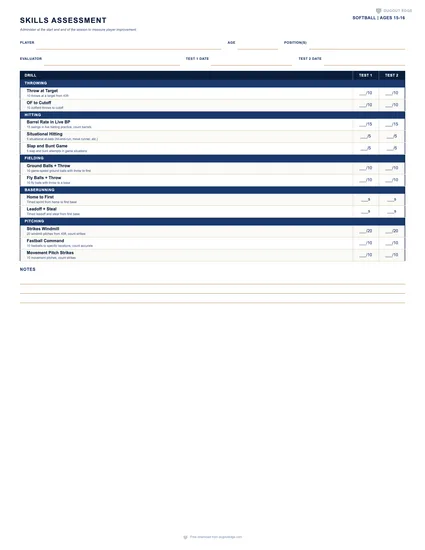
Softball Skills Assessment (Ages 15-16)
PremiumMeasurable skills test for ages 15-16. Throwing, hitting, fielding, and baserunning drills with pre/post season columns.
Softball Skills Assessment (Ages 17-18)
PremiumMeasurable skills test for ages 17-18. Throwing, hitting, fielding, and baserunning drills with pre/post season columns.
Softball Skills Assessment (Ages 18+)
PremiumMeasurable skills test for ages 18+. Throwing, hitting, fielding, and baserunning drills with pre/post season columns.
Baseball Practice Stat Tracking
Baseball Practice Stat Tracker (Ages 4-6)
Station-based stat tracking sheets for ages 4-6. One page per station, 20 player rows. Track throwing, hitting, fielding, and baserunning measurements.
Baseball Practice Stat Tracker (Ages 7-8)
Station-based stat tracking sheets for ages 7-8. One page per station, 20 player rows. Track throwing, hitting, fielding, and baserunning measurements.
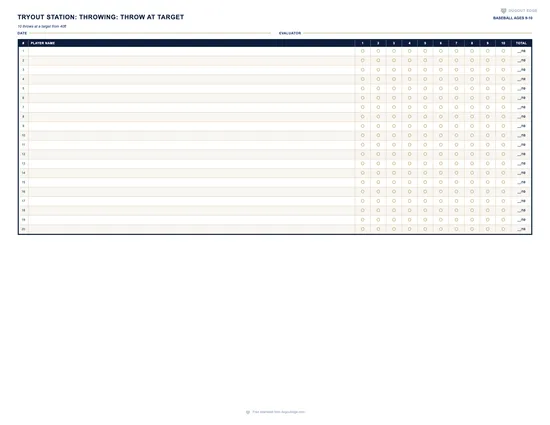
Baseball Practice Stat Tracker (Ages 9-10)
Station-based stat tracking sheets for ages 9-10. One page per station, 20 player rows. Track throwing, hitting, fielding, and baserunning measurements.
Baseball Practice Stat Tracker (Ages 11-12)
Station-based stat tracking sheets for ages 11-12. One page per station, 20 player rows. Track throwing, hitting, fielding, and baserunning measurements.
Baseball Practice Stat Tracker (Ages 13-14)
PremiumStation-based stat tracking sheets for ages 13-14. One page per station, 20 player rows. Track throwing, hitting, fielding, and baserunning measurements.
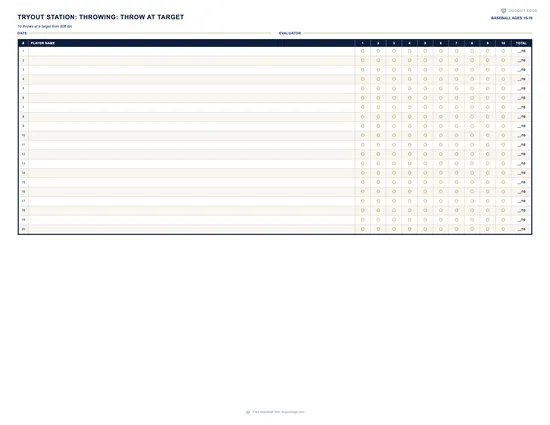
Baseball Practice Stat Tracker (Ages 15-16)
PremiumStation-based stat tracking sheets for ages 15-16. One page per station, 20 player rows. Track throwing, hitting, fielding, and baserunning measurements.
Baseball Practice Stat Tracker (Ages 17-18)
PremiumStation-based stat tracking sheets for ages 17-18. One page per station, 20 player rows. Track throwing, hitting, fielding, and baserunning measurements.
Baseball Practice Stat Tracker (Ages 18+)
PremiumStation-based stat tracking sheets for ages 18+. One page per station, 20 player rows. Track throwing, hitting, fielding, and baserunning measurements.
Softball Practice Stat Tracking
Softball Practice Stat Tracker (Ages 4-6)
Station-based stat tracking sheets for ages 4-6. One page per station, 20 player rows. Track throwing, hitting, fielding, and baserunning measurements.
Softball Practice Stat Tracker (Ages 7-8)
Station-based stat tracking sheets for ages 7-8. One page per station, 20 player rows. Track throwing, hitting, fielding, and baserunning measurements.
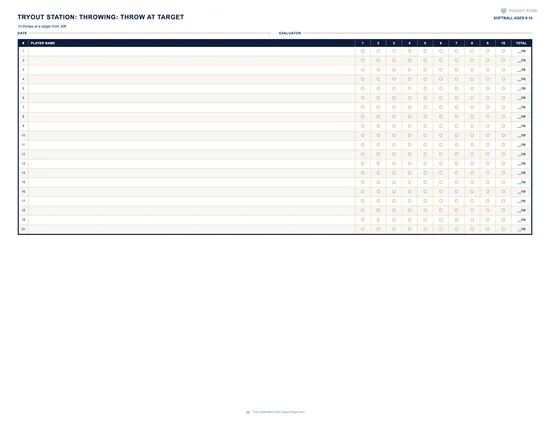
Softball Practice Stat Tracker (Ages 9-10)
Station-based stat tracking sheets for ages 9-10. One page per station, 20 player rows. Track throwing, hitting, fielding, and baserunning measurements.
Softball Practice Stat Tracker (Ages 11-12)
Station-based stat tracking sheets for ages 11-12. One page per station, 20 player rows. Track throwing, hitting, fielding, and baserunning measurements.
Softball Practice Stat Tracker (Ages 13-14)
PremiumStation-based stat tracking sheets for ages 13-14. One page per station, 20 player rows. Track throwing, hitting, fielding, and baserunning measurements.
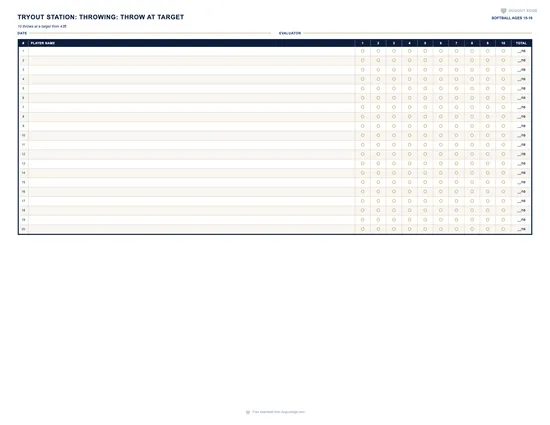
Softball Practice Stat Tracker (Ages 15-16)
PremiumStation-based stat tracking sheets for ages 15-16. One page per station, 20 player rows. Track throwing, hitting, fielding, and baserunning measurements.
Softball Practice Stat Tracker (Ages 17-18)
PremiumStation-based stat tracking sheets for ages 17-18. One page per station, 20 player rows. Track throwing, hitting, fielding, and baserunning measurements.
Softball Practice Stat Tracker (Ages 18+)
PremiumStation-based stat tracking sheets for ages 18+. One page per station, 20 player rows. Track throwing, hitting, fielding, and baserunning measurements.
Skill Levels
Baseball Pitching Skill Levels (Rookie Ball → All-Star)
Minor-league-themed pitching rubric. Seven levels from Rookie Ball through All-Star with measurable benchmarks per age (FB velo, strike rate, pitch mix, mechanics). Use it to evaluate and progress every pitcher on your staff.
Softball Pitching Skill Levels (Rookie Ball → All-Star)
Fastpitch pitching rubric using minor-league levels. Seven tiers tracking velocity, strike rate, pitch arsenal, and circle composure with age-banded benchmarks.
Baseball Hitting Skill Levels (Rookie Ball → All-Star)
Hitting progression rubric using minor-league levels. Contact rate, exit velocity by age, plate discipline, situational mastery. Use it to evaluate and progress every hitter on your roster.
Softball Hitting Skill Levels (Rookie Ball → All-Star)
Fastpitch hitting rubric using minor-league levels. Contact rate, exit velocity by age, plate discipline, and situational mastery.
Baseball Throwing Skill Levels (Rookie Ball → All-Star)
Positional throwing rubric (NOT pitching). Velocity, accuracy, transfer time, and arm-action repeatability for infielders, outfielders, and catchers.
Softball Throwing Skill Levels (Rookie Ball → All-Star)
Positional throwing rubric for fastpitch. Velocity, accuracy, transfer time, and arm-action repeatability across infield, outfield, and catcher.
Baseball Infield Defense Skill Levels (Rookie Ball → All-Star)
Infield defense rubric using minor-league levels. Hands, footwork, range, double-play turns, and pre-pitch positioning. For 1B / 2B / SS / 3B development.
Softball Infield Defense Skill Levels (Rookie Ball → All-Star)
Fastpitch infield defense rubric using minor-league levels. Hands, footwork, range, double-play turns, and pre-pitch positioning.
Baseball Outfield Defense Skill Levels (Rookie Ball → All-Star)
Outfield defense rubric using minor-league levels. Reads, jumps, routes, communication, wall play, and arm strength.
Softball Outfield Defense Skill Levels (Rookie Ball → All-Star)
Fastpitch outfield defense rubric using minor-league levels. Reads, jumps, routes, communication, wall play, and arm strength.
Baseball Speed & Baserunning Skill Levels (Rookie Ball → All-Star)
Speed and baserunning rubric using minor-league levels. 60-yard dash benchmarks by age, secondary leads, base-stealing reads, and game-IQ on the bases.
Softball Speed & Baserunning Skill Levels (Rookie Ball → All-Star)
Fastpitch speed rubric using minor-league levels. 60-yard dash benchmarks by age, secondary leads, base-stealing reads, slap-runner game IQ.
Player Tracking
Baseball Individualized Training Plan
After the belt evaluation, build the player’s 8-week plan. Identify the gap to the next belt for each skill, assign weekly drill blocks, and track completion. Player + coach sign-off.
Softball Individualized Training Plan
Fastpitch player’s 8-week plan. Identify the gap to the next belt for each skill, assign weekly drill blocks, track completion, and lock in player + coach sign-off.
Baseball Wristband Signs: Create & Print Custom Play Cards
A baseball wristband is the simplest way to call signs without giving them away. The coach yells a number from the dugout, every player on the field looks at their wrist, and a card slipped inside a QB-style wristband holder tells them the play. No more chains of swipes, taps, and indicators that the third-base coach has to remember and the opposing dugout is trying to crack. Print our free baseball wristband sign templates, laminate them, slip them into a holder, and you have a complete play-calling system in under ten minutes.
Every team needs two wristband cards: one for pitch calling (catcher and pitcher) and one for offensive signs (hitters and baserunners). The pitch wristband uses a 2-digit code: the first digit picks the pitch type (fastball, curve, change-up, etc.), and the second digit picks the location on a 9-zone strike-zone grid. The offensive sign wristband uses a 3-digit code with a rotating “live digit” indicator: the live digit is what the player decodes; the other two are decoys that confuse the opposing dugout. Both cards above are pre-filled with a standard scheme so new coaches can use them out of the box, or you can grab the premium custom version and write your own play list.
What is a baseball wristband?
A baseball wristband is a Velcro armband with a clear plastic flap that holds a printed sign card. Borrowed directly from football quarterbacks, it lets coaches call plays by number instead of by hand signal. Every player wearing one can decode the same call at the same time: pitcher, catcher, hitter, baserunner, and the on-deck circle. They’re cheap, durable, and they kill the most common youth-baseball problem: signs missed because a kid was tying his shoe.
Why a sign cheatsheet beats hand signals
Hand signals look cool but they fail in real games. The kid in right field can’t see them, the runner on second is staring at the pitcher’s glove, and the hitter is fighting his stance. A printed baseball sign cheatsheet on a wristband solves all three. The same number reaches all 9 players at the same time; opponents can’t pick patterns; and rookie coaches don’t have to memorize 25 sequences. It’s the lowest-tech upgrade with the biggest game-day return.
How to set up your wristband sign system in 4 steps
- Print the wristband templates above. Pick the Pitch-Calling Wristband for catchers and pitchers, and the Offensive Sign Wristband for hitters and baserunners. Each sheet produces multiple cards.
- Laminate & cut along the dashed lines. Lamination matters: rain, sweat, and dirt destroy paper cards in two innings.
- Slide each card into a QB-style wristband holder (see the picks below). One per pitcher, one per catcher, one for every hitter, one for the dugout binder.
- Practice the system once at full speed before game day. Yell two or three calls in a live BP and let the players decode in real time. Confidence is the difference between a system that works and a system that gets abandoned in inning two.
Common baseball signs to put on your wristband
These are the ten plays we pre-fill on the offensive wristband. Adjust them to your team’s playbook (the premium templates above let you write your own).
Ready to put these on a wristband? Build and print your own with the free wristband signs generator. Pick your plays, set the grid, and print a card your players can wear.
Frequently Asked Questions
- What coaching printables do I need for youth baseball?
- The essentials are lineup cards, a scorekeeping card for tracking games, a pitch tracker for pitcher safety, and player evaluation forms for tryouts. Dugout Edge offers free versions of all of these in both baseball and softball formats.
- What is the difference between the basic and advanced pitch trackers?
- The basic pitch tracker charts each pitch as a ball or strike with numbered cells and row totals. The advanced version (designed for 18+) also logs pitch type (fastball, curveball, etc.) and pitch location on a strike zone grid for detailed scouting.
- What should a baseball tryout evaluation form include?
- A good evaluation form includes player info fields, skill ratings on a 1-5 scale for hitting, fielding, baserunning, pitching, and intangibles like attitude and coachability. Our forms include a scoring rubric so all evaluators rate consistently.
- Do you have scorekeeping cards for both 7-inning and 9-inning games?
- Yes. We offer scorekeeping cards in both 7-inning (for youth and Little League) and 9-inning (for high school and travel ball) formats, available for both baseball and softball.
- How does a baseball wristband sign system work?
- A baseball wristband sign system replaces hand signals with a printed card slipped into a QB-style wristband. The coach yells a 2- or 3-digit number from the dugout. Every player on the field looks at their wrist and decodes the live digit using the card. Pitch-call wristbands map the code to a pitch type plus zone. Offensive wristbands map the live digit to a play (bunt, steal, hit-and-run, etc.). Decoy digits and a rotating live-digit indicator stop opposing dugouts from cracking the system.
- What is the best way to print baseball signs on a wristband?
- Use the free printable wristband templates above: pick the Pitch-Calling Wristband for catchers and pitchers and the Offensive Sign Wristband for hitters and baserunners. Print on standard letter paper, laminate the page, cut along the dashed lines, and slide each card into a standard QB-style wristband holder. The premium versions remove the watermark and let you write your own play scheme.
- Are wristband signs legal in Little League and high school baseball?
- Yes. Wristband sign systems are legal at every level of organized baseball, including Little League, travel ball, USSSA, and NFHS high school. Major League Baseball started using PitchCom electronic devices in 2022, but printed wristbands have been used for decades and remain the standard for amateur baseball.
- What is a baseball sign cheatsheet?
- A baseball sign cheatsheet is a printed reference card that maps numbered codes to specific plays (bunt, steal, hit-and-run, take, etc.). Coaches and players keep one in their wristband or dugout binder so they can decode the coach's call in seconds. Dugout Edge offers free pre-filled cheatsheets and premium fill-in-your-own-scheme versions.
How to Use These Coaching Printables
How to Use the Scorekeeping Card
Each row in the lineup grid represents a batting order spot. Write the player name and position. When they bat, use the diamond symbol in that inning column to track what happens.
Draw a line along the base path for each base reached. A single fills in the line to first base. A double goes to second base. A home run traces all four bases. Use standard scoring notation in the diamond to record how the batter reached base or was put out.
The AB, R, H, and RBI columns on the right track each batter's game totals. The SUMS section at the bottom tracks team totals per inning. The Pitchers section logs pitching stats for each pitcher used in the game.
Use the 3 sub-rows per batting spot for defensive substitutions or pinch hitters entering the game mid-inning.
How to Use the Basic Pitch Tracker
Each numbered cell represents one pitch. When the pitcher throws, circle B for ball or S for strike in that pitch's cell. Move left to right across each row.
At the end of each row of 10 pitches, tally the balls and strikes in the Totals column. When the pitcher is done, add up the totals at the bottom for total balls, total strikes, and total pitches thrown.
Use the rest day reference chart at the bottom to determine how many days of rest the pitcher needs based on their total pitch count. This follows USA Baseball guidelines for pitcher safety.
How to Use the Advanced Pitch Chart
For each pitch, write the pitch type abbreviation (FB, CB, SL, etc.) in the Type column, then mark a dot on the strike zone grid where the pitch crossed the plate. The thick-bordered inner box is the strike zone. The outer area represents pitches outside the zone.
Add a result symbol next to your dot: S for swinging strike, C for called strike, F for foul, B for ball, H for hit, O for out. This gives you a complete picture of pitch selection, location, and outcomes.
After the outing, tally pitch counts by type in the summary table. This helps identify pitch mix, first-pitch strike percentage, and location tendencies over time.
How to Use the Player Evaluation Form
Fill in the player's name, age, position, and your name as evaluator. For each skill listed, fill in one of the five circles to rate the player on a 1-5 scale where 1 is needs work and 5 is exceptional.
Use the evaluation rubric on page 2 as a reference to ensure consistent scoring across all evaluators. The rubric describes what each rating level looks like for each skill category at the appropriate age group.
Two forms print per page so you can evaluate two players per sheet. The notes section at the bottom is for any observations that do not fit the skill categories.
Related Coaching Resources
Free Lineup Generator
Auto-generate fair batting orders and defensive rotations in seconds.
Free Practice Planner
Build organized practice plans with drills, stations, and time blocks.
Scorebook Generator
Build a custom scorebook with cover page, roster, and game scorecards.
Batting Cages Near You
Find indoor and outdoor batting cages by city and state.
Baseball Fields Near You
Browse little league, travel ball, and rental fields nationwide.
Want lineups generated automatically?
Our free lineup generator builds a complete batting order and defensive rotation in seconds, with built-in playing time tracking.
Try the Free Lineup GeneratorPrinting these to carry into the dugout?
Game Day puts the same things on your phone and keeps them current: batting order, field positions by inning, pitch counts per pitcher, and who has sat. Free, no account needed.