Free Baseball Scorecards
Printable baseball score card templates for every age group and inning format
Free printable baseball scorecards from tee ball to varsity. Simple scorecards for younger players who just need to track outcomes. Full diamond-grid scorecards for coaches who want to track every baserunner, pitch, and substitution. Pick your inning count, print, and score.
Looking for more coaching printables?
Pitch trackers, tryout forms, skills assessments, practice plans and more.
Game Day
Scorekeeping and pitch tracking forms for games.
Simple Scorecards
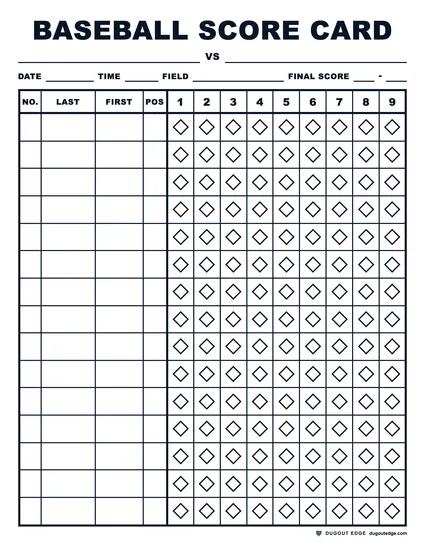
Bold Baseball Score Card (9-Inning)
One team, one page, drawn with heavy lines and big boxes so it is easy to read and write on in the dugout. 9 innings and 15 batting spots with a diamond in every box, plus number, name, and position columns. No legend, no stat tables.
Simple Baseball Scorecard (3-Inning)
Both teams on one page. 3-inning format for tee ball and coach pitch (ages 4-6). Just track the outcome, no diamonds. Includes scoring legend.
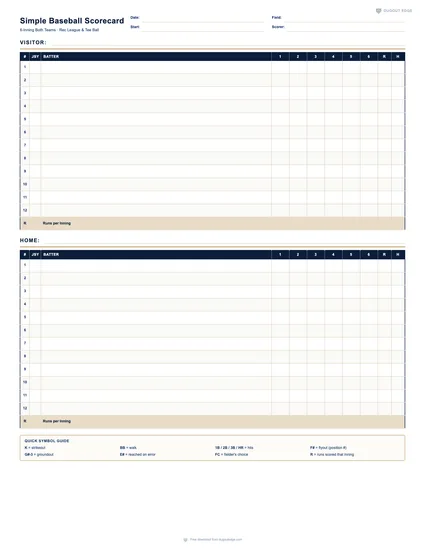
Simple Baseball Scorecard (6-Inning)
Both teams on one page. 6-inning format for youth rec leagues (ages 7-10). Track hits, outs, and runs without diamond notation. Includes scoring legend.
Scorekeeping Cards
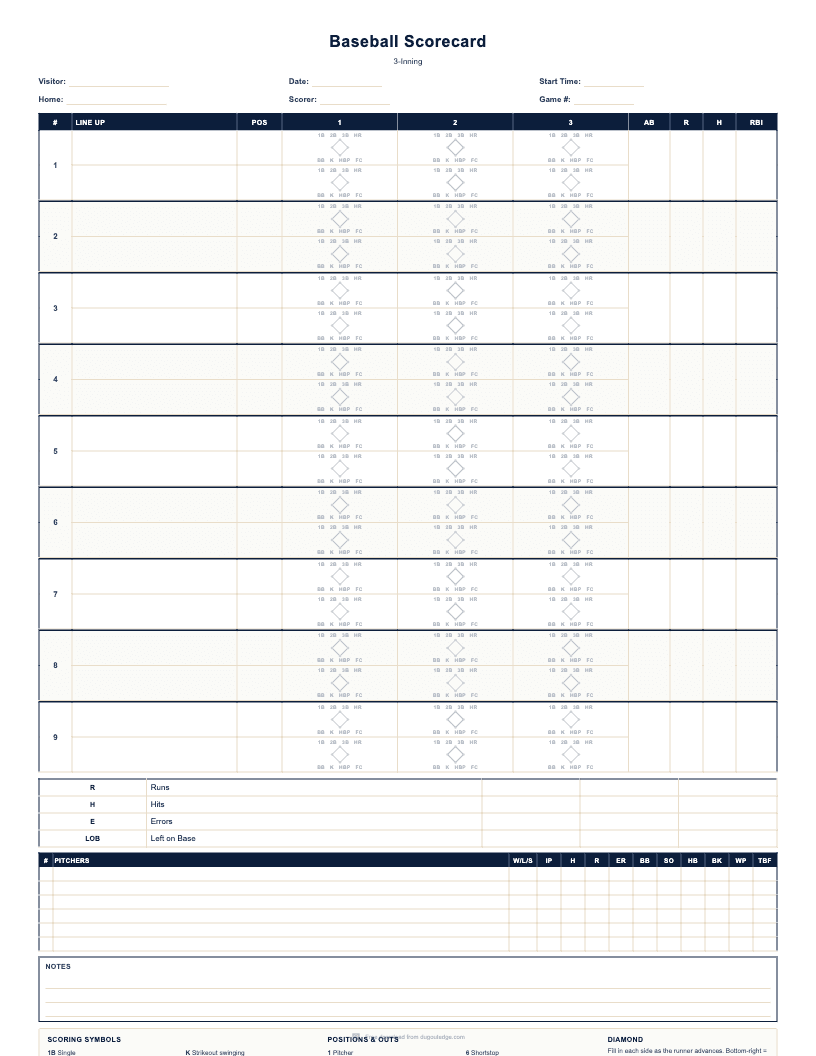
Baseball Scorecard (3-Inning)
Diamond-grid scorecard for short-format games. 3 innings with baserunner tracking, pitcher log, and scoring legend. Great for introducing scorekeeping to young players.
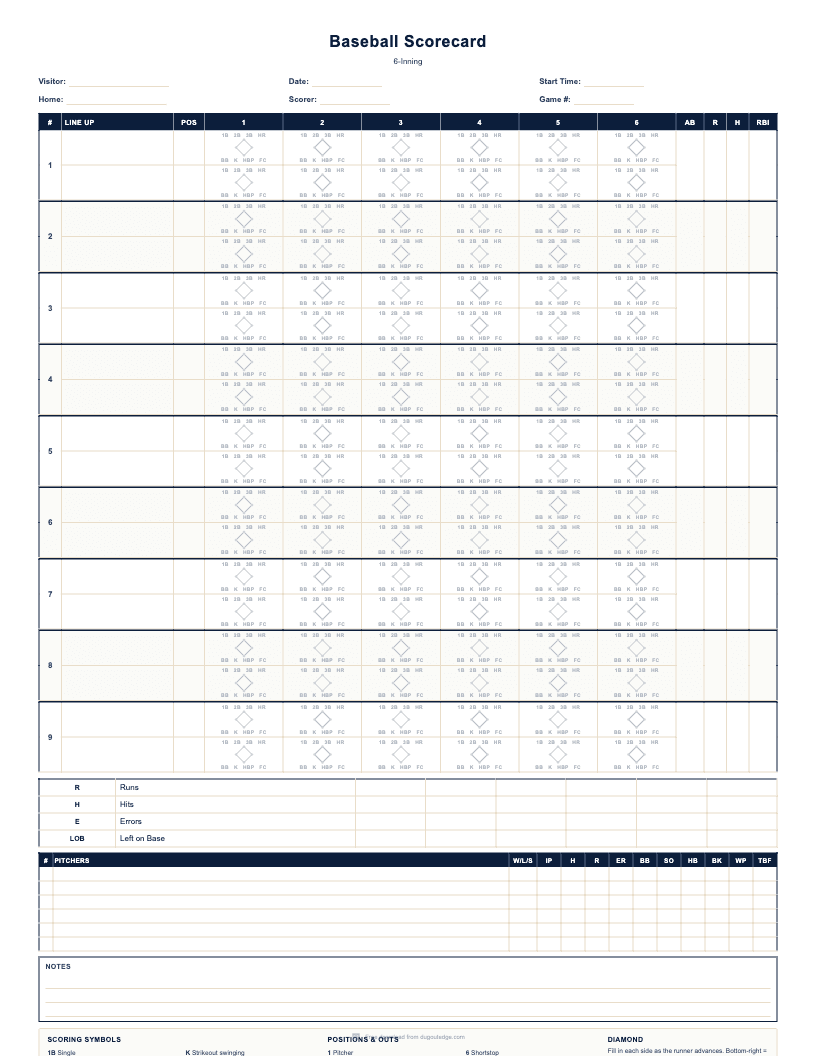
Baseball Scorecard (6-Inning)
Diamond-grid scorecard for 6-inning youth games. Full baserunner tracking, pitcher log, and scoring legend. Standard format for ages 9-12.
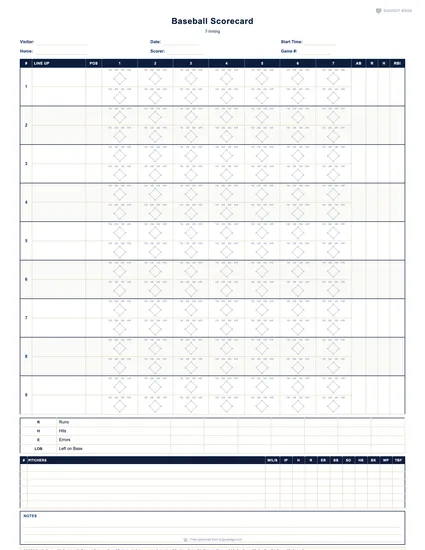
Baseball Scorecard (7-Inning)
Standard 7-inning scorecard with diamond symbols for each at-bat. Track baserunning, AB, R, H, RBI plus pitcher and catcher stats. Includes scoring legend.
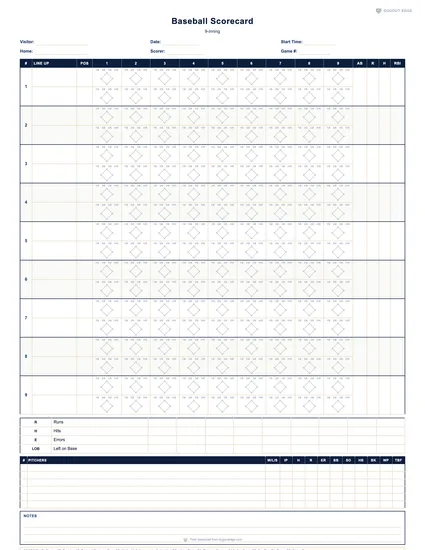
Baseball Scorecard (9-Inning)
Full 9-inning scorecard with diamond symbols for each at-bat. Tracks baserunning, stats, pitching, and umpires. For travel ball, high school, and competitive leagues.
What Is on a Baseball Scorecard?
Every scorecard in our collection uses the same core layout. Once you understand the five zones, you can score any game on any template.
Batting Grid
Rows are batting order positions (1-9 or 1-10). Columns are innings. Each cell holds one at-bat and contains a small diamond for tracking baserunners.
Diamond Cells
The small diamond inside each cell represents the four bases. Fill in each side as the runner advances: bottom-right for first, top-right for second, top-left for third, bottom-left for home.
Pitcher Log
A dedicated section at the bottom or side of the card for tracking each pitcher: innings pitched, hits, runs, earned runs, walks, and strikeouts.
Inning Totals Row
The bottom row tallies runs, hits, and errors per inning. This is the row that feeds the line score you see on any scoreboard.
Need a refresher on scoring symbols? See our baseball scorekeeping symbols guide or the full how to keep score in baseball walkthrough.
How to Use These Scorecards
1. Before the Game
- Print the scorecard that matches your game format (7-inning for youth and most rec leagues, 9-inning for high school and travel).
- Write the team name, date, field, and umpire info at the top.
- Fill in the batting order down the left column. Include uniform numbers and positions (use standard position numbers: 1=P, 2=C, 3=1B, 4=2B, 5=3B, 6=SS, 7=LF, 8=CF, 9=RF).
- If your league tracks pitch counts, print a pitch tracker sheet too and clip it behind the scorecard.
2. During Each At-Bat
- Find the cell where the batter's row meets the current inning column.
- Record the result using standard notation: 1B (single), 2B (double), 3B (triple), HR (home run), BB (walk), K (strikeout), or the fielding sequence for outs (e.g., 6-3 for a ground out short to first).
- Fill in the diamond sides as the runner advances around the bases.
- If the runner scores, fill in the entire diamond or mark it with a dot in the center.
3. End of Each Half-Inning
- Draw a line under the last batter of the inning to mark where the next inning picks up.
- Tally runs, hits, and errors for that inning in the totals row at the bottom.
- Update the pitcher log with pitch counts if tracking.
4. After the Game
- Total the R-H-E row across all innings for the final line score.
- Complete the pitcher log: IP, H, R, ER, BB, K for each pitcher.
- Circle or highlight any notable plays you want to remember for practice planning.
- File the scorecard in your binder or scorebook. If using single sheets, three-hole punch and add to the front of the stack so the most recent game is always on top.
Want a bound scorebook for the full season?
We are building a coach-grade spiral-bound scorebook with these same scorecard layouts, roster pages, pitcher logs, and a season stats summary. Heavy paper, lay-flat binding.
Frequently Asked Questions
Related Coaching Resources
How to Keep Score in Baseball
Step-by-step guide to scorekeeping notation, symbols, and recording plays.
Lineup Card Templates
16 free printable lineup cards — the companion to your scorecard.
Virtual Scoreboard
Free game-day scoreboard that shows the score to both benches live.
Pitch Count Tracker
Track pitch counts and rest days by Little League and USSSA rules.
Free Lineup Generator
Auto-build batting orders and defensive rotations in seconds.
Free Practice Planner
Build organized practice plans with drills, stations, and time blocks.
Scorekeeping gear coaches keep in the bag
Print your scorecards above, then back them up: a bound scorebook for the season, an umpire indicator, and a magnetic coach clipboard. We may earn a commission on Amazon purchases. Thanks for supporting Dugout Edge.


Prefer tapping to pencil? Score your next game live with the free Game Day app
Coming 2026
Score every game by hand. Digitally.
A digital scorecard that works the way you already keep score: pencil in the 6-4-3, advance the runner, mark the backwards K. The same notation you know by heart, with nothing to store in a closet and nothing lost to a rained-out dugout. Built for coaches and fans who love the craft of scoring a game by hand. Launching in 2026. Join the waitlist and we will send early access the week it goes live.
Want to see it in context? Read what the digital scorekeeper does.