Should You Teach Your Players a 2-Strike Approach? Here Is What the Data Says.

Every coach has stood in the third base box with two strikes on a kid and said the same thing: shorten up, protect the plate, just put it in play.
It is good instinct. But most coaches have never thought hard about whether they are teaching a skill or just reacting to the moment. And there is a legitimate debate about which approach actually makes better hitters.
Two Schools of Thought
Before getting into the data, it is worth laying out the debate honestly.
School 1: Teach a deliberate 2-strike approach. The idea is that two strikes changes the job. In a hitter's count, your job is to find a pitch you can drive. With two strikes, your job is to put the ball in play and not give away the out. Those are genuinely different tasks. Teach both. Practice both. Make the adjustment automatic.
School 2: Each pitch is its own battle. Just compete. The idea here is that overthinking counts creates hitters who are always in their heads about the situation rather than locked in on the ball. A ball is a ball and a strike is a strike. Don't swing at balls, and put a good swing on strikes. The count doesn't change that right? There's a fine line to be toed. Coaching it explicitly can create hesitation, mechanical tinkering, and hitters who are never quite on one approach or the other.
Both schools have coaches who have produced excellent hitters. Both have their own pros and cons, and as a coach it is your job to understand both sides of the coin. What works for one player might not work for another.
What the Data Shows
I pulled every contact swing from the full 2025 MLB regular season that had bat speed data attached. That is 318,895 swings. I split them by count and measured two things: average bat speed and average swing length.
Here is the full table:
| Count | Avg Bat Speed | Avg Swing Length | Swings |
|---|---|---|---|
| 3-0 | 74.8 mph | 7.48 ft | 566 |
| 3-1 | 72.6 mph | 7.30 ft | 7,607 |
| 2-0 | 72.2 mph | 7.36 ft | 8,914 |
| 1-0 | 71.3 mph | 7.32 ft | 27,755 |
| 2-1 | 71.2 mph | 7.27 ft | 20,135 |
| 3-2 | 70.5 mph | 7.18 ft | 23,896 |
| 0-0 | 70.5 mph | 7.26 ft | 54,292 |
| 1-1 | 70.3 mph | 7.25 ft | 36,648 |
| 0-1 | 69.5 mph | 7.22 ft | 42,741 |
| 2-2 | 69.0 mph | 7.18 ft | 36,048 |
| 1-2 | 68.2 mph | 7.17 ft | 37,621 |
| 0-2 | 67.4 mph | 7.15 ft | 22,672 |
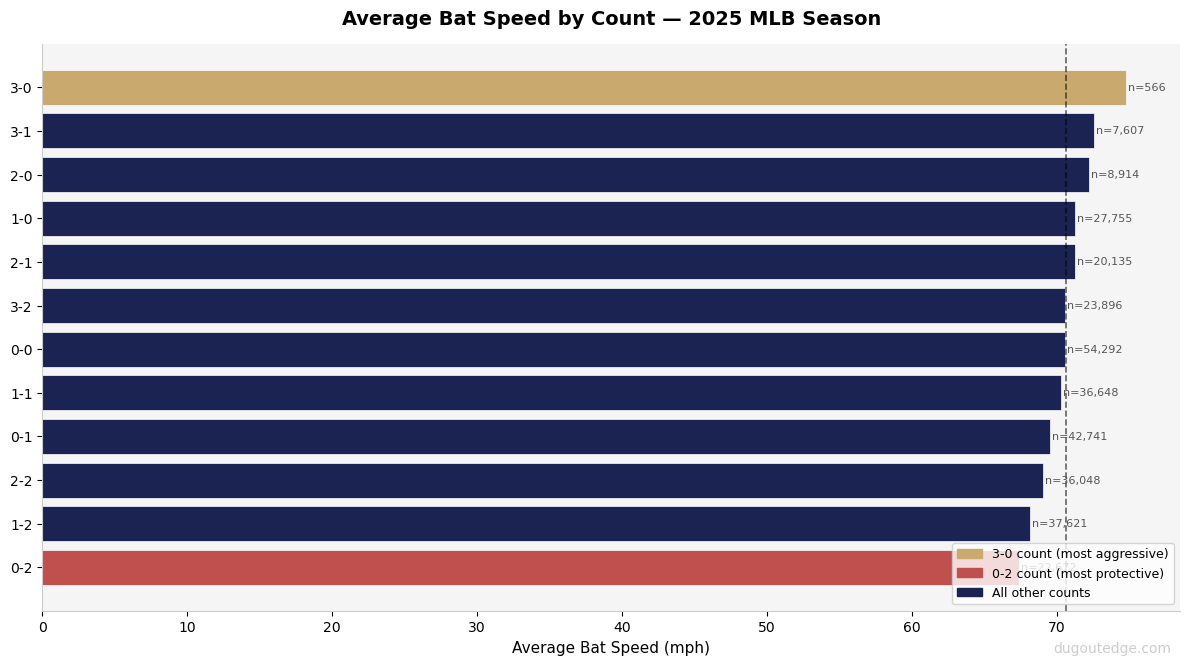
The pattern is clear. From the best hitter's count (3-0) to the worst (0-2), average bat speed drops 7.4 mph. Swing length drops 0.33 feet. The two-strike counts cluster at the bottom. The ball-heavy counts cluster at the top. The ordering is nearly perfect across 318,000 swings.
MLB hitters are swinging differently with two strikes. The question is why, and that is where it gets interesting.
Is this a taught skill, or just survival?
Here is the honest answer: the data cannot tell you.
What the data shows is that the adjustment happens. What it cannot prove is whether hitters are executing a deliberate, coached 2-strike approach or simply becoming more protective when they feel the pressure of the count. Those two things produce the same measurable outcome, a shorter, slower swing, but they come from very different places.
The "survival instinct" argument has real merit. When you have two strikes, you do not want to strike out. Every hitter knows this. Some will naturally widen their stance, shorten their path, lay off borderline pitches, not because a coach told them to, but because the situation demands it. The data we are seeing in the table above may be picking up that natural self-preservation response as much as any deliberate technique.
Swing length tells the same story
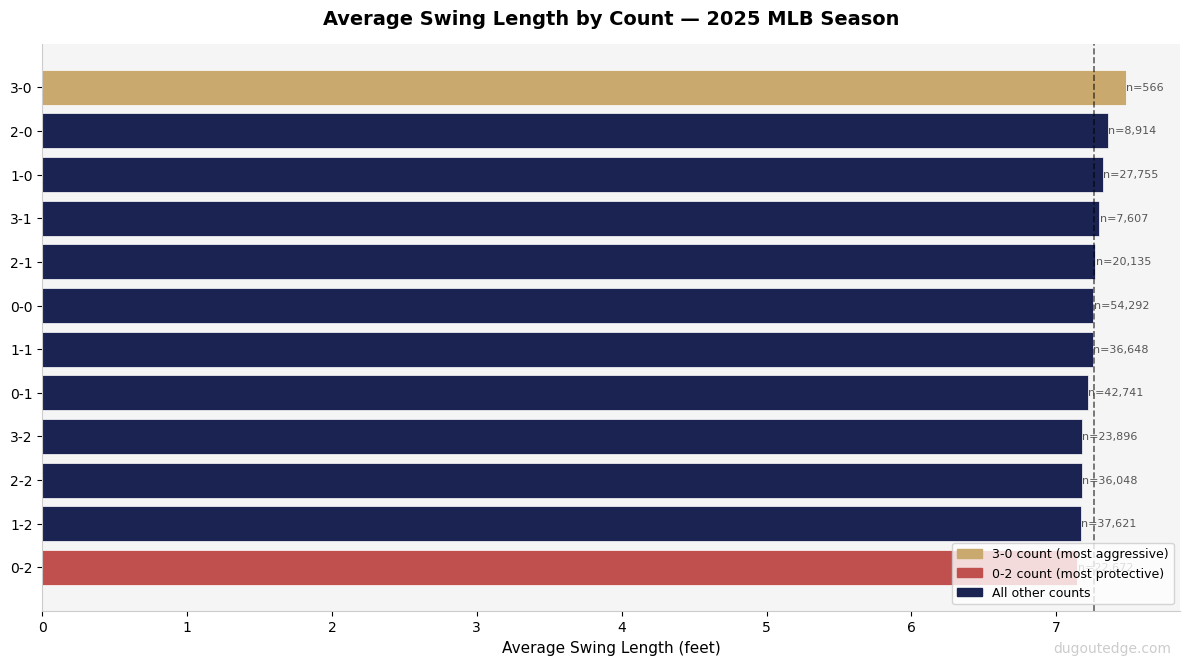
The 3-0 swing averages 7.48 feet. The 0-2 swing averages 7.15 feet. A third of a foot difference in path length, automatically. This is exactly what coaches mean when they say "shorten up", a literal narrowing of the swing arc.
A longer path generates more bat speed and power. But it also means more time for the pitch to move, more margin for the barrel to miss, and less coverage on borderline pitches. When the pitcher has leverage and can work off the plate, the long swing becomes a liability. The shorter path covers more of the zone.
Whether a hitter gets there by coaching or by instinct, the physical outcome is the same.
The best hitters in the world adjust
Here are three of the best hitters in baseball broken out by 0-0 versus 0-2 bat speed:
| Player | 0-0 Count | 0-2 Count | Adjustment |
|---|---|---|---|
| Shohei Ohtani | 75.6 mph | 68.1 mph | -7.5 mph |
| Juan Soto | 72.7 mph | 68.0 mph | -4.7 mph |
| Freddie Freeman | 69.1 mph | 65.3 mph | -3.8 mph |
Ohtani's adjustment mirrors the league average almost exactly. He uses all of his swing when the count allows and pulls back when it does not.
Soto's drop of 4.7 mph is smaller, but do not read that as less discipline. Soto is one of the best two-strike hitters in baseball. He maintains more swing speed with two strikes than almost anyone else in the league because his pitch recognition is elite. He does not need to be as defensive with two strikes because he rarely swings at the pitch he cannot handle. His smaller adjustment is a product of skill, not lack of awareness.
Freeman's adjustment is the smallest at 3.8 mph. Freeman is a contact-first hitter even in hitter's counts. His baseline is already lower than most. The gap between his aggressive and protective swings is narrower because his full swing is already fairly controlled.
Different profiles, same direction. The adjustment happens across all three, but what drives it varies.
Does a bigger adjustment actually help? Weakly.
If the deliberate 2-strike approach were clearly the right answer, you would expect hitters who make larger adjustments to strike out less. Let us check.
I ran the correlation between delta bat speed (0-0 minus 0-2) and strikeout rate across 283 players with enough plate appearances in both count buckets.
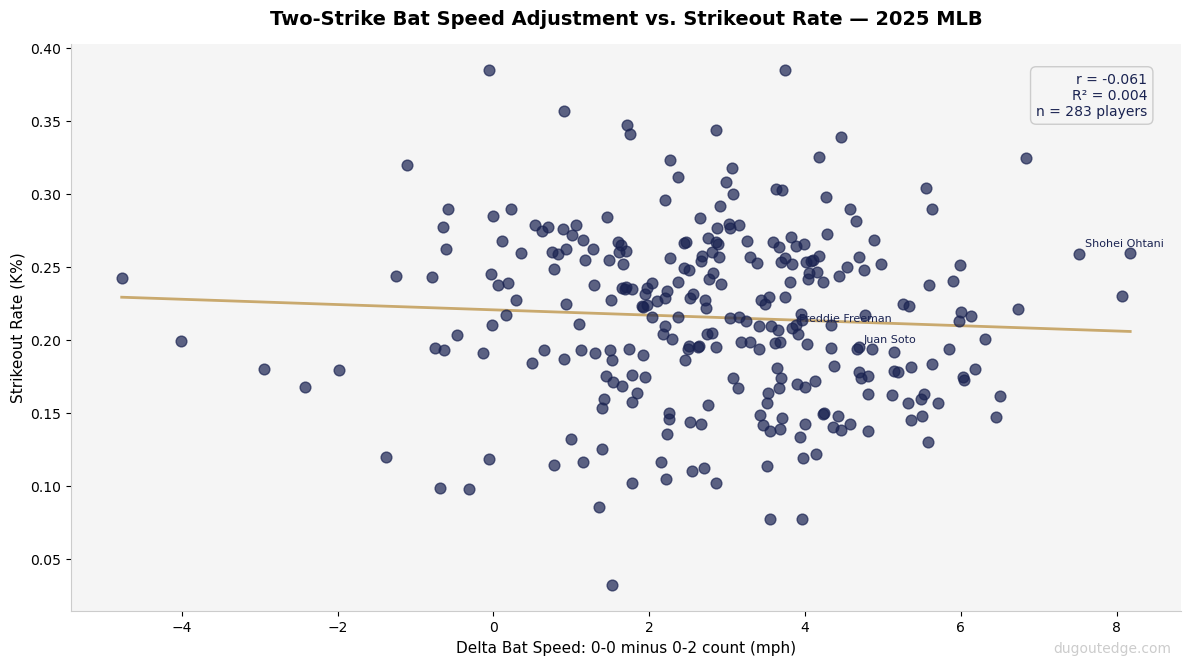
Two-Strike Adjustment vs. K Rate: r = -0.061 | r2 = 0.004 | n = 283 players | direction correct but not statistically significant
The direction is right, bigger adjusters tend to have slightly lower strikeout rates. But the correlation is r = -0.061. That is less than half a percent of the variance in K rate. Not statistically significant. Additionally, purely focusing on making contact will be more beneficial in some scenarios than others. Often, the goal is to get on base, not just to make contact that turns into an out.
This is the clearest evidence yet that the adjustment alone is not the answer. Hitters who adjust more do not dramatically strike out less. Which means the outcome depends far more on pitch recognition, swing decisions, and overall approach than on the size of the mechanical change. The adjustment is one piece of a larger picture.
What This Means for Coaches
The data does not settle the philosophical debate. Here is a reasonable way to think through it for your own team.
If your players are old enough to process count-based thinking (roughly 10U and up): there is value in being deliberate about it, especially if your team is striking out looking a lot. Not because mechanical adjustments guarantee fewer strikeouts, the data shows they do not, but because teaching players to think about what the count means builds baseball awareness that pays off in other ways. A kid who understands that 0-2 and 3-0 require different approaches is learning to read the game, and that carries forward. Once you get to older ages, players will start to understand that they are more likely to get better pitches in plus counts, so being more aggressive and swing hard is statistically going to work out better in more advantageous counts. You will find that even some Major Leaguers however, that try not to think about the count.
If your players are younger or are still developing basic contact skills: the "each pitch is its own battle" school may serve them better. Asking a 7-year-old to manage a 2-strike adjustment on top of just making contact is adding complexity they cannot use yet. For young hitters, the simpler coaching point is just: hang in there and swing at strikes.
The one thing most coaches agree on: do not over-coach it during the at-bat. If you have a two-strike cue, work on it in practice so it is already there when the moment comes. A reminder called out from the dugout mid-at-bat can create hesitation more than it helps. Build the habit, then trust the player to use it.
Another key coaching point is that you never really want your players to "think" while they are playing the game. One of the most effective ways to coach the 2-strike approach is to make physical adjustments as soon as the hitter steps into the box with 2 strikes. Widening stance, choking up, crowding the plate are all common advice that have their own benefits.
Widening the Stance
The idea is simple: a wider base keeps the hitter more balanced and gives them more time to see the pitch without drifting forward.
Pros:
- Lowers the center of gravity, which keeps the head quieter and improves pitch recognition
- Reduces the tendency to lunge, which is one of the most common two-strike mistakes
- Helps the hitter stay back on off-speed pitches, which is exactly where pitchers like to go with two strikes
- Requires no change to hand position or grip, so it is easy to practice and easy to trigger automatically
Cons:
- A stance that is too wide restricts hip rotation, which cuts into what power the hitter does have
- Can limit coverage on high pitches if the hitter drops too low
- Some hitters naturally widen when they are nervous anyway, so coaching it as a cue can result in them getting too wide rather than just slightly wider
Good cue for players: "One inch wider on each side. That is it."
Choking Up
Choking up moves the hands higher on the handle, which shortens the effective length of the bat and speeds up the swing through contact.
Pros:
- The most direct mechanical way to shorten the swing path, the data shows two-strike swings are physically shorter, and this is the fastest way to get there deliberately
- Improves bat control on tough pitches, especially the ones that break late or run in on the hands
- Helps hitters foul off pitches they cannot do damage with, which extends at-bats
- Works at every age level and is easy to teach and easy to see from the dugout
Cons:
- Reduces reach on the outer half, which is the other place pitchers like to go with two strikes
- Hitters who choke up but keep their full swing path do not actually benefit much, the grip change only helps if the swing path also tightens
- Some hitters associate choking up with giving up, which is a mental hurdle worth acknowledging with older players
Good cue for players: "Two fingers up. That is your two-strike grip."
Crowding the Plate
Moving closer to the plate changes the geometry of the at-bat. The hitter covers more of the outside corner, and the pitcher's best two-strike pitch, the backdoor breaking ball, becomes harder to locate without getting called a strike.
Pros:
- Takes away the outer half, which is where most two-strike strikeouts happen at every level
- Forces the pitcher to come inside, which is harder to locate and easier to identify early
- A hitter who handles inside pitches well can actually turn this into an offensive opportunity rather than just a survival tactic
Cons:
- Increases the risk of getting jammed on inside pitches, if the hitter does not have quick hands, crowding makes them easier to get out, not harder
- The hitter has to trust the umpire on inside borderline pitches, which is not always reliable at youth levels
- Requires practice to feel natural, and a hitter who crowds without the right hand path tends to pull off on inside pitches rather than driving them
Good cue for players: "Move up in the box half a step and get comfortable. The outside corner is yours now."
Which One Should You Teach?
There is no single right answer, and the honest coaching move is to let players find what works for them through repetition. That said, most coaches start with choking up because it is the most universally applicable and the easiest to reinforce from the dugout. Widening the stance pairs well with it. Crowding the plate is better suited to older players who already have some understanding of the strike zone and can handle the trade-off on inside pitches.
The goal in any case is the same: get the adjustment to happen automatically when the hitter sees two strikes on the board, before the next pitch is thrown. If the player is thinking about it mid-at-bat, the cue came too late.
A few practical cues by age, if you go the deliberate route
8U and below: One cue only. "Choke up and look for anything over the plate." That is the whole instruction. Choking up shortens the path automatically. Do not overthink it.
10U and 12U: Introduce the job framing. "A 2-0 count means the pitcher needs you. A 0-2 count means you need the pitcher." Choke up, widen the stance slightly, and tell them the goal is contact, not a hit. Run situational BP rounds where every hitter starts 0-2.
14U through high school: You can get more specific here. Protect the corners, not just the middle. Accept a weaker contact outcome. Fight off tough pitches rather than taking them. And explain why, because at this age, pitchers are starting to locate secondary stuff, and the full swing leaves you exposed on the edges.
Caveats and Limitations
This analysis uses MLB Statcast data. Youth pitchers are slower, the shapes are different, and the movement profiles do not match. The numbers will not look like this at the youth level.
The underlying principle, that the same pitcher has more leverage with two strikes and can work more difficult locations, transfers. Whether the speed is 65 mph or 95 mph, the hitter who covers the zone with a controlled swing is better positioned than one who is maxing out swing speed and leaving corners exposed.
One note on the 3-0 count: 566 swings is much smaller than every other count in this dataset. Most 3-0 counts result in a take. The 74.8 mph average there represents a filtered sample of pitches pitchers actually committed to in a 3-0 count. Read that number with that context.
The correlation between adjustment size and K rate is directionally right but weak. More data and better controls for pitch recognition and swing decision quality would sharpen it. As it stands, the adjustment helps at the margin. It is not a silver bullet.
In This Series
These articles use public MLB data to answer questions youth coaches actually ask:
- ABS Challenges 2026: Who Wins More, Hitters or Catchers?
- Bat Speed Doesn't Matter As Much As You Think
- The 5-20 Degree Window: Attack Angle Explained
- What a Short Swing Actually Means
- Batting Average Is Lying to You About Your Hitters: What to Measure Instead
- Blasts: The Most Valuable Swing in Baseball
- How to Set Your Batting Order: What MLB Data Says
- When to Bunt: What Run Expectancy Data Says
- When to Steal: The Break-Even Math
Data sourced from Baseball Savant Statcast search (pybaseball library). Analysis run April 11, 2026. Full 2025 MLB regular season, 318,895 contact swings with bat speed data recorded.
About the Author
Former Stanford baseball player and professional in the Seattle Mariners organization. 7 years in professional data analytics. Founder of Dugout Edge.
Tags
Measure Your Exit Velocity
Use our free exit velocity calculator to turn bat speed and pitch speed into expected exit velo, with benchmarks by age and level.
Open the Calculator