The Swing Tip Every Youth Coach Has Given That No MLB Hitter Actually Uses
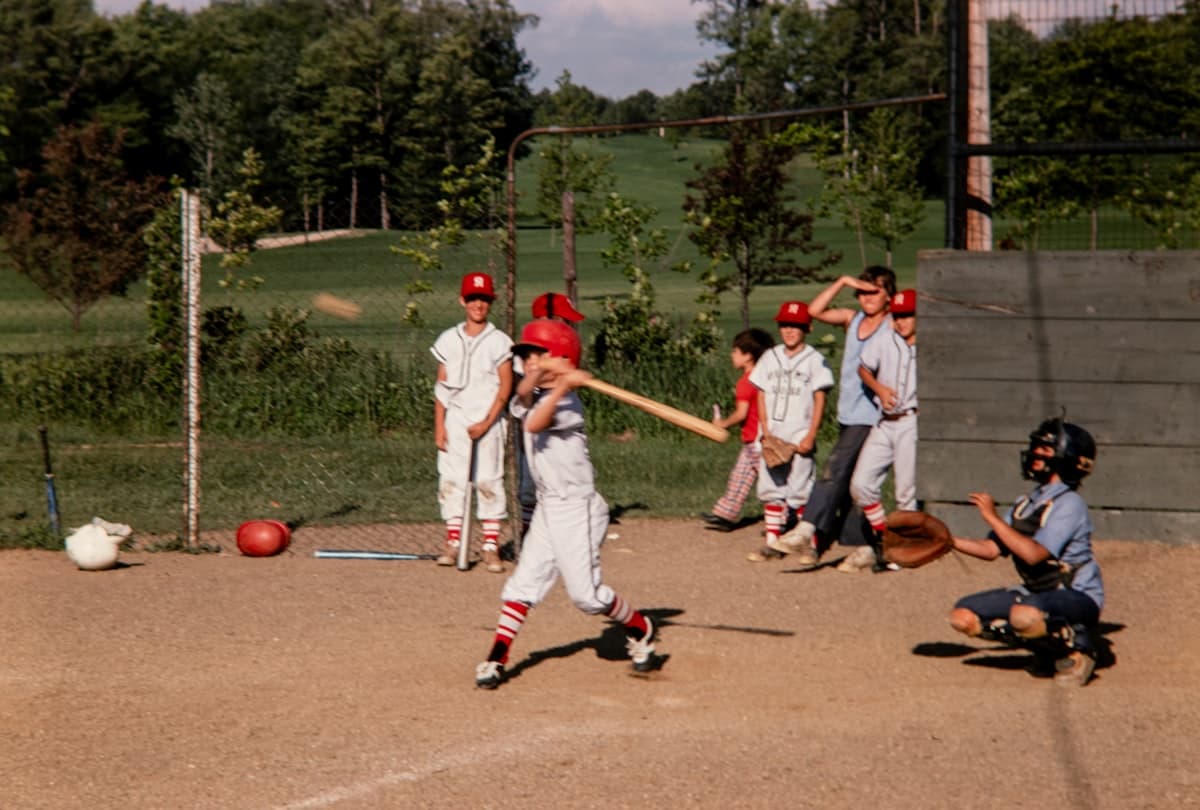
If you played before 2010, you were taught to swing down. The ball goes up if you swing down, the coaches said. Keep it on the ground. Level swing. Chop down. It was handed down like it was written somewhere official, repeated on practice fields every spring across every level of youth baseball in this country.
Zero MLB hitters actually do this.
I heard the same thing. I played at Stanford and professionally in the Mariners organization. It was conventional wisdom when I was a kid, and I watched it persist long after the data started telling a different story. Now we have the data. In spring 2025, Baseball Savant released a swing path and attack angle leaderboard for the first time. I downloaded it, pulled in HR/FB data from the MLB Stats API, and ran the numbers across 240 major league hitters with a full season's worth of at-bats.
The debate about whether to teach a downward swing is over. The question now is what you do with that information on your practice field.
Why Coaches Teach It (And Why It Seems to Work)
Before getting into the numbers, let's give the conventional wisdom its fair hearing. This is not advice passed down by bad coaches. There are real reasons intelligent, experienced people have taught this for generations.
Feel does not equal real. Alex Rodriguez, one of the best hitters who ever played the game, teaches this. His point is that what a swing feels like to the hitter and what the swing actually looks like on video are often completely different things. If you ask a hitter to swing slightly upward through the zone, many of them will grossly exaggerate it into a steep uppercut. So coaches overcorrect. They say "swing down" to get somewhere closer to level. The cue is intentionally wrong because the body does not execute the cue literally. For certain hitters, at certain stages, it works as a corrective tool.
Backspin. A downward blow on the ball is also easier to generate backspin with. Backspin carries. A ball hit with true backspin hangs in the air longer and travels farther. Coaches watched their hitters create backspin when they emphasized a downward swing, saw the ball carry, and reinforced the cue. The observation was not wrong.
It works fine off a tee. Here is where the practical reality gets complicated. Hitting off a tee, or off soft toss, is a controlled timing environment. The ball is sitting still or moving slowly and predictably. A hitter using a downward swing path can get away with it because timing is essentially removed from the equation. They can put the barrel on the ball at any point in their path. It looks good in practice. Coaches watch it and conclude the cue is working.
The problem shows up against live pitching, especially as velocity increases. A pitch arriving at 85 or 90 mph is traveling on a steep downward plane. A bat swinging downward is traveling in the opposite direction. Those two paths intersect at exactly one point, for a fraction of a fraction of a second. The timing window is microscopic. Miss it by even a small amount and the barrel is already past or above the ball. That is why the same swing that looked clean off the tee produces a flood of weak grounders and foul tips against higher velocity. It is not that the hitter got worse. The physics changed.
The goal is to stay on plane with the ball. Match the pitch's downward trajectory with a slight upward swing path, so the barrel and the ball are traveling in the same direction for as long as possible. That expanded window is what separates "looks good in practice" from "works under game conditions."
The Short Answer
For most youth hitters, "match the plane of the pitch" is a more accurate and productive cue than "swing down" or "stay on top of the ball." That is what the data supports, and it is what professional hitters actually do.
How to Apply It: Coaching by Age Group
Before we get into the numbers, here is what this means for you as a coach. The MLB data is the proof. This section is the point.
Cues Worth Reconsidering
These are some of the most common hitting cues in youth baseball, and for most hitters, they work against the physics of what you are trying to achieve:
- "Swing down on the ball"
- "Chop down"
- "Stay on top of the ball"
- "Keep it on the ground"
A downward swing fights the trajectory of every pitch and creates only one tiny contact window. When that window is off by a fraction, you get a weak grounder or a foul tip. These cues were originally invented to correct severe uppercuts, and as a corrective overcorrection for a hitter with a very steep upswing, they can still serve that purpose. But as default instruction for most hitters, they create a different problem.
If you have a hitter who is pulling everything into the ground or rolling over constantly, "stay on top" might be exactly the right temporary cue. Coaching is about matching the cue to the problem in front of you.
What to Say Instead
Use these:
- "Match the plane of the pitch"
- "Swing through the ball"
- "Stay through the zone"
- "Hit it hard into the outfield"
That last one works especially well with younger players. You are not asking them to visualize degrees. You are giving them a target. Where does the ball go after contact? A line drive into the outfield gap is the feedback. A popup or a weak grounder is the feedback. Ball flight tells the story.
Specific Drills by Age
Ages 6-9. Focus entirely on ball flight, not mechanics. Ask players to watch where their hits go. Reinforce line drives. Avoid any swing cues that include the word "down." At this age, the mental model you install is the one that sticks.
Ages 10-12. Tee work with intentional observation. Set the tee at contact point and have the player hit, then both of you watch the flight. If the ball is consistently rolling weakly on the ground, the path is too steep downward. Talk about "swinging through the ball" rather than fixing the path mechanically. The tee lets players feel the difference between hitting on top of the ball and swinging through it.
Ages 13-15. You can introduce the concept of matching pitch plane. Pitchers at this level are developing velocity and movement. A swing that fights the ball's trajectory is going to produce weak contact more consistently. Talk about getting the barrel on the plane of the pitch early and staying through the zone. Soft toss and front toss at realistic angles reinforce the feel.
Ages 16-18. Players at this level can handle more direct mechanical feedback. If a hitter is chopping down and producing nothing in the air, walk them through the pitch trajectory concept. The ball is coming downward at roughly 6 to 10 degrees. A downward swing is traveling in the opposite direction. A swing that matches that plane travels with the ball for a fraction longer, expanding the contact window. That is physics, and older players can process it.
If a Player is Uppercut Excessive
The fix is not to chop down. That overcorrects past the ideal window in the wrong direction. Work on contact point and keeping the hands through the ball longer. Focus on where the ball goes. A ball hit on a line into the outfield gap is the target, not a ball hit straight up.
What Is Attack Angle?
Attack angle is the vertical angle of the bat's sweet spot at the moment of contact. Positive values mean the bat is traveling upward. Negative values mean it is traveling downward. Zero degrees is a perfectly level swing.
A pitch thrown from a major league mound arrives at the plate on a downward trajectory, roughly 6 to 10 degrees depending on pitch type, velocity, and release point. A fastball thrown at a downward angle and a bat swinging at a flat or downward angle are traveling in opposite directions. They can only meet at one precise point. Miss by a fraction and you get a weak grounder or a foul tip.
If the bat matches the plane of the incoming pitch instead, the sweet spot and the ball travel in the same direction for a fraction of a second longer. That shared path produces more consistent hard contact. The physics favor it. The data confirm it.
When hitters swing with a slight upward path through the zone, not chopping down, not going vertical, just matching the natural downward angle of the pitch, they make more solid contact and hit more fly balls that carry. That is the window we are talking about.
The relationship between attack angle and contact quality connects directly to squared-up rate, which measures barrel efficiency. When your attack angle matches pitch plane, you give yourself the best chance of finding the barrel on the ball.
The Data: Zero MLB Hitters Swing Down at the Ball
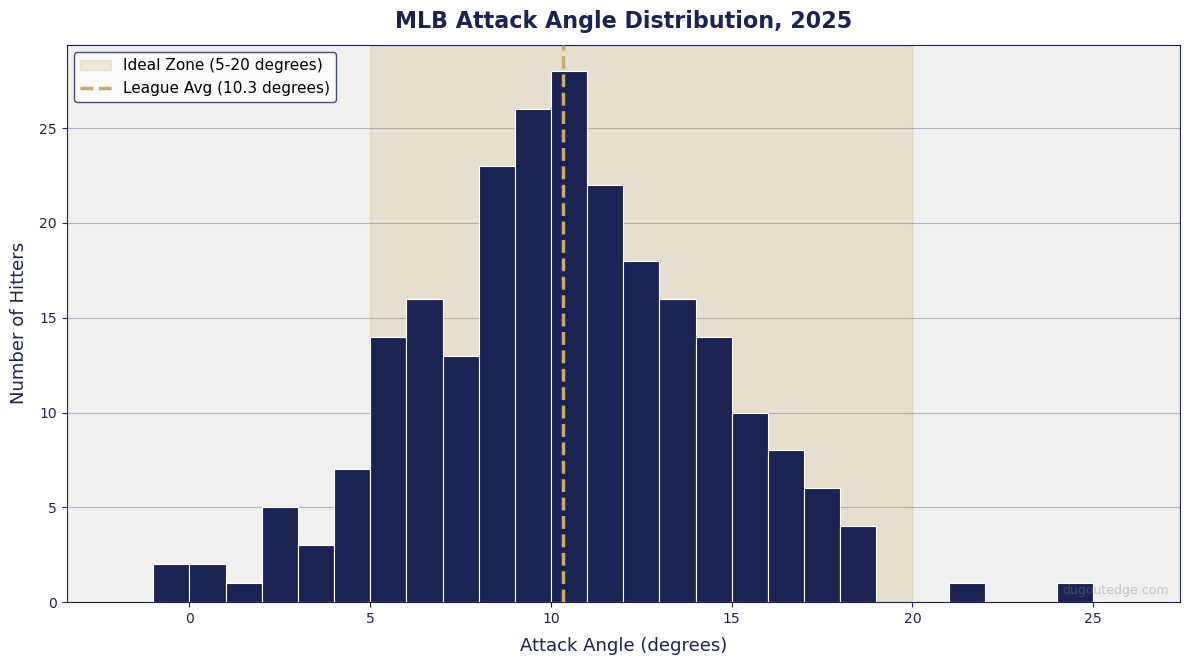
The histogram above shows where every major league hitter landed in 2025. The shaded region is the 5 to 20 degree window. Look at where the distribution sits.
| Metric | 2025 MLB Average |
|---|---|
| Avg Attack Angle | 10.34 degrees |
| Ideal Attack Angle Rate (5-20 degrees) | 51.5% |
| Avg Swing Path Tilt | 32.35 degrees |
| Players in ideal zone (5-20 avg) | 218 of 240 |
218 of 240 major league hitters with a full season's worth of at-bats averaged between 5 and 20 degrees. The league average attack angle was 10.34 degrees upward. Only two players had technically negative attack angles, and the lowest of them was Joey Ortiz at -0.08 degrees. That is functionally zero. Not a meaningful downward swing in any physical sense.
On the other end of the spectrum, Zach Neto had the highest average attack angle in the dataset at 24.72 degrees. That is above the ideal window, in territory associated with more pop-ups and more whiffs.
The middle of the distribution sits right in the 5 to 15 degree range. That is where major league hitters live. This is not a fringe position adopted by a small group of launch-angle obsessives. It is what every professional baseball hitter does. The coaches who built careers telling kids to chop down were giving advice that no MLB hitter actually follows.
The 5-20 Degree Window
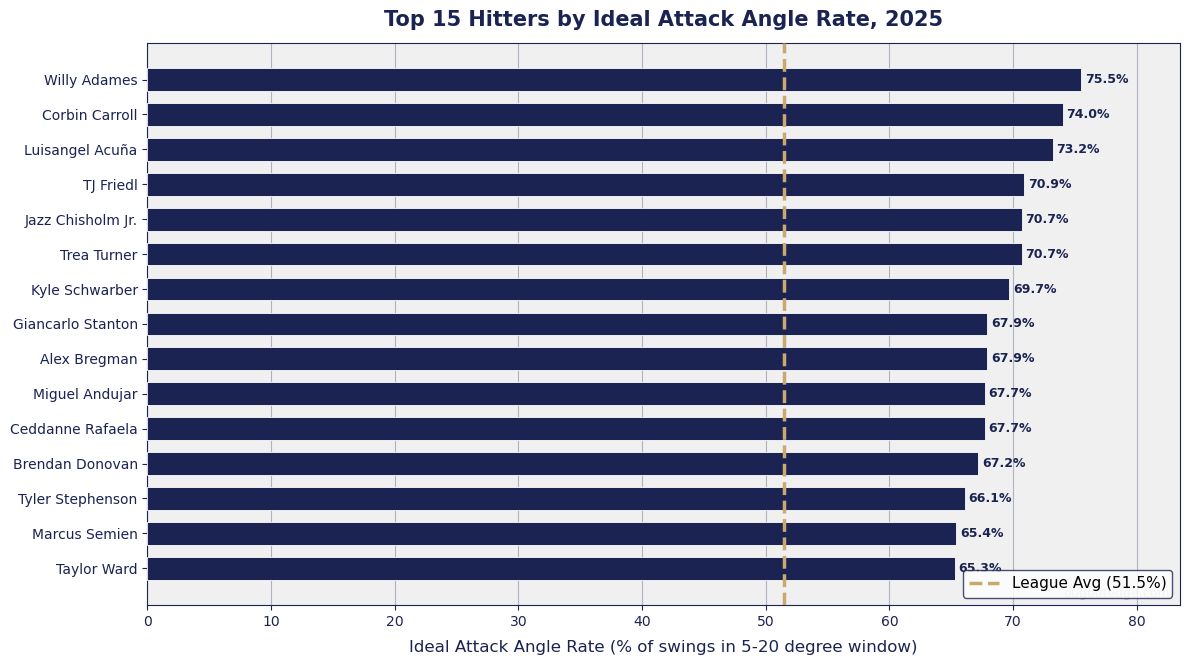
Baseball Savant defines the 5 to 20 degree range as the ideal attack angle window. Swings below 5 degrees tend to produce weak grounders and lack the upward trajectory needed to match pitch plane consistently. Swings above 20 degrees start pulling the bat away from the ball's path, producing more pop-ups and increased miss rates on pitches that tail or cut.
Here are the top 15 hitters by how consistently they stayed in that window in 2025:
| Rank | Player | Ideal Attack Angle Rate | Avg Attack Angle | HR/FB% |
|---|---|---|---|---|
| 1 | Willy Adames | 75.5% | 14.11 degrees | 14.1% |
| 2 | Corbin Carroll | 74.0% | 12.83 degrees | 16.4% |
| 3 | Luisangel Acuna | 73.2% | 9.60 degrees | 0.0% |
| 4 | TJ Friedl | 70.9% | 10.48 degrees | 7.2% |
| 5 | Jazz Chisholm Jr. | 70.7% | 13.10 degrees | 20.9% |
| 6 | Trea Turner | 70.7% | 10.03 degrees | 9.3% |
| 7 | Kyle Schwarber | 69.7% | 13.16 degrees | 27.3% |
| 8 | Giancarlo Stanton | 67.9% | 11.20 degrees | 31.6% |
| 9 | Alex Bregman | 67.9% | 14.67 degrees | 11.0% |
| 10 | Miguel Andujar | 67.7% | 7.49 degrees | 10.5% |
| 11 | Ceddanne Rafaela | 67.7% | 11.16 degrees | 9.1% |
| 12 | Brendan Donovan | 67.2% | 10.02 degrees | 6.8% |
| 13 | Tyler Stephenson | 66.1% | 12.95 degrees | 17.6% |
| 14 | Marcus Semien | 65.4% | 15.68 degrees | 7.8% |
| 15 | Taylor Ward | 65.3% | 7.40 degrees | 17.8% |
The names at the top of this list include some of the most consistent contact hitters in the game. Willy Adames and Corbin Carroll lead the way, both with average attack angles squarely in the middle of that window. More home runs on fly balls and more line drives come from hitters in that range. The connection is real and consistent across the full 2025 season.
One name on this list deserves honest commentary: Luisangel Acuna. He ranks third, with an average attack angle of 9.60 degrees, right in the heart of the ideal zone. His HR/FB rate is 0.0%. He hit zero home runs on fly balls in 2025.
That is the data being honest with you. Getting into the right window is not a power formula. Acuna's swing plane is textbook, but bat speed, barrel accuracy, and squared-up rate still determine what happens after contact. The right attack angle is a necessary condition for consistent quality contact. It is not sufficient on its own. You still have to hit the ball hard. The swing path gets you into position. The rest is still the hitter's job.
Attack Angle and Home Runs: A Moderate Connection
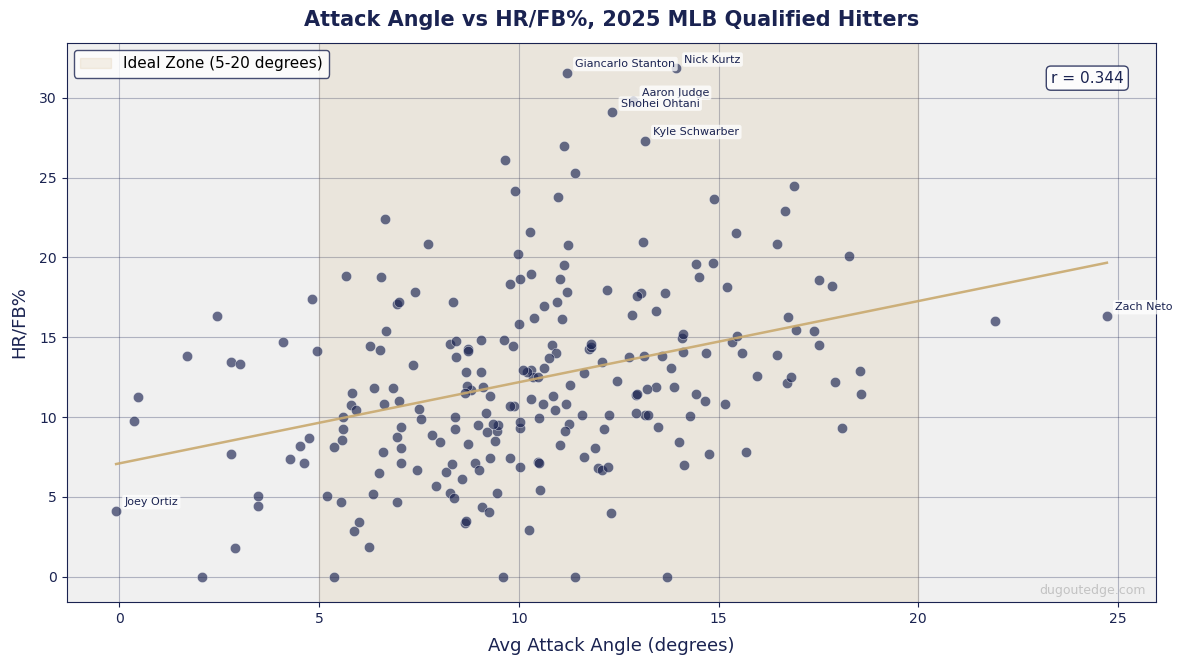
Avg Attack Angle vs. HR/FB%: r = 0.344 | r2 = 0.118 | n = 232 players | moderate positive
Ideal Attack Angle Rate vs. HR/FB%: r = 0.069 | r2 = 0.005 | n = 232 players | weak
The scatter plot shows the relationship between average attack angle and HR/FB rate across 232 hitters. There is a real, moderate positive connection. As average attack angle increases, HR/FB rate tends to increase. This makes sense. Swinging with more upward angle produces more balls hit in the air with carry. More carry means more home runs.
That said, average attack angle only explains a portion of the variation in HR/FB rate across hitters. The rest comes from other factors: exit velocity, barrel rate, pull rate, park factors. Attack angle is one piece of a larger picture.
The more interesting finding is the relationship between consistently staying in the 5-20 degree window and HR/FB rate. That connection is almost nonexistent. Being consistently in the window does not predict power on its own. What the window provides is contact quality and consistency. What you do with good contact, in terms of how hard you hit it and where, determines the power output. This is the same finding that shows up in the bat speed vs. contact quality analysis: raw power metrics and contact quality metrics measure separate things.
The practical read here: the data suggests a coach who helps a hitter find the right attack angle window will likely see better contact quality. They should not expect a home run surge from mechanics alone. Acuna's line is the reminder.
The Coaching Caveat: Youth Baseball Is Not MLB
This section matters, and I want to be direct about it.
The data above comes from MLB hitters facing MLB pitchers. A pitcher throwing 92 mph with late-running sinker action creates a specific pitch trajectory at the plate. That trajectory informed the research that established the 5 to 20 degree window as optimal.
A 10-year-old facing a 55 mph fastball with minimal break is a different equation. The pitch arrives on a flatter plane. The velocity is slower. The ball stays in the hitting zone longer. The optimal attack angle for a youth hitter in those conditions may differ from 10 degrees upward. I do not have data at that level to tell you exactly where the window shifts.
What transfers from this data is the principle, not the precise numbers. No level of baseball rewards swinging down at the ball. Chopping down creates a bat path that fights the trajectory of every pitch and limits the window for solid contact. That is true whether the pitcher is throwing 55 mph or 95 mph.
One approach that works well is to use this data to retire an outdated cue, rather than to install a new measurement system at the 10-year-old level. The right frame is not "our kids need to swing at exactly 10 degrees." It is "we should not be teaching a downward chop, because every professional hitter swings upward through the zone."
A Note on This Data
This is first-year data. Baseball Savant released the swing path and attack angle leaderboard for the first time in spring 2025, covering the 2025 MLB season. One season is suggestive, not definitive. The league-average findings are consistent with what biomechanics researchers and hitting coaches have been publishing for years, which adds confidence. But a single season of publicly available tracking data has limits.
These are also season-average attack angles, not per-swing or per-pitch metrics. A player's average may mask swing-to-swing variability that matters. Pitch-level attack angle data, broken down by pitch type, velocity, and location, is not publicly available. When that data becomes accessible, the analysis will get more precise.
The HR/FB data was pulled from the MLB Stats API and calculated as HR divided by the sum of HR and air outs, matching the standard FanGraphs definition. Where a player had no fly ball outs or home runs in the dataset, they were excluded from the correlation analysis, leaving 232 of 240 players.
The Takeaway
No MLB hitter swings down at the ball. The range is 5 to 24.72 degrees upward. The league average is 10.34 degrees. 218 of 240 major league hitters with a full season's worth of at-bats averaged between 5 and 20 degrees in 2025. The data does not leave room for debate on this.
For youth coaches, this is permission to stop teaching the chop. The data suggests the ideal swing matches the plane of the incoming pitch with a slight upward angle through the zone. That is what every professional hitter does. The precise optimal angle for a 10-year-old facing a 55 mph fastball may differ from what MLB data shows, but the direction is the same. Up. Not down.
Higher average attack angle shows a moderate connection with home run rate. Being consistently in the ideal window shows almost no connection with power on its own. Acuna's 0% HR/FB at 73.2% consistency in the window is the honest reminder: mechanics put you in position. You still have to hit the ball hard.
The next article in this series looks at bat speed data from the same Baseball Savant dataset. If attack angle is about plane, bat speed is about what happens when the bat gets there. The two together tell a more complete story than either does alone.
In This Series
These articles use public MLB data to answer questions youth coaches actually ask:
- Do MLB Hitters Change Their Swing With 2 Strikes?
- Bat Speed Doesn't Matter As Much As You Think
- What a Short Swing Actually Means
- Batting Average Is Lying to You About Your Hitters: What to Measure Instead
- Blasts: The Most Valuable Swing in Baseball
- How to Set Your Batting Order: What MLB Data Says
- When to Bunt: What Run Expectancy Data Says
- When to Steal: The Break-Even Math
Data sourced from Baseball Savant Swing Path and Attack Angle Leaderboard (first released spring 2025) and MLB Stats API. Analysis run April 11, 2026. 2025 MLB regular season, 240 qualified hitters.
About the Author
Former Stanford baseball player and professional in the Seattle Mariners organization. 7 years in professional data analytics. Founder of Dugout Edge.
Tags
Ready to Generate Your Perfect Lineup?
Try our free softball and baseball lineup generator to create balanced, fair lineups in minutes.
Try Free Lineup Generator