What Separates Good Contact From Great Contact, and How to Teach It
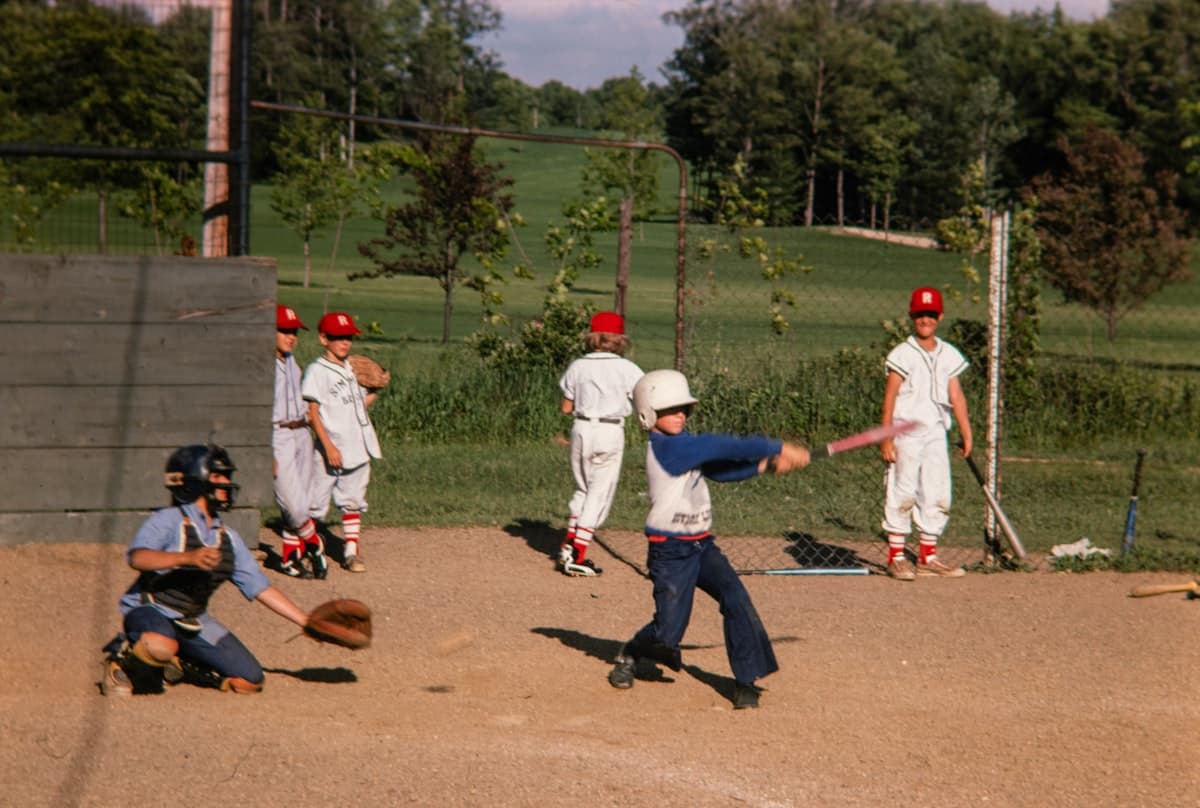
When a kid absolutely crushes a ball, not just a hit, a missile, what actually happened? And more importantly, can you teach it?
The answer is yes, but only if you understand which part you can actually coach and which part you have to wait for.
Here is the short version. A great swing requires two things to happen at the same time: the bat has to be moving fast, and the barrel has to find the right spot on the ball. Those are two separate skills. MLB's tracking system has a name for when both happen at once. They call it a blast.
The coaching insight is this: you teach barrel accuracy first. Bat speed is mostly a physical attribute that arrives with growth and strength. Barrel accuracy is coachable at any age, at any level.
This article walks through what to actually do with your players at practice, then shows you the MLB data that backs it up.
How to Apply This at Practice (Ages 6-18)
Before the data, here is the actionable piece, because that is what you are actually here for.
Ages 6-9: Just find the ball
At this age, the goal is contact. Not hard contact. Not launch angle. Contact.
Run drills that build hand-eye coordination and help kids learn where the bat actually is in space. Tee work is your best friend. Keep the tee at a consistent height and location until they can square it up reliably, then move it around. Soft toss from the side. Machine work at low speeds if you have access.
Do not talk about swinging hard. Do not talk about power. The only cue that matters is "see the ball, hit the ball."
Ages 10-13: Teach the swing plane
This is when you can start working on mechanics in a meaningful way. Kids at this age can retain coaching cues and apply them during a drill.
One of the most valuable things to develop at this age is barrel path, the barrel needs to travel through the hitting zone, not just to it. A swing that gets to the contact point on a correct path gives the hitter a much larger window to square the ball up. A swing that drops late or sweeps creates a tiny window where contact is possible at all.
Work on drills that reinforce barrel path. Inside-out hitting, where you put the tee on the inside corner and ask hitters to drive it to the opposite field. High tee work to keep the barrel from dropping. Two-tee drills where the back tee teaches the hitter to swing above the obstacle.
Talk about where the barrel is, not how hard the swing is.
Ages 14-17: Add intent
By high school, you can start asking for more. Kids who have built a solid swing path can now start putting real effort behind it. This is where bat speed development through strength training starts to pay off.
The key is that the path has to come first. A player who has learned to barrel the ball correctly and then gains 5 mph of bat speed through an offseason lifting program is going to see a significant jump in hard contact. A player who has been swinging as hard as possible for four years without learning the path just hits the ball harder in the wrong direction.
Build practice plans around contact quality at this age. Track how hard the ball comes off the bat if you have a radar gun or a Blast Motion sensor. The number going up while keeping strike zone discipline is the signal you are looking for.
The key cue at every age
Think of it this way: a great swing requires two keys to turn at the same time. Bat speed is one key, barrel accuracy is the other. In youth development, you can hand a player one of those keys right now through coaching. The other key arrives later.
Make sure the lock is ready when the second key shows up.
What a Blast Is, and Why It Matters
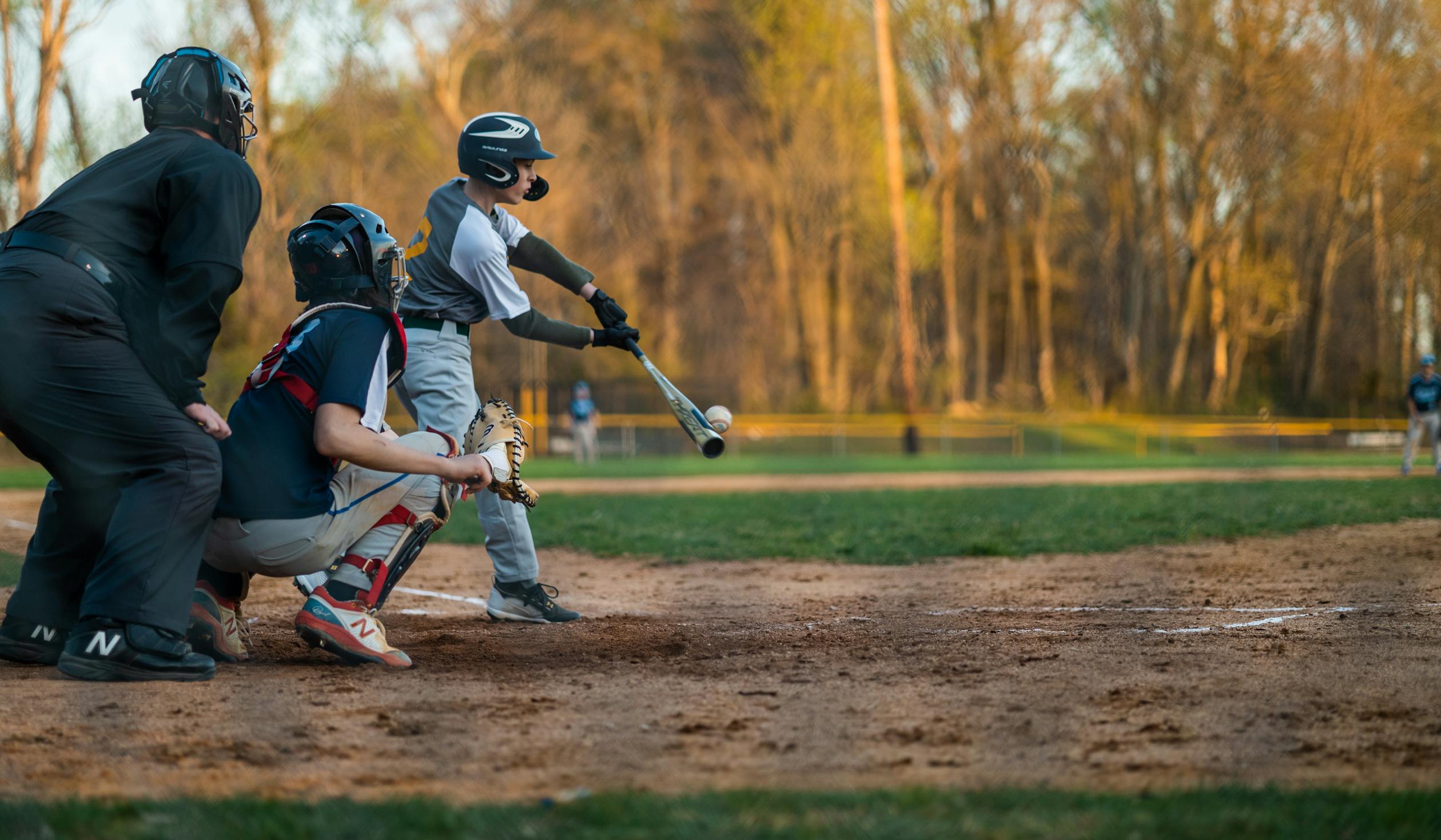
MLB calls it a blast when a hitter swings fast AND finds the sweet spot at the same time. Both things have to happen together. You can't have one without the other.
Squared-up contact is not just a hard hit ball. It is a ball hit at close to the maximum potential of what the hitter's swing speed could produce. A hitter who squares a ball up perfectly will get more out of the swing than a hitter with a faster bat who catches the ball off the end or off the handle. The squared-up concept captures barrel efficiency, not raw power.
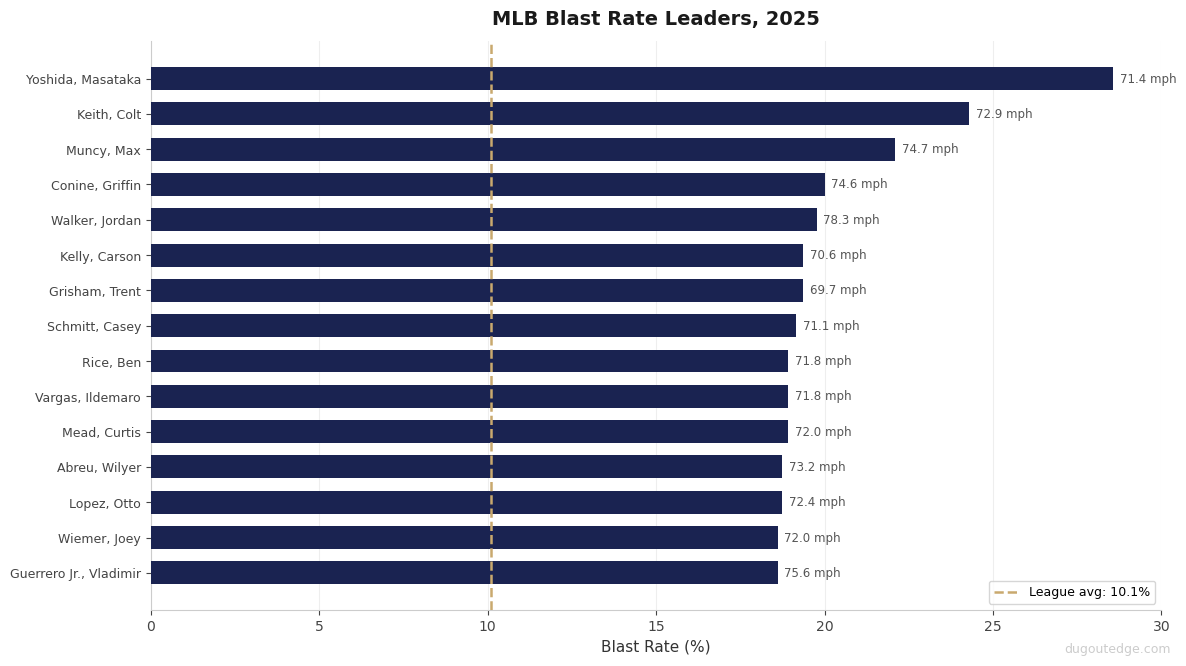
The league average is sobering. Across major league hitters with a full season's worth of at-bats in 2025, the average blast rate was 10.1%. That means on roughly nine out of ten swings that result in contact, even professional hitters are not achieving both a fast swing and a squared-up ball at the same time.
Who Produces the Most Blasts? The 2025 Leaderboard
| Player | Blast Rate | Bat Speed | Squared-Up Rate | Fast Swing Rate |
|---|---|---|---|---|
| Yoshida, Masataka | 28.6% | 71.4 mph | 46.4% | 10.7% |
| Keith, Colt | 24.3% | 72.9 mph | 40.0% | 25.7% |
| Muncy, Max | 22.1% | 74.7 mph | 30.2% | 53.5% |
| Conine, Griffin | 20.0% | 74.6 mph | 27.5% | 47.5% |
| Walker, Jordan | 19.8% | 78.3 mph | 24.4% | 83.7% |
| Kelly, Carson | 19.4% | 70.6 mph | 33.9% | 6.5% |
| Grisham, Trent | 19.4% | 69.7 mph | 30.6% | 6.5% |
| Schmitt, Casey | 19.2% | 71.1 mph | 29.8% | 14.9% |
| Rice, Ben | 18.9% | 71.8 mph | 27.0% | 27.0% |
| Vargas, Ildemaro | 18.9% | 71.8 mph | 29.7% | 18.9% |
| Mead, Curtis | 18.9% | 72.0 mph | 32.4% | 27.0% |
| Abreu, Wilyer | 18.8% | 73.2 mph | 27.5% | 32.5% |
| Lopez, Otto | 18.8% | 72.4 mph | 30.0% | 27.5% |
| Wiemer, Joey | 18.6% | 72.0 mph | 23.3% | 34.9% |
| Guerrero Jr., Vladimir | 18.6% | 75.6 mph | 26.7% | 54.7% |
The first thing you will notice in this table is that the blast rate leaders are not who you would expect. Masataka Yoshida is at the top with a 28.6% blast rate. His bat speed is 71.4 mph, right at the league average and not meaningfully faster than most of the hitters around him. His fast swing rate is just 10.7%, meaning he almost never swings at maximum effort.
What Yoshida does instead is square up the ball at an elite level. His squared-up rate of 46.4% is the highest in this table by a significant margin. He is making so much high-efficiency contact that even with a modest fast swing rate, the swings that do reach full speed are almost always on the sweet spot. He reaches the top of the blast leaderboard not through raw power, but through extraordinary barrel control paired with just enough swing speed on the right pitches.
Now compare that to Jordan Walker, who sits fifth on the leaderboard at 19.8%. Walker's bat speed is 78.3 mph, one of the fastest in baseball, and his fast swing rate is 83.7%. He swings hard on almost every pitch. But his squared-up rate is just 24.4%, right at league average. He produces blasts at a high rate because he is almost always swinging fast, and a quarter of his contacts happen to also be squared up. Completely different path to the same destination.
This is the Yoshida vs. Walker comparison worth understanding. Two players with nearly the same blast rate. One gets there through elite precision with enough speed. One gets there through elite speed with average precision. Neither can get there without both.
Vladimir Guerrero Jr. appearing at the bottom of the top 15 is also worth noting. He is one of the most physically gifted hitters in baseball, with one of the faster bat speeds in the game and a tendency to swing hard most of the time. But his blast rate of 18.6% sits at the same level as players with far less raw power. The squared-up rate of 26.7% is what holds him back. Even with elite raw bat speed, barrel efficiency is the constraint.
Blast Rate and Production: The Data Connection
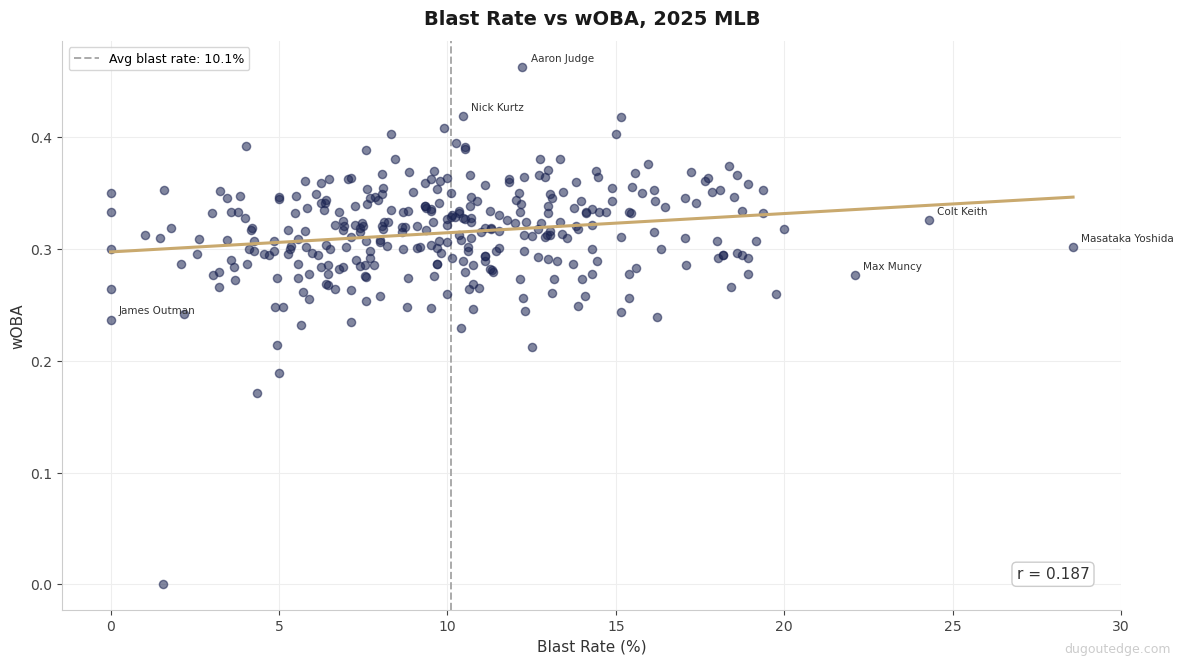
Blasts connect to offensive success, but the relationship is modest. Plenty of hitters with few blasts still produce good offenses because pitch selection and plate discipline matter too. What the data does show clearly is that blasts come from bat speed more than barrel accuracy. But for coaches, that is actually an argument for teaching barrel accuracy first. Bat speed is mostly physical development. Barrel accuracy is a skill you can build right now.
The scatter plot makes this visible. There are still plenty of players with low blast rates who post good numbers at the plate, and players with high blast rates who underperform. But the density of high-production players increases as blast rate goes up. The hitters posting the best overall offensive production in this dataset are disproportionately the ones with higher blast rates.
The Two Skills: What the Numbers Say
Blast Rate vs. Bat Speed: r = 0.423 | n = 332 players
Blast Rate vs. Squared-Up Rate: r = 0.364 | n = 332 players
Blast Rate vs. Fast Swing Rate: r = 0.360 | n = 332 players
Of the two ingredients in a blast, bat speed is the stronger predictor. The data shows a meaningfully higher connection between blast rate and average bat speed than between blast rate and barrel accuracy.
What this tells you is that among MLB hitters, bat speed is more of a limiting factor than barrel accuracy when it comes to blast production. The speed threshold that defines a fast swing is set at a level that many professional hitters are near or below on average. If your average bat speed sits around 69 or 70 mph, you are producing few fast swings regardless of how well you barrel the ball. The speed requirement filters out most of your contact events before barrel accuracy even has a chance to matter.
For hitters with above-average bat speed, the calculation shifts. Those hitters have fast swings available on most contacts, and barrel accuracy becomes the binding constraint on blast rate.
This is the reason the development sequence matters so much. At the youth level, bat speed is limited by physical development, not by effort or mechanics. You cannot coach a 12-year-old into professional-level bat speed. You can coach them into better barrel accuracy. So you teach what you can teach, build the foundation, and let the bat speed arrive when the body is ready.
A Note on Context
The 2025 data in this analysis was collected through early April, with a minimum number of swings required to qualify. Some players near the top of the blast rate leaderboard have smaller samples, which means their numbers will likely settle closer to the league average as the season progresses. Masataka Yoshida's 28.6% blast rate and Colt Keith's 24.3% rate are striking early-season figures that will be worth revisiting at midseason.
The blast framework is built around MLB-calibrated thresholds. At youth levels, players swing considerably slower. A 12U player might average 50 to 55 mph of bat speed. The absolute numbers do not translate. But the concept does: at every level, there is a speed-accuracy combination that produces the best possible contact outcome for that player's physical profile. The MLB data is a useful lens for understanding that relationship at the professional level, and the same principles apply all the way down.
This connects to what the attack angle data shows: the swing plane must match the pitch trajectory. And what the swing length data shows: compact swings reach the contact zone more efficiently. Blasts are the final output of mechanics and approach built brick by brick.
The Full Picture
This is the sixth article in an ongoing series examining what MLB bat tracking data tells youth coaches about the game.
The findings from each article:
Hitters adjust their swing by count. They shorten up and protect in two-strike counts, producing slower but more precise swings. The data tells you that approach adjustability is a real, measurable skill.
Bat speed alone does not predict production. The slowest bat in baseball belongs to one of the most productive contact hitters. Speed without precision produces nothing.
Attack angle matters, and no MLB hitter swings down. The average MLB attack angle is positive, meaning the barrel travels upward through the contact zone. Coaching kids to swing down at the ball runs counter to what every professional hitter actually does.
A short swing means 6.5 feet or less. The average MLB swing length is 7.33 feet. Players coached to be short to the ball are not producing shorter swings in the absolute sense. Swing length reflects barrel path efficiency more than effort or approach.
Squared-up rate is the most coach-friendly metric because it captures barrel efficiency independent of bat speed. It tells you whether a hitter is finding the right part of the ball regardless of how hard they are swinging.
Blasts require both skills at once. The blast framework shows what happens when speed and accuracy combine in the same swing. The result is a better predictor of production than either metric alone.
The series will continue with midseason updates as the 2025 season produces larger samples and the leaderboards stabilize. The early-season data gives us directional signals. The full season data will sharpen the picture.
In This Series
These articles use public MLB data to answer questions youth coaches actually ask:
- Do MLB Hitters Change Their Swing With 2 Strikes?
- Bat Speed Doesn't Matter As Much As You Think
- The 5-20 Degree Window: Attack Angle Explained
- What a Short Swing Actually Means
- Batting Average Is Lying to You About Your Hitters: What to Measure Instead
- How to Set Your Batting Order: What MLB Data Says
- When to Bunt: What Run Expectancy Data Says
- When to Steal: The Break-Even Math
Data sourced from Baseball Savant Bat Tracking Leaderboard and Expected Statistics Leaderboard. Analysis run April 11, 2026. 2025 MLB regular season.
About the Author
Former Stanford baseball player and professional in the Seattle Mariners organization. 7 years in professional data analytics. Founder of Dugout Edge.
Tags
Measure Your Exit Velocity
Use our free exit velocity calculator to turn bat speed and pitch speed into expected exit velo, with benchmarks by age and level.
Open the Calculator