What Does 'Stay Short' Actually Mean? Here Is How to Coach It.

Coaches say "stay short" at every level. Almost none of them can explain what short actually means.
Short compared to what? Shorter by how much? Watch a youth game and you will hear it from every dugout, but the kid who swings gets zero information. They do not know what to change, and the coach does not know how to tell them. "Shorter" meant "not as big." Everyone nodded and nobody had a better answer.
This article gives you the answer and three drills to go with it.
This is the third article in a series on MLB bat tracking data. The first covered bat speed and contact quality. The second showed how hitters adjust their swing with two strikes. This one focuses on swing length: what it means, how to teach it, and what the MLB data proves.
What a Short Swing Actually Is
When coaches say "stay short," they are not really talking about arc length. They are talking about timing.
A short swing is one that gets from load to on-plane quickly. The question is: how much time does it take for a hitter to go from their loaded position to a strong contact position with the barrel on the plane of the pitch? Less time, shorter swing. More time, longer swing. The bat head distance is a byproduct of that, not the cause.
This distinction matters because it changes what you look at. A hitter with a big leg kick is not necessarily long. A hitter with a quiet setup is not necessarily short. What matters is how fast they can get the barrel on-plane from wherever their load takes them. Big loads will generally take longer to uncoil, but some of that timing gap can be closed by swing speed. A hitter who loads big but accelerates fast can still arrive on-plane as quickly as a hitter with a compact load and slower acceleration.
This creates a genuine balancing act every swing requires:
- Short to the ball: getting on-plane fast enough to handle velocity and late movement
- Enough bat speed: generating force so that contact actually does damage
- Hand-eye coordination: arriving at the right position so the sweet spot meets the ball at the right angle
Change one variable and you affect the others. A hitter who shortens dramatically may lose bat speed. A hitter who loads up for power may gain speed but cost themselves time. The best hitters find their own version of that balance. It is not one shape for everyone.
When "Stay Short to the Ball" Is the Right Cue
This is the key coaching question. "Short to the ball" works as a cue for a specific type of player in a specific situation:
- A hitter with a long, drifting path from load to contact, their barrel wanders before getting on-plane
- A hitter who is consistently late on fastballs, they are not getting on-plane fast enough
- A hitter in a two-strike count who needs to protect the plate, less time to decide, so less time to waste getting the barrel there
- A hitter who is casting or barring out, their hands go wide before the barrel arrives, which adds time and distance
It is not the right cue for a hitter whose timing is fine but who simply lacks bat speed. Telling that player to "be shorter" will likely make them slower and weaker without fixing what is actually wrong. Coaching is about matching the cue to the problem. "Short to the ball" is a powerful cue. Like all cues, it works on certain players and can hurt others.
A longer arc gives the barrel more chances to drift off the plane of the pitch. A shorter, more direct path stays on-plane longer. That is why the advice is correct, it just needs to be pointed at the right hitter.
How to Coach It (Ages 6-18)
There are three mechanical adjustments that produce a measurably shorter swing. Teach all three. Two of them you can drill today. One is a cue you repeat until it sticks.
1. Choke Up
This is the most direct lever you have. When a hitter moves their hands up the handle, the effective length of the bat is shorter. A shorter bat traces a smaller arc to contact. One to two inches up the handle takes a measurable amount of arc out of the swing path. It also tends to make the swing a little faster because there is less weight at the end.
For youth players, make choking up a standard two-strike adjustment. Give them explicit permission to do it without feeling like they are giving something up. The data shows the best hitters in the world shorten their swings with two strikes. You are not asking your player to do something the pros would never do. You are asking them to do exactly what the pros do.
Build it into your practice plans. A dedicated two-strike round with choke-up required is more useful than ten rounds of unrestricted swings. Make it a habit before it is ever needed in a game.
Age notes: Works at every level. With 6-8 year olds, just tell them to put two fingers on the label and swing. With older players, talk through the reason so they own the adjustment.
2. Quiet the Load
Long swings often start long. A big leg kick, an exaggerated stride, a wide load before the hands start moving. Each of those adds movement that has to be timed and recovered from before the actual swing begins.
More moving parts before contact means more chances for timing to break down. A compact, quiet load produces a more compact swing, not because less pre-swing movement directly shortens the arc, but because less movement reduces drift and keeps the hands on the right path.
For youth hitters, this means simplifying the setup. Watch for players who are doing too much before the swing starts. A small weight shift is enough. A small stride is enough. The barrel cannot be short if everything before it is big.
Drill: Soft toss, feet planted, no stride. The hitter stands in their normal stance, rocks their weight back slightly, and swings without stepping. This removes the stride from the equation and forces the hitter to generate a compact swing from the waist up. Do this for 10-15 reps before any tee work. Once they feel what a quiet load produces, add the stride back.
Age notes: 8U and younger benefit most from this drill. Older players can add complexity back once the quiet load is a habit.
3. Keep the Hands Inside the Ball
This one is harder to feel without coaching feedback, but it is the most direct mechanical connection to swing length.
When a hitter's hands drift outside the flight path of the incoming pitch, the barrel has to travel a longer route around the hands to reach the contact zone. When the hands stay tight to the body and lead the barrel directly to the ball, the path is shorter.
"Inside the ball" is not just a cue for bat path. It is a literal description of a shorter route to contact.
Drill: Set up a tee on the inside corner and place a second tee or a batting glove about a foot outside the front hip. Tell the hitter their hands have to clear the inside obstacle without hitting it. If the hands go outside, they catch it. If they stay inside, they barrel the ball. Do this 20 swings per practice until it stops requiring conscious thought.
Age notes: This drill works from 10U and up. Younger players do not have the body awareness to benefit from it yet. For 10-14 year olds who are casting or barring out, this is often one of the most impactful adjustments you can make.
Why It Works: The Data
For most of the history of baseball, "stay short" was a feeling. Now it has a number.
Baseball Savant tracks swing length on every swing in the major leagues, using MLB's tracking system. It reports the distance the bat head travels from swing start to contact, in feet. That number gives the instruction a definition.
The league average among MLB hitters in 2025 is 7.33 feet. Players at 6.5 feet or below are in a genuinely different category.
Who Has the Shortest Swings in Baseball
Here are the ten players with the shortest average swing lengths in 2025, among hitters with at least 50 swings tracked:
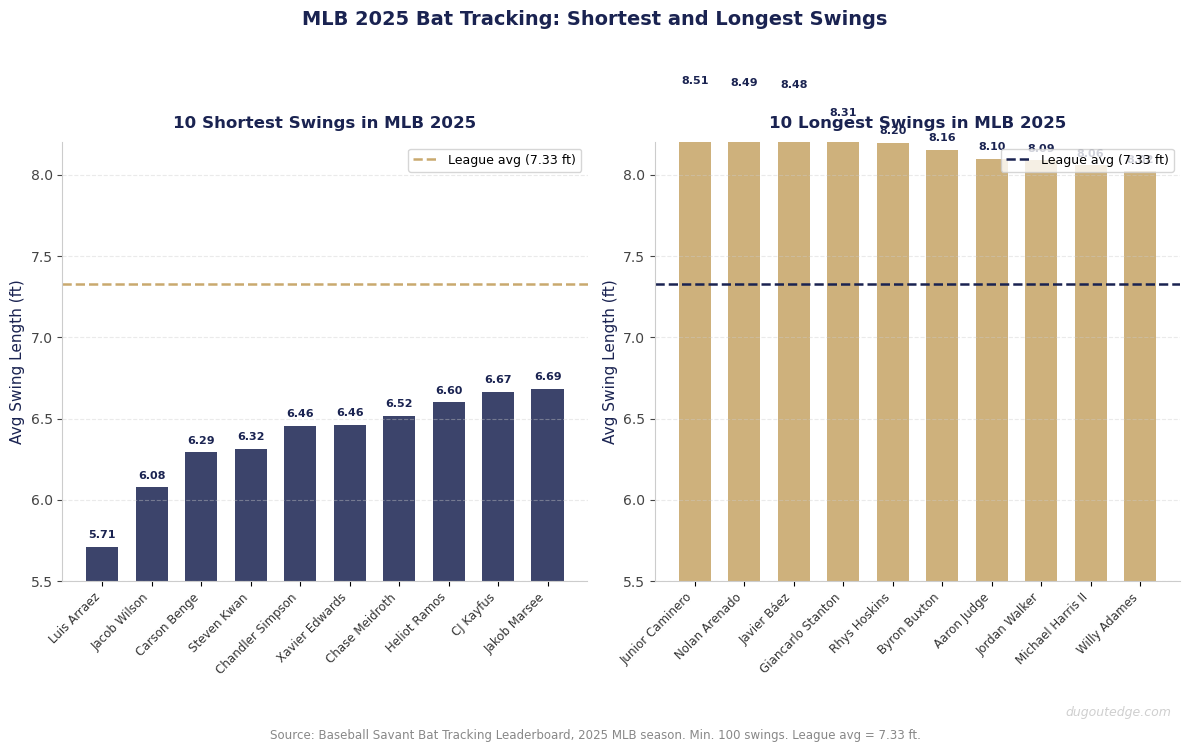 MLB 2025 bat tracking leaderboard. Left: 10 shortest swing lengths. Right: 10 longest. Dashed line = league average (7.33 ft). Source: Baseball Savant.
| Player | Avg Swing Length | Whiff Rate |
|---|---|---|
| Luis Arraez | 5.71 ft | 9.3% |
| Jacob Wilson | 6.08 ft | 15.4% |
| Carson Benge | 6.29 ft | 25.6% |
| Steven Kwan | 6.32 ft | 5.9% |
| Chandler Simpson | 6.46 ft | 4.5% |
| Xavier Edwards | 6.46 ft | 15.6% |
| Chase Meidroth | 6.52 ft | 15.3% |
| Heliot Ramos | 6.60 ft | 31.6% |
| CJ Kayfus | 6.67 ft | 36.0% |
| Jakob Marsee | 6.69 ft | 10.7% |
Luis Arraez averages 5.71 feet. That is not a small difference from league average. That is a completely different relationship with the strike zone. Arraez, Kwan, Edwards, Wilson. These are hitters known for two things: high contact rate and no interest in selling out for power. The compact swing is the mechanism behind both outcomes. Less arc means less time for the barrel to drift off the pitch plane. Less drift means more contact. These same players show up near the top of squared-up rate leaderboards for exactly this reason.
The long-swing side looks different. Junior Caminero at 8.51 feet. Nolan Arenado at 8.49 feet. Javier Baez at 8.48 feet. Giancarlo Stanton at 8.31 feet. Big, physical hitters who generate enormous power and accept more whiffs as the tradeoff. That is a deliberate choice at the MLB level. For most youth hitters who are still developing contact skills, a more compact swing tends to be a better starting point, but some players are naturally built for a longer, more powerful swing path, and that is not inherently wrong.
Shorter Swings Make More Contact: The Correlation
The connection is straightforward: longer swing paths lead to more whiffs. Across 262 major league hitters with a full season's worth of at-bats in 2025, the pattern held consistently. Longer swing, more misses. Shorter swing, more contact.
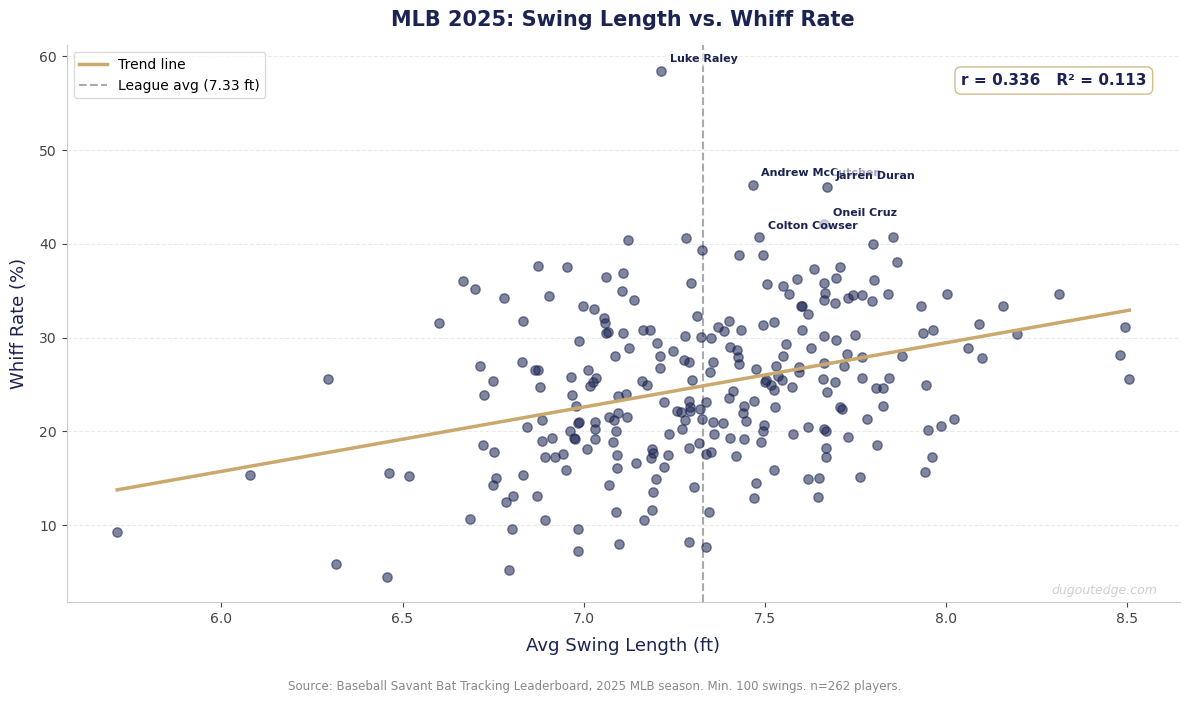 Scatter plot: 262 MLB hitters with at least 50 swings tracked, 2025 season. Each dot = one player. TAN line = trend. Source: Baseball Savant.
Here is the simple reason it works: a shorter path gives the barrel less opportunity to drift off the plane of the pitch. Less drift means more solid contact.
Swing length is one factor in the contact equation, not the only one. Pitch recognition, bat speed, hand-eye coordination, and the quality of pitching all play a role. But the direction of the relationship is clear and it is consistent with everything coaches have been saying for decades.
MLB Hitters Already Do This With Two Strikes
The previous article in this series showed that MLB hitters make measurable swing adjustments by count. The swing length data confirms it. When hitters are ahead in the count, they take their full swing. When they fall behind, they shorten up.
Here is the count-by-count swing length table from the 2025 pitch-level dataset covering 318,895 contact swings:
| Count | Avg Swing Length | Swings |
|---|---|---|
| 3-0 | 7.48 ft | 566 |
| 2-0 | 7.36 ft | 8,914 |
| 1-0 | 7.32 ft | 27,755 |
| 3-1 | 7.30 ft | 7,607 |
| 2-1 | 7.27 ft | 20,135 |
| 0-0 | 7.26 ft | 54,292 |
| 1-1 | 7.25 ft | 36,648 |
| 0-1 | 7.22 ft | 42,741 |
| 3-2 | 7.18 ft | 23,896 |
| 2-2 | 7.18 ft | 36,048 |
| 1-2 | 7.17 ft | 37,621 |
| 0-2 | 7.15 ft | 22,672 |
From 3-0 (7.48 ft) to 0-2 (7.15 ft), that is a drop of 0.33 feet. Every count with two strikes has a shorter average swing than every count with zero or one strike at the same ball count. The direction is consistent. The adjustment is real.
This is the most direct proof that "shorten your swing" is grounded in real mechanics and real outcomes at the highest level of the sport. The best hitters in the world do it automatically when they need to protect the plate. Youth coaches should be building that habit on purpose.
Caveats Worth Naming
The 2025 data covers the regular season. The minimum threshold of 50 swings is a relatively low bar, so some players near the bottom of the qualifying list have smaller samples. Arraez's 5.71-foot number is striking, but it should be read in the context of his full career as one of the best contact hitters in baseball, not as a curiosity from a small sample.
One thing worth knowing: swing length averages out over a whole season. Any individual swing varies. What the data captures is a hitter's tendency, not a fixed mechanical fact.
Youth pitching environments are different. Trajectories, speeds, and movement patterns are all different from the majors. The optimal swing for a 12U hitter facing 55 mph is not the same as for a major leaguer facing 98. The principles transfer. The exact numbers do not.
What transfers cleanly is the direction: shorter swings make more contact. Two-strike counts call for shorter swings. Choking up, quieting the load, and keeping the hands inside are the mechanical levers. The MLB data is the receipts.
Conclusion
"Stay short" now has a number behind it. Seven point three three feet is average. Six point five feet and below is short. Luis Arraez swings at 5.71 feet and makes contact better than nearly anyone in the sport. The pattern with whiff rate is real, consistent, and lines up with everything coaches have been saying for a hundred years.
More important than the number: you now have three mechanical cues to actually teach. Choke up. Quiet the load. Hands inside the ball. Those are the levers. Use the data when a player asks why.
The next article in this series covers squared-up rate, which measures contact quality on batted balls. A short swing gets the bat to the ball. Whether the barrel arrives on-plane with the pitch is what determines whether that contact is hard or soft.
In This Series
These articles use public MLB data to answer questions youth coaches actually ask:
- Do MLB Hitters Change Their Swing With 2 Strikes?
- Bat Speed Doesn't Matter As Much As You Think
- The 5-20 Degree Window: Attack Angle Explained
- Batting Average Is Lying to You About Your Hitters: What to Measure Instead
- Blasts: The Most Valuable Swing in Baseball
- How to Set Your Batting Order: What MLB Data Says
- When to Bunt: What Run Expectancy Data Says
- When to Steal: The Break-Even Math
Data sourced from Baseball Savant Bat Tracking Leaderboard and pitch-level data. Analysis run April 11, 2026. 2025 MLB regular season. Minimum 50 swings for individual player leaderboard. Count-level data from 318,895 contact swings across all 12 count states.
About the Author
Former Stanford baseball player and professional in the Seattle Mariners organization. 7 years in professional data analytics. Founder of Dugout Edge.
Tags
Ready to Generate Your Perfect Lineup?
Try our free softball and baseball lineup generator to create balanced, fair lineups in minutes.
Try Free Lineup Generator