When to Put the Bunt Sign on as a Coach - A Complete Guide
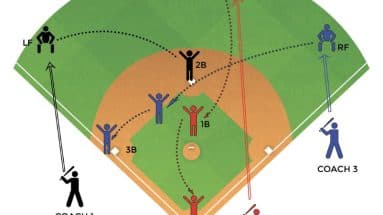
Every coach has stood in that spot. Runner on first, leadoff batter in the inning, tie game late. The third base coach is looking at you. Do you put the bunt sign on?
The default answer is no. In most situations you should swing away and trust your hitters. Bunting voluntarily trades an out for a base advance, and outs are the most expensive thing in baseball because outs end innings. Most of the time, that trade hurts you.
But the bunt is not always wrong. There are specific situations where it makes sense, and knowing which ones they are is what separates a coach who uses information from one who just goes on instinct. Run through the five questions below before you put the sign on.
Decision Framework for Youth Coaches
When you are standing in the dugout with the bunt sign half-formed in your head, work through these five questions before you commit.
1. Do you need exactly one run, or do you need multiple?
This is the first question because it is the most important one. If you are down two runs, bunting is almost never correct. You are giving up your big-inning potential for a marginal improvement in the probability of scoring one run. You need multiple runs, and swinging away is the only way to get them.
If you need one run to tie or win a close game in the final innings, the math shifts. You are no longer asking how many runs you will score. You are asking whether you will score at least one. Bunting can improve that probability in specific situations. The exact numbers are in the data section below.
2. Is this batter likely to make an out anyway?
The weaker the hitter at the plate, the more defensible the bunt becomes. The bunt costs less relative to the alternative when your hitter's chance of reaching base on a swing is already low. If you have a strong hitter at the plate, you are giving away one of your best offensive weapons. The strength of the batter is one of the biggest variables in this decision.
3. Can your runner advance two bases without a bunt?
If your runner on first is fast enough to go first-to-third on a single, or score from second on a single, the base advance from the bunt is worth less than it looks. Swinging away gives you a chance at multiple base advances. The bunt gives you one guaranteed base while eliminating the chance at more. A fast runner on first makes bunting less attractive, not more.
4. Is this a squeeze situation?
A runner on third with fewer than two outs is a different situation entirely. The squeeze bunt is not the same as a standard sacrifice bunt. A well-executed safety squeeze or suicide squeeze scores a runner who would otherwise have to wait for a hit. The risk-reward is different, and the goal is a guaranteed run rather than just a base advance. If you have a runner on third and fewer than two outs, the squeeze deserves serious consideration on its own terms.
5. Is the opposing defense likely to mishandle a bunt?
At youth levels, infield errors on bunt plays happen at a meaningful rate. If the opposing infielders are likely to bobble the ball or throw it away, the expected value of the bunt attempt is better than the clean-fielding scenario assumes. Two runners on base instead of one changes the whole situation. Factor in what you know about the defense you are facing.
If those five questions do not clearly point toward bunting, swing away. Now here is why the data backs that up.

What Is Run Expectancy?
For decades, analysts have tracked what happens after every game situation in baseball, runner on first with nobody out, bases loaded with two outs, every combination you can imagine. The result is a clear picture of when teams score and when they don't. The short version: every out you give away costs you runs, on average. The bunt trades an out for a base advance, and most of the time the math says that is a bad trade.
The Data: Bunting Usually Costs Runs in MLB
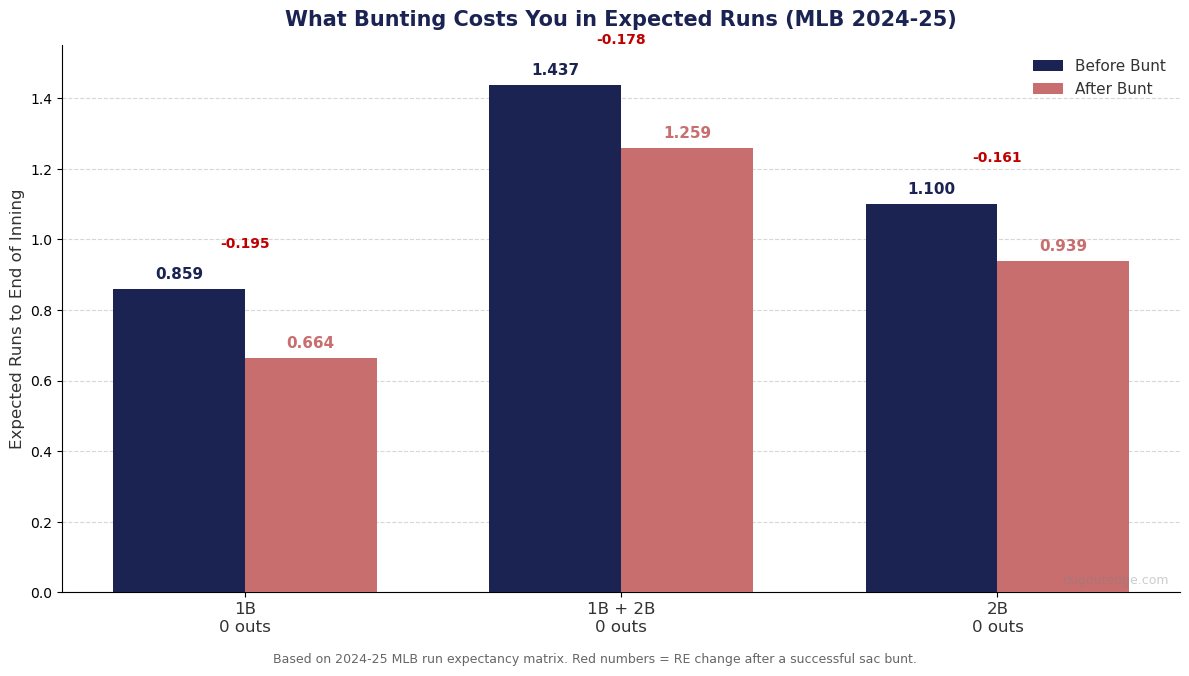
The chart above shows the three most common sacrifice bunt situations and what the data says about each one. Every bar pair shows the run expectancy before the bunt and after a successful sacrifice bunt. The red number is the change.
| Situation | RE Before Bunt | RE After Bunt | Change |
|---|---|---|---|
| Runner on 1st, 0 outs | 0.859 | 0.664 | -0.195 |
| Runners on 1st and 2nd, 0 outs | 1.437 | 1.259 | -0.178 |
| Runner on 2nd, 0 outs | 1.100 | 0.939 | -0.161 |
| Runner on 1st, 1 out | 0.511 | 0.305 | -0.206 |
| Runners on 1st and 2nd, 1 out | 0.883 | 0.570 | -0.313 |
| Runner on 2nd, 1 out | 0.664 | 0.360 | -0.304 |
Every single scenario costs runs. The most common bunt situation in baseball, runner on first with nobody out, costs nearly 0.2 expected runs on average. The first-and-second scenario costs a similar amount. Even the runner-on-second situation, which coaches often cite as a textbook bunt, costs more than 0.16 expected runs.
The one-out situations are worse. Bunting with a runner on first and one out is particularly damaging, because you are trading out number two for a base advance and leaving yourself with two outs and a runner on second. That is a situation with very limited ability to score multiple runs.
The problem is arithmetic. An out is the most expensive thing in baseball because outs end innings. When you sacrifice bunt successfully, you trade an out for a base advance. In most situations, the data says the out cost more than the base gained.
This is why MLB teams have dramatically reduced their bunting over the past two decades. In 2005, major league teams combined for roughly 1,831 sacrifice bunts across the season. By 2015 that number had fallen to approximately 1,012. By 2023 it was around 548, a 70 percent decline. Front offices built around analytics figured this out and stopped doing it. The coaches who kept bunting were voluntarily giving away outs.
Where the Math Changes
The data above is the general case. But general cases have exceptions, and this one has meaningful exceptions that matter for your decision framework.
You need exactly one run and it is late in a close game.
There is one situation where the math shifts a little: late in a close game when you need exactly one run. In that situation, moving a runner to second or third with an out to spare can be worth it. The chance of scoring at least one run goes up slightly. That is the only scenario where bunting moves the math in your favor, and even then, it depends on who is hitting.
This only applies when you need exactly one run, when the game situation makes a big inning essentially irrelevant, and when the extra base advance meaningfully improves your scoring probability. It does not apply in the first inning or when you are down by more than one run.
Your pitcher is hitting.
In leagues without a universal DH, this is the clearest case for bunting. Your pitcher at the plate is extremely likely to make an out anyway. A pitcher swinging away produces an out most of the time without the base advance. A pitcher bunting produces an out with the base advance. The expected value of the bunt is better specifically because the batter's offensive capability is close to zero.
At youth levels, this logic extends to your weakest hitters. The data assumes a league-average hitter at the plate. If your batter is not league-average, the cost of the bunt is lower relative to the alternative.
Your batter is weak and your runner is fast.
If your runner is exceptionally fast, his probability of scoring from second on a single is higher than the average runner in the dataset. That makes the second base advance more valuable than the numbers suggest. If your batter is significantly below average, swinging away is worth less than the data assumes. The combination of a fast runner and a weak hitter moves the bunt decision from "almost never" toward "worth considering."
Bunting against a heavy shift.
If the defense is dramatically shifted toward the pull side, a well-placed bunt toward the open side becomes a hit attempt, not an out trade. You are trying to get on base, not sacrifice an out. The math here is completely different. This is not the traditional sacrifice bunt situation.
Youth Baseball Is a Completely Different Game
Everything above is based on MLB data. Youth baseball, particularly at the 8-14 age range, operates under fundamentally different conditions that change the calculus in important ways.
Fielding errors happen far more often. In MLB, a well-placed sacrifice bunt succeeds at a high rate because professional infielders can field the ball cleanly almost every time. At youth levels, the defense mishandles bunt attempts far more frequently. An error on a bunt attempt can put two runners on base instead of advancing one. When the defense's error rate on bunt plays is meaningful, the offensive value of the bunt attempt increases because the expected outcome is better than the clean-fielding scenario assumes.
Walks are cheap and plate appearances have different value. Many youth pitchers at the younger age brackets cannot reliably throw strikes. When a pitcher is walking batters at a high rate, plate appearances have intrinsic value independent of what the batter does. Each at-bat is an opportunity for the walk, the wild pitch, or the passed ball. Burning that plate appearance on a sacrifice bunt discards the walk potential entirely. At these ages, the value of simply getting to the plate and making the pitcher work is often higher than any base advance the bunt could produce.
Pitchers are harder to score against in different ways. At youth levels, dominant pitching tends to come from velocity and unpredictability rather than location. A pitcher who is dominant because he throws hard is harder to score against with contact. A pitcher who is dominant because he hits spots is the MLB scenario the data assumes. The game theory differs accordingly.
Speed advantages are amplified. Youth defenses have less range, slower reaction times, and less polished throwing mechanics. A fast runner's advantage at the youth level is larger than the advantage a fast MLB runner gets. A fast youth player on second base scoring on a single is close to automatic in many situations. That changes how much a base advance is worth.

The conclusion for youth coaches is not "ignore the MLB data." The conclusion is that the same analytical framework applies but with different inputs. For the related decision of whether to send a baserunner, the break-even math works the same way. See When to Steal: The Break-Even Math for the full framework. The general principle holds: bunting costs an out, and outs are expensive. But the specific numbers shift because your error rates, your pitching quality, and your run-scoring probabilities are all different from the MLB numbers.
A Note on This Data
The run expectancy data reflects MLB play. The numbers come from millions of plate appearances at the highest level of the sport. Error rates at that level are very low. Pitching quality is very high. Batters are professional hitters. The gap between youth baseball and MLB is large enough that these exact numbers do not apply directly to your 11-year-old league.
What does apply directly is the framework. Outs are expensive in every version of baseball. Base advances have value that can be compared against the cost of the out. Whether the bunt trade-off is a net positive or negative depends on the specific situation, the specific personnel, and the specific game context. The data gives you a starting point for that analysis, not a final answer.
The coaches who dismissed the analytics entirely kept bunting in situations where it cost them runs. The coaches who overcorrected and never bunted missed the legitimate situations where it helped. The goal is to understand what the data actually says, apply it to the game in front of you, and make better decisions than you would have made going purely on instinct.
Know the framework. Apply it to what you see. Your call.
In This Series
These articles use public MLB data to answer questions youth coaches actually ask:
- Do MLB Hitters Change Their Swing With 2 Strikes?
- Bat Speed Doesn't Matter As Much As You Think
- The 5-20 Degree Window: Attack Angle Explained
- What a Short Swing Actually Means
- Batting Average Is Lying to You About Your Hitters: What to Measure Instead
- Blasts: The Most Valuable Swing in Baseball
- How to Set Your Batting Order: What MLB Data Says
- When to Steal: The Break-Even Math
Run expectancy data from Tom Tango / Retrosheet multi-year MLB play-by-play research, consistent with FanGraphs and Baseball Savant published tables. Values represent 2024-25 MLB regular season averages. MLB sacrifice bunt trend data from Baseball Reference season totals. Analysis run April 11, 2026.
About the Author
Former Stanford baseball player and professional in the Seattle Mariners organization. 7 years in professional data analytics. Founder of Dugout Edge.
Tags
Ready to Generate Your Perfect Lineup?
Try our free softball and baseball lineup generator to create balanced, fair lineups in minutes.
Try Free Lineup Generator