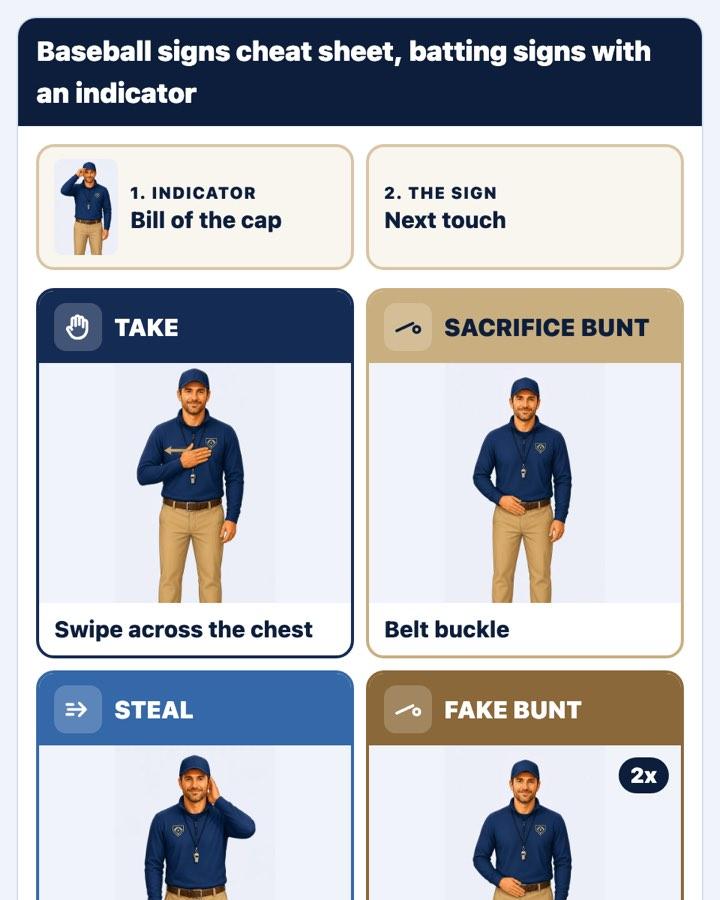
BattingFree
10U and up · 4 signs
Browse and pick signs for your youth baseball and softball team. Choose from dozens of simple, proven sign systems and print a free cheat sheet with examples.
Skip the setup and open a sample sheet to see how it works.
Print a finished sign sheet, or open it in the builder and change it.
10U and up · 4 signs
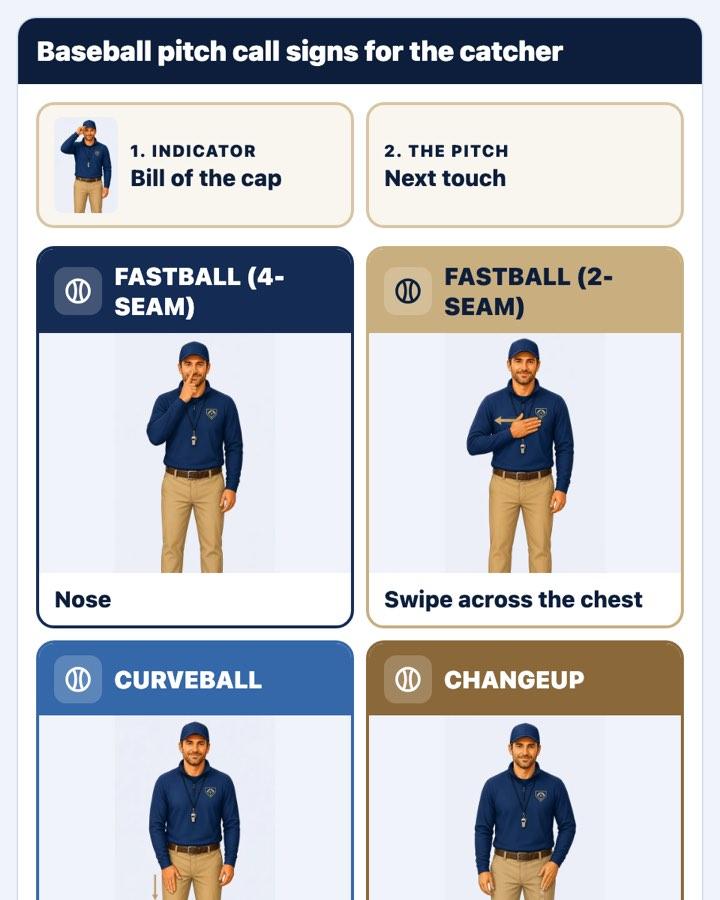
11U and up · 4 pitches
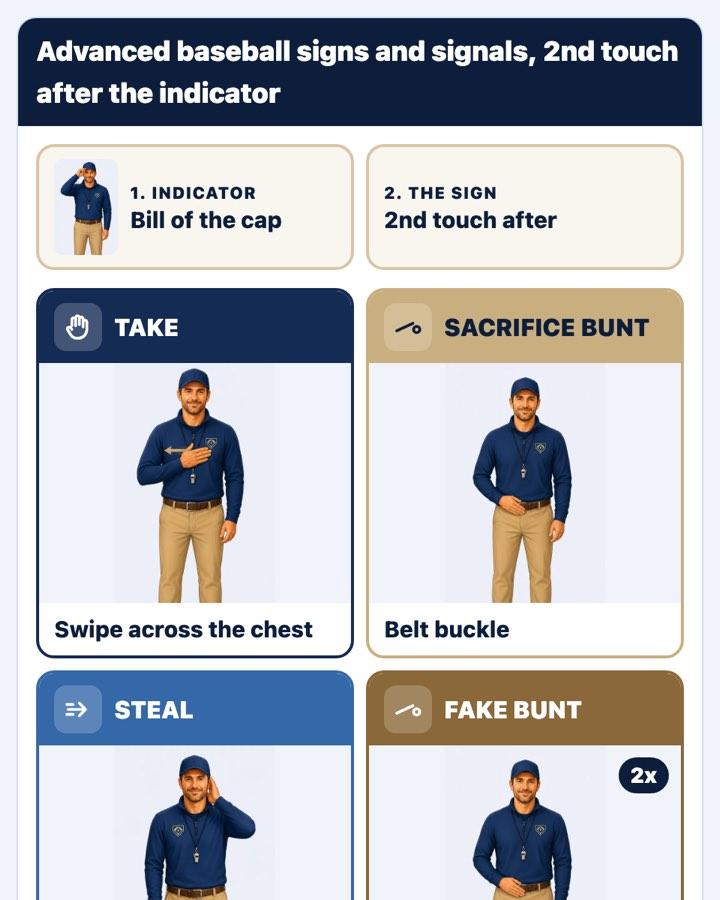
13U and up · 7 signs
More baseball sign sheets
The simplest system is one touch for one play: if the coach touches the belt, that is the steal. The next step up is an indicator: touch the indicator, and the next touch is the sign. A third way skips the indicator and makes the first, second or last touch the live one. A hot sign is the advanced version: it switches the signs on, and after it the first play touched is the sign, with decoy touches in between. Whichever you pick, your players should be able to say the rule in one sentence, like "the touch after the cap is the call."
Each touch is a sign by itself. Belt is steal, nose is bunt.
Example: Coach touches the belt: steal.
Fits: Practice drills. In a game, the other dugout reads it within a few pitches.
One touch says the sign is coming. The touch right after it is the sign; the rest are decoys.
Example: Ear, sleeve, cap, belt: the cap is the indicator, so belt (steal) is live.
Fits: Most youth teams once players can read a short sequence.
The hot sign switches the signs on. After it, the first play the coach touches is the sign, and any touches in between are decoys. Some teams use the 2nd or last play instead.
Example: Cap (the hot sign), chin, sleeve, belt: belt (steal) is the first play after the cap, so it is live.
Fits: Older teams whose players already read an indicator every time.
No indicator. The team agrees which touch in the sequence is live.
Example: Last touch: chin, belt, nose. Nose (bunt) is live.
Fits: Defensive calls that are a choice among set plays.
The wipe off cancels every sign before it. The repeat request asks the coach to give it again.
Example: Steal, then a wipe off across the chest: the runner stays.
Fits: Every team, at every level.
Keep the list short. Most youth teams need take, bunt and steal, plus a hit and run once the team can run one. Systems where players count touches are for older teams; with young players they are the most common reason a sign gets missed. Signs that go too fast are the next most common, so give them slowly and deliberately with younger kids.
The batter and the runners read the coach at the same time, so their signs need different touches. The batter's signs are take, bunt, and hit and run. The runner's signs are the steal, the delayed steal and, with runners on first and third, the double steal. Base coaches give those separately from the batter's sign.
Whether runners can lead off decides which plays exist. In Little League Majors and Minors a runner cannot leave the base until the pitch reaches the batter, so there is no lead to hold and no pitcher pickoff, but steals, delayed steals and catcher back-picks still happen. Most travel ball, Little League Intermediate 50/70 and up, and high school allow real leads, and the pickoff game opens up. Check your league's rules and set the switch to match.
Little League's coaching material has every player learn hold and go, and with younger kids the coach says it out loud too. A sign never replaces a voice at first base.
Signs are not only for the offense. A defensive sign picks one of a few set plays before the pitch, and every fielder knows their job from that one call. It can be a coach's touch, a call from the catcher, or a wristband number. Many youth teams run bunt defense on a verbal call from the catcher and third baseman.
The corners start at bunt defense depth and charge as the ball is bunted; where they finish is not where they line up. More in the bunt defense guide and the bunt defense rules.
With runners on first and third, the defense has to decide what happens when the runner on first goes. The usual calls:
Call it before the pitch. Young players decide slowly once the runner breaks, so the decision has to be made already. The first and third guide covers each play.
When a runner might go, the catcher can call a back-pick to first or third, or a pitchout. Pitcher pickoffs only belong in your signs if runners in your league can lead off. The pickoff signs guide has the timing plays.
When the coach calls the pitches, the sign travels twice. The coach signs the catcher with touches, disguised with a system just like the batting signs, because the other dugout is watching too. Then the catcher shows the pitcher fingers.
The catcher gives pitch signs between their legs, fingers tight to the inner thigh so the base coaches cannot see. A common starting set is one finger for a fastball, two for a curveball and three for a changeup. Put only the pitches your pitcher actually throws on the sheet.
A runner on second can see the catcher's fingers. That is when teams switch to a sequence, or to numbers on a wristband. The wristband signs generator builds those cards, with many numbers for every pitch so nobody can match a number to a pitch.
Pitch signs start once kids pitch. Coach pitch has no pitcher to call pitches to, so at that level signs are for the offense. More in the catcher signs guide.
Try three signs from a baseball sheet.
Read the coach
1 of 3The touch right after the indicator is the sign.
 IndicatorBill of the cap
 TakeSwipe across the chest
 Sacrifice buntBelt buckle
 StealLeft earFake buntTouch the belt twice
 Wipe offBrush the forearm
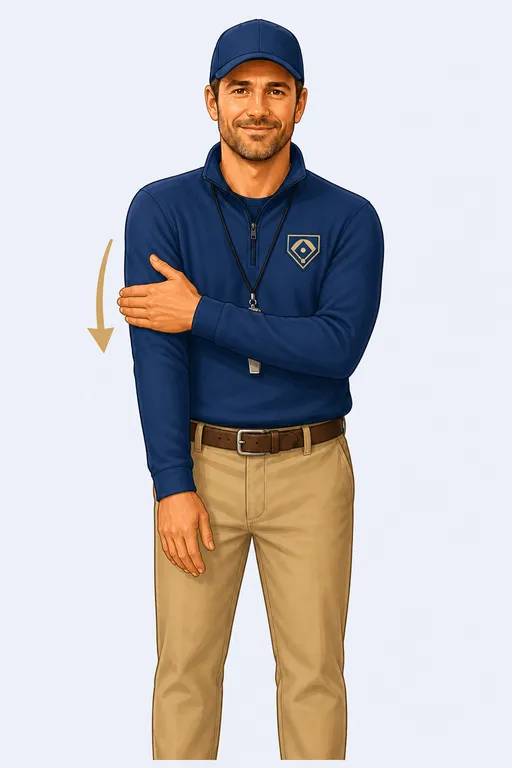 0 of 3
What's the call?
Players who miss signs usually miss them for the same few reasons: the system is too complex, they have to count touches, the coach signs too fast, nobody told them they could call time, or the wristband is on the wrong arm.
With a Dugout Edge membership your signs save to your team, and each player can get a link to the signs with a quiz on them.
Batter and runner signs work the same way in softball. Slap, bunt and the short game often matter more than a long sign menu, and wristbands with called numbers are common in fastpitch, for the offense and for pitch calls. The softball signs generator opens on softball, with the slap and slug bunt ready to add.
Most youth teams need only a few: take, bunt and steal, plus a hit and run once the team is old enough to run it. Add a wipe off that cancels everything before it, and a way for a player to ask for the sign again. Start with 2 or 3 live signs and add more only when players read those without thinking.
An indicator is a touch that tells the player the real sign is coming. If the indicator is the bill of the cap, the touch right after the cap is the sign and every other touch is a decoy. A hot sign goes one step further: it switches the signs on, and after it the first touch that is a play is the sign, even with decoy touches in between. Some teams use the 2nd or last play after the hot sign instead. With the youngest players, a touch number (the first, second or last touch) is the simplest system that still hides the sign.
It is a sign system with no indicator. The team agrees which touch in the sequence is live: the first, the second or the last. Everything else is a decoy. Coaches often use it for calls that are a choice among set plays, like which first and third defense to run.
Yes. The templates under the builder are finished sign sheets with a picture of the coach giving every touch. Batting signs with an indicator, pitch calls for the catcher and youth signs on the last touch print free. Each one opens in the builder, where you can change any touch before you print.
Yes. Print opens the sign sheet in your browser's print window. Choose Save as PDF as the printer to keep a copy you can email or text to your team.
The wipe off cancels every live sign given before it in that sequence. If the coach puts on a steal and then wipes it off, the runner stays. Every team should have one, because coaches change their minds between pitches.
Fingers between the legs, held against the cup so the base coaches cannot see them. A common starting set is one finger for a fastball, two for a curveball and three for a changeup; use only the pitches your pitcher actually throws. With a runner on second, who can see the catcher, switch to a sequence or wristband numbers.
Three common ones. Straight up: the corners charge and the second baseman covers first. Wheel: the third baseman charges and the shortstop rotates to third. Corners crash: the first and third basemen crash in on the pitch. Call it before the pitch with a touch, a catcher call or a wristband number.
Decide the play before the pitch, because young players decide slowly once the runner breaks. The usual choices are throw through to second, a middle infielder cutting the throw off in front of the bag, a fake throw, or going home when the runner from third breaks. The coach or catcher gives one call and everyone knows their job.
The batter and runner signs work the same way. The differences are on the bases and in the circle: in Little League Softball Majors and up runners leave on the release, some 12U leagues hold runners until the ball crosses the plate, and pickoffs come from the catcher rather than the pitcher. Wristbands with called numbers are common in fastpitch.
Ask for it again. Most teams use a repeat request, such as pointing at the coach and rolling the wrist, and the player calls time if they are still unsure. If the sign still is not clear, default to no play. Confusion costs more than not putting the play on.