The Wheel Play in Baseball: Who Goes Where, When to Run It, and When to Skip It
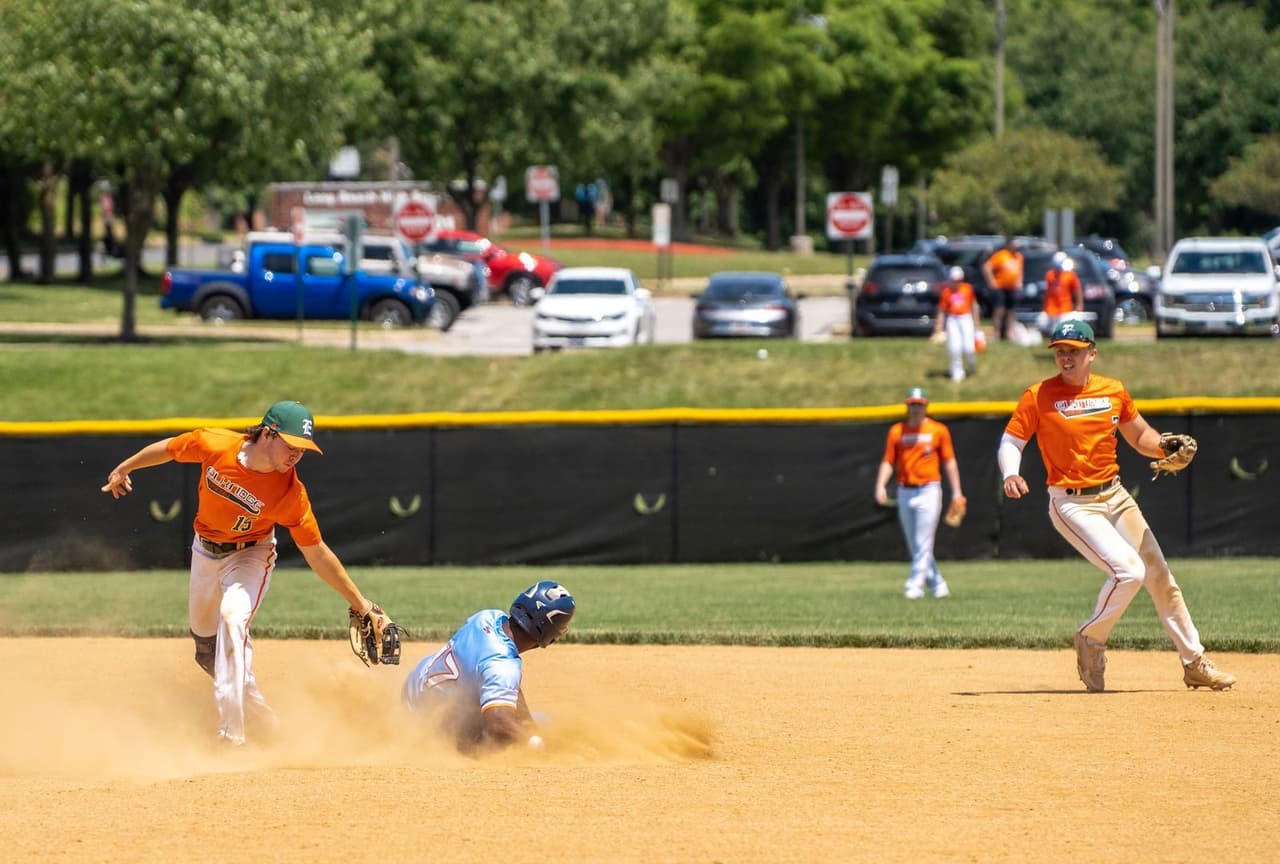
Runners on first and second, nobody out, and the batter at the plate is going to bunt. Everybody in the park knows it. You can give them the base and take the out at first, or you can try to take the lead runner away. The wheel play is how you try to take it away.
This guide covers what the wheel play is, who goes where, when to call it, what it costs you when it goes wrong, and an honest take on which youth levels should run it and which should keep a simpler coverage. For every other bunt situation (runner on first, runner on second, squeezes, drag bunts), the full position-by-position reference lives in our bunt defense handbook guide.
Quick answer: The wheel play (or rotation play) is a bunt defense for runners on first and second. The first and third basemen charge, the shortstop runs to third, the second baseman covers first, the pitcher breaks toward the third base line, and the center fielder covers second. The throw goes to third for a force on the lead runner. It works when the offense is certainly bunting and your infield has practiced it. It is risky against a team that will slash.
What the wheel play is
With runners on first and second, the sacrifice bunt is built to move both runners up. The offense is fine giving you an out at first as long as they get a runner to third with one out.
In a normal bunt defense, the third baseman has a problem. If he charges the bunt, nobody is at third to take a throw. If he stays home, bunts down the third base line sit there for the bunter. The wheel play solves that problem by sending the shortstop to third, which lets the third baseman crash the plate with no hesitation. Now two fast fielders are coming at the bunt, and a fielder is standing at third for a force play on the lead runner.
The name comes from the movement. At the pitch, the infield turns like a wheel: short to third, third to home, first in, second over to first.
Who goes where
Here is the wheel play next to a simpler standard coverage for the same situation, runners on first and second with a sacrifice coming.
| Position | Standard coverage | Wheel play |
|---|---|---|
| Pitcher | Fields bunts in front of the mound, takes the third base side if the third baseman stays home | Breaks toward the third base line after the pitch and owns that lane |
| Catcher | Fields bunts in front of the plate, calls the base | Fields bunts in front of the plate, calls the base ("Three" is the default) |
| First baseman | Charges, fields the first base side | Charges hard, fields the first base side |
| Second baseman | Covers first | Covers first |
| Shortstop | Holds the runner at second, covers second | Holds the runner, then breaks for third before the pitch and takes the throw there |
| Third baseman | Reads the bunt: stays at third if the pitcher can field it, charges if he cannot | Crashes the plate on the pitch, fields anything hard to the third base side |
| Left fielder | Backs up third | Backs up third |
| Center fielder | Backs up second | Charges in to cover second |
| Right fielder | Backs up first | Backs up first |
The timing that makes it work
The whole play lives or dies on the shortstop's break. Go too early and the runner at second sees it, or the offense takes the bunt off. Go too late and he is not at third when the throw gets there.
The common version: the pitcher comes set and looks back at second, the shortstop holds the runner close, then breaks for third, and the pitcher delivers as the shortstop goes. The third baseman starts in as the pitcher's front foot lands, and the first baseman does the same on his side. Some teams use a verbal or a count ("look, look, go") so the pitcher and shortstop are on the same clock. There is more than one way to time it; pick one and practice it until it looks the same every rep.
Where the throw goes
The catcher has the whole play in front of him, so he makes the call. On the wheel play, "Three" is the default because the throw is a force, no tag needed. If the bunt is dead on the line and the fielder has to turn his back to third, or the lead runner got a great jump, the call switches to "One" and you take the out at first. A fielder who hears "One" and throws to third anyway is how one bunt becomes a run.
When to put it on
Call the wheel play when all of these are true:
- Runners on first and second (the throw at third is a force only with first and second occupied).
- Nobody out, or one out in a game where the lead runner is the run that beats you.
- The bunt is coming. The batter is a weak hitter, the score and inning say sacrifice, or you have seen this coach bunt in this spot all season.
- Your infield has run it in practice. Run it with a live bunter enough times that the rotation is automatic.
If you want the other side of this decision, our breakdown of when to bunt, using run expectancy data shows why a sacrifice with runners on first and second usually costs the offense runs. That same math is why taking the sure out at first is not a bad result for your defense. The wheel play is you getting greedy on purpose.
The risks
The wheel play is aggressive, and every aggressive play leaves something open.
The slash. The offense shows bunt, your corners crash, and the batter pulls the bat back and swings. Now you have a ball hit hard at a third baseman who is sprinting toward the plate, and the holes at short and second are empty. Crashing corners must learn to read the hands: if the bat pulls back, stop, get low, and get the glove up. This is a safety issue before it is a strategy issue, especially on a 60 foot diamond where the corners end up very close to the hitter.
The empty middle. With the shortstop at third and the second baseman at first, a ground ball up the middle or a bunt pushed past the charging first baseman rolls into the outfield. A push bunt past the first baseman is the one that hurts most, because nobody is there to field it.
The steal and the pickoff. In leagues that allow leads, the runner at second can read the shortstop's break and take off for third, or the offense can run a fake bunt with a double steal. Many teams pair the wheel play with a pickoff look at second off the same setup, so the runner cannot count on the shortstop leaving. See our pickoff guide for how that fits in.
The throw to third. A rushed throw from a charging fielder to a shortstop running full speed toward the bag is not an easy play. If it gets by him, the left fielder had better be there, because otherwise a run scores and the trail runner is on third.
Which youth levels should run it
This is where most wheel play articles stop being useful to youth coaches. Here is our honest take, level by level. Every team is different, so treat it as a starting point, not a rule.
9 and 10, kid pitch. Skip it. At this age most innings end on a walk, a passed ball, or an error, not a bunt. The best bunt defense for a 10 year old team is: field it, look at first, throw it to first. Spend the practice time on catching and throwing, which will save you more runs than any rotation play.
11 and 12, Little League Majors and similar 60 foot fields. Teach the standard coverage first. If you have a real shortstop, a pitcher who fields his position, and corners who can stop and get low on a fake bunt, the wheel play can be a special play you pull out a few times a season. One thing works in your favor here: Little League and most rec leagues do not allow runners to leave the base until the pitch reaches the batter, so the runner at second starts on the bag and the shortstop does not have to worry about him taking off early. The other thing works against you: on a 60 foot diamond with a 46 foot mound, charging corners end up very close to the hitter, so the slash read matters even more.
12U and 13U travel ball. Travel ball usually allows leads, so the runner at second can get a big jump the moment the shortstop leaves. The play still works, but the pickoff look at second has to be part of the package, or good teams will run on you.
13 and up on a 90 foot field, and high school. This is the wheel play's home. The lead runner has 90 feet to cover, which gives a hard-charging corner time to field and throw, the infielders have the arm strength to make the throw, and teams bunt in these spots often enough that the play earns its practice time.
If you are not sure your team is ready, the test is simple. Run it live at practice ten times with a coach bunting and a coach sometimes slashing. If the throw to third is on target and the corners stop on the slash most of the time, put it in. If not, keep the standard coverage and take your out at first.
How to practice it
A wheel play practice needs a bunter, runners at first and second, and the full infield plus center fielder. Start slow with a coach rolling the ball so the rotation gets clean, then add a live bunter, then add the slash. The bunt defense handbook guide has a team bunt defense drill and a two-ball communication drill you can build around it.
Put it in its own block in the practice planner so it gets reps every week during the part of the season when you will need it, not just the day before a tournament. The drill library has more infield and bunt work to fill out the block.
One lineup note: the wheel play only works with the right kids at shortstop, pitcher, and the corners. If you rotate positions for playing time, you may have innings where you simply do not have the personnel to run it, and that is fine. Check your inning-by-inning fielding plan from the lineup generator before the game so you know, before the bunt comes, which innings the wheel is available and which innings you are taking the out at first.
The takeaway
The wheel play is a good play for the right team in the right spot: runners on first and second, a bunt that everyone can see coming, and an infield that has practiced the rotation until it is automatic. Its cost is real. It opens the middle of the field, invites the slash, and needs a clean throw to a moving target. Most youth teams will win more games with a simple coverage that gets an out every time. Teach that first, and add the wheel play when your players are ready for it.
About the Author
Youth and high school baseball and softball coaches focused on player development, fair playing time, and helping coaches run better games.
Tags
Ready to Generate Your Perfect Lineup?
Try our free softball and baseball lineup generator to create balanced, fair lineups in minutes.
Try Free Lineup Generator