Youth Baseball Signs: A Simple Sign System for Little League Teams
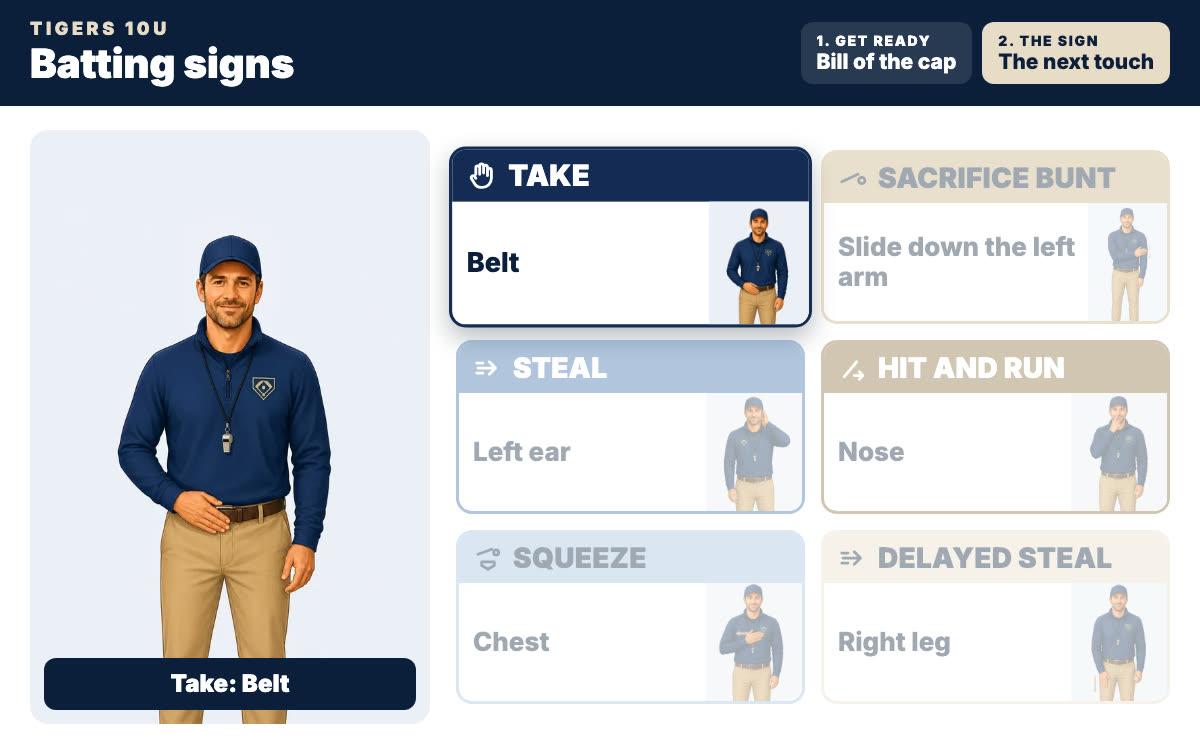
A sign tells your batter and your runners what to do on the next pitch. For a youth team the goal is simple: every kid reads the sign right, every time. A simple system that every kid on the team reads beats a clever one that half the team misses.
This guide covers which signs a youth team needs, which system fits each age, and how to teach signs so they stick.
The signs a youth team needs
Start with three:
- Take: the batter lets the pitch go.
- Sacrifice bunt: the batter bunts to move the runner.
- Steal: the runner goes.
That covers most youth games. Add a fake bunt once your hitters can bunt. Add a hit and run once your team can run one in practice. A short list keeps the signs easy to read, and every kid on the team can learn it in a week of practice.
Every set also needs two keys:
- A wipe off. A brush of the forearm cancels every sign before it. Use it when you change your mind.
- A way to ask again. If a player misses the sign, they spin both fingers around each other, and the coach gives it again. Tell your players they can always call time if they are still unsure.
Which sign system fits each age
A sign system is the rule for which touch counts. Pick the one your youngest player can read.
| Age | System | How players read it |
|---|---|---|
| Tee ball and coach pitch | Say it out loud | The coach tells the runner "go" or "stay" |
| 8U to 10U | Last touch (or first touch) | The coach gives a few touches. The last one is the sign. |
| 10U to 14U | Indicator | A touch, often the bill of the cap, says the next touch is live. Everything before the indicator is a decoy. |
| 13U and up | Hot sign | After the hot sign, the first play the coach touches is the sign, with decoys in between. |
Leave counting systems, such as "the number of touches is the play," for high school teams. Counting touches is one of the most common reasons young players miss a sign.
Coaches disagree on the exact ages, and that is fine. Plenty of 9U teams read an indicator well. Move up when your players read the current system right every time.
Leadoff rules decide which plays you need
Check your league's leadoff rule before you build a steal sign. In Little League Majors and Minors, a runner cannot leave the base until the pitch reaches the batter. Steals still happen, so your steal sign still matters, but there are no leads to hold and no pitcher pickoffs to worry about.
In Little League Softball Majors and up, runners leave on the pitcher's release. Some 12U softball leagues hold runners until the ball crosses the plate, so check yours.
A ready cheat sheet for 9U and 10U
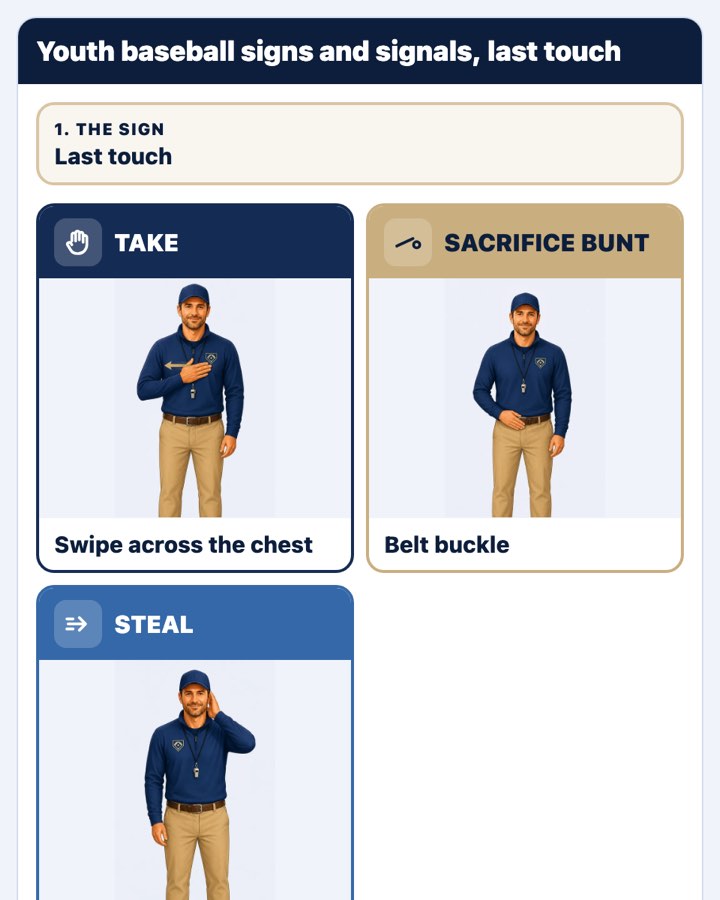
This is the sheet I would hand a 9U or 10U team. The last touch is the sign.
| Play | Touch |
|---|---|
| Take | Swipe across the chest |
| Sacrifice bunt | Belt buckle |
| Steal | Left ear |
| Wipe off | Brush the forearm |
So if the coach touches the nose, then the chest, then the left ear, the left ear is last. That is a steal.
Try reading a few yourself.
Read the coach
1 of 3The last touch is the sign.
 TakeSwipe across the chest
 Sacrifice buntBelt buckle
 StealLeft ear
 Wipe offBrush the forearm
0 of 3What's the call?
You can print this sheet for free, or change the touches to your own, in the baseball signs builder. Softball coaches can start from the softball signs builder.
How to give signs to young players
- Go slow. Young players need time to see each touch. Give signs slowly and deliberately.
- Give signs on every pitch. Run through a few touches before every pitch, even when nothing is on. Players learn to look every time.
- Stand in the same spot. Give signs from the same place in the coach's box, so players know where to look.
- Have players look at you after every pitch. The batter steps out, finds the coach, gets the sign and steps back in.
Teach your whole team to read the signs
Every player on the team should know the signs, including the kids on the bench. Have the dugout follow along on every pitch and read the sign with the batter. A bench that reads every sign stays in the game, and the next batter walks up already knowing the system.
Practice signs the same way you practice ground balls:
- Spend five minutes at every practice giving signs and having players call out the play.
- Use your real signs in scrimmages, so players read them at game speed before a game asks them to.
- Before each game, quiz small groups on the live signs.
What to run at your next practice
Line your team up along the third base line. Give ten sets of signs from the coach's box. After each set, the whole line calls out the play together. Then pick one player to give the signs while the coach reads them. Giving the signs is one of the fastest ways for a kid to learn them.
Tags
Build Your Team's Signs
Pick a sign system, set each play to a touch, and print a sign sheet with the coach doing every touch.
Open the Signs Builder