How to Keep Score in Baseball: A Step-by-Step Guide for Youth Coaches
Nobody hands you a scorebook and explains what to do with it. You show up to your first game as a coach, someone points at a clipboard with a grid on it, and says "you're scoring today." Then you spend the next two hours pretending you know what you're doing.
Keeping score in baseball is one of those skills that looks complicated from the outside and turns out to be surprisingly logical once someone walks you through it. This guide does exactly that. By the end, you will know every symbol, how to mark every type of at-bat, how to track pitch counts, and how to use a digital scoreboard when a paper book is not practical.
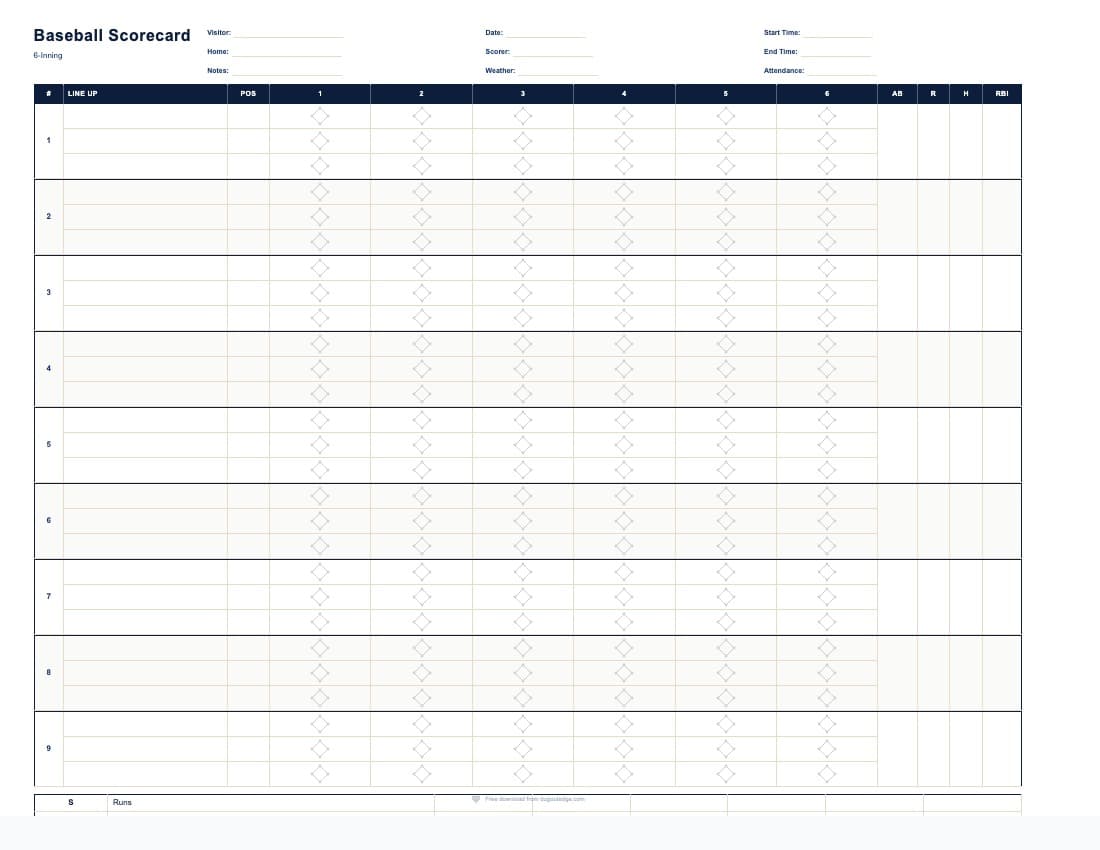
Scoring by hand is a real skill and this guide teaches it. Print a free scorecard and work through the game below.
Or skip the notation entirely. Game Day keeps score from your phone with button taps, no symbols to learn, and builds the box score for you. Free, no account needed to start.
The 5-Step Scorekeeping Workflow
If you are scoring a game in the next hour, this is the whole job. Everything after this section is detail.
- Write the lineup before first pitch. Full name, not just a jersey number, plus batting order slot and defensive position. Do it ten minutes before game time. Writing it in after the first pitch means you are already behind.
- Record the at-bat result in the diamond cell. Use the short code from the symbol table below. Quick beats elegant. Shortstop fields it and throws to first: write 6-3 and move on.
- Trace runners around the bases. Fill in the corner of the diamond for each base a runner reaches, and shade the middle when they score. Later you can see the whole path at a glance, which is what settles an argument about an RBI.
- Total each half inning before the next one starts. Runs, hits, errors and left on base go in the totals row the moment the inning ends. Do not wait. You will not remember who was on second with two outs.
- Finalize after the last out. Sign the card. Tally batting (AB, R, H, RBI) and pitching (IP, H, R, ER, BB, SO, pitch count). Keep it or photograph it, because next practice can use what actually happened.
What Is a Baseball Scorecard?
A baseball scorecard is a grid that records everything that happens in a game. Across the top are innings (usually 6 for youth leagues). Down the left side is your batting order, every player in the lineup, in order. Each box in the grid represents one player's turn at bat in one inning.
Inside each box, you draw a small diamond. The four corners of the diamond represent the four bases: bottom is home, left is first, top is second, right is third. When a player reaches a base, you mark that corner. When they score, you fill in the diamond.
That is the entire structure. Everything else is just notation inside that box.

The Basic Symbols Every Scorekeeper Needs to Know
You do not need to memorize every official scoring symbol on day one. These are the ones that cover 95% of what happens in a youth baseball game.
Position Numbers
Every fielder has a number. When a ball is fielded and thrown for an out, you record the position numbers of everyone who touched the ball.
| Number | Position |
|---|---|
| 1 | Pitcher |
| 2 | Catcher |
| 3 | First Baseman |
| 4 | Second Baseman |
| 5 | Third Baseman |
| 6 | Shortstop |
| 7 | Left Fielder |
| 8 | Center Fielder |
| 9 | Right Fielder |
A groundout to the shortstop thrown to first is written 6-3. A flyout caught by the center fielder is simply 8.
At-Bat Results
| Symbol | Meaning |
|---|---|
| 1B | Single |
| 2B | Double |
| 3B | Triple |
| HR | Home Run |
| K | Strikeout (swinging) |
| K (backwards) | Strikeout (looking) |
| BB | Walk (base on balls) |
| HBP | Hit by pitch |
| E + number | Error (E6 = error by shortstop) |
| FC | Fielder's choice |
| SAC | Sacrifice bunt |
| SF | Sacrifice fly |
Situational Symbols
| Symbol | Meaning |
|---|---|
| WP | Wild pitch (runner advances) |
| PB | Passed ball (runner advances) |
| SB | Stolen base |
| CS | Caught stealing |
| DP | Double play |
How to Score Each Type of At-Bat
Single
The batter hits the ball and reaches first base safely.
- Write 1B in the at-bat box
- Mark the lower-left corner of the diamond (first base reached)
- If they advance later, mark the next corners as they touch each base
Strikeout
Write K in the box. If the batter struck out looking (did not swing), some scorekeepers write a backwards K. Either is fine at the youth level, just be consistent.
Groundout
Write the fielding sequence. A groundout to the second baseman thrown to first is 4-3. A groundout to the pitcher thrown to first is 1-3.
Draw an X or line through the box to indicate the out.
Walk
Write BB in the box and mark the lower-left corner of the diamond. The batter is on first.
Error
Write E followed by the position number of the player who made the error. E6 means the shortstop made an error. The batter still reaches base, so mark the corner they reached.
Home Run
Write HR and fill in the entire diamond, all four bases touched plus home plate. This is the most satisfying mark in the scorebook.
Fielder's Choice
Write FC. A fielder's choice means a fielder got a different runner out instead of the batter, so the batter reached base. Mark the corner they ended up on.
Tracking Runs, RBIs, and Outs
Runs scored: When a player touches home plate, circle the diamond in that player's box. At the end of each inning, count the circles in that column to get the inning's run total.
RBIs: Next to the at-bat notation, some scorekeepers add a small number indicating RBIs. Write 1B (1) for a single that drove in one run, 2B (2) for a double that drove in two. This is optional at the rec level but useful if you track stats.
Outs: At the bottom of each inning column, keep a running tally. Mark each out as it happens. Three marks means the inning is over. This sounds obvious until you lose count in a long inning.
How to Track Pitch Counts While Scoring
At youth levels, pitch counts matter for arm health and league rules. Many leagues require coaches to track and report pitch counts per pitcher per game.
The simplest method: every time your pitcher throws a pitch, make a small tally mark in the margin next to their name in the lineup. Group them in fives (four vertical marks, one diagonal). At the end of each inning, count and note the total.
If you are using a paper scorebook, designate a column for pitch counts. If you are using a digital tool, the Dugout Edge Pitch Count Tracker handles this automatically and alerts you when a pitcher approaches the limit for their age group.
Using a Digital Scoreboard Instead of Paper
A paper scorebook is the traditional approach, but it has real limitations on game day. It requires someone dedicated to scoring who is not also coaching, managing the dugout, or dealing with parents. Rain ruins it. Bright sunlight makes it hard to read. And if you are coaching alone, it is nearly impossible to score and coach simultaneously.
A digital scoreboard solves the portability problem. The Dugout Edge Virtual Scoreboard runs in your browser on any phone or tablet. You tap to update the score, track outs and innings, and display it for both benches without needing to yell across the field.
For tracking detailed individual stats and pitch counts, the Dugout Clicker gives you a fast tap interface designed for game-speed data entry.
Neither replaces the discipline of learning to score properly, understanding the symbols and notation makes you a better scorekeeper in any format. But for the parent coach running the game alone, digital tools are a practical upgrade.

The 4 Mistakes New Scorekeepers Make
- Waiting to total innings. Fill the totals row the second the inning ends. By the top of the fourth you will not remember.
- Charging an error that is actually a hit. If the defender had to make a hard play, it is a hit. Only charge an error when a routine play was missed.
- Forgetting the pitch count. Most leagues require a running total per pitcher, and a missing count is a forfeit waiting to happen. See the pitch count rules by age if you are unsure what your league requires.
- Trying to look like the pros. The elaborate notation you saw on TV is not required. Your future self just needs to read what you wrote. Clean beats clever.
Common Scoring Questions
What is the difference between an error and a hit?
If the official scorer judges that a routine play was mishandled and would have resulted in an out with ordinary effort, it is an error. The batter reaches base but does not get credit for a hit, and the pitcher is not charged with it. If the play was difficult enough that most fielders would not have made it, it is a hit. At the youth level, this judgment call is yours as the scorekeeper. When in doubt, be generous, errors that discourage young fielders serve no one.
Does a walk count as an at-bat?
No. A walk (BB), hit by pitch (HBP), sacrifice bunt (SAC), and sacrifice fly (SF) do not count as official at-bats. They are plate appearances but not at-bats. This matters when calculating batting average: hits divided by at-bats, not plate appearances.
What is a sacrifice fly?
A sacrifice fly is a fly ball caught by an outfielder that is deep enough for a runner on third to tag up and score. The batter is out, but the run counts and the batter is not penalized in their batting average. Write SF in the box.
What if two fielders are involved in an out?
Write both position numbers in sequence. 6-3 means the shortstop fielded and threw to first. 5-4-3 means the third baseman threw to second for one out, and second threw to first to complete a double play.
How do I score a dropped third strike?
If the catcher drops the third strike and the batter reaches first, it is scored as a strikeout (K) but the batter is not out. Mark the K and the base they reached. This only applies when first base is unoccupied or there are two outs.
What if I make a mistake?
Cross it out neatly and write the correction next to it. Official scorers do this all the time. The scorebook is a record, not a test.
Your Scorekeeping Toolkit
Paper: Any standard baseball scorebook works. The spiral-bound books available at most sporting goods stores have everything you need, including a template for lineup entry and space for pitch counts.
Digital, still by hand: Print a free scorecard and score it the way this guide describes. The Virtual Scoreboard puts the runs, outs and inning on a screen both benches can see, which is a different job from keeping the book.
Digital, no notation: If none of this appeals and you just want the result, Game Day scores from your phone with button taps. You never write a 6-4-3; it builds the box score, batting lines and pitch counts for you. Free in the browser, no account needed to start.
Shortcut: If you need to score quickly on a phone without a dedicated tool, keep a simple notes app open and track the score and outs by inning. It is not pretty, but it works in a pinch.
The more games you score, the faster and more automatic the notation becomes. After a full season, you will mark a 6-4-3 double play without thinking about it. That is the point.
The rest of the scorekeeping guides:
Learn the notation
- Baseball Scorekeeping Symbols: Complete Cheat Sheet, every symbol on one page
- How to Keep Score in Softball, the softball version, including DP/FLEX and illegal pitch notation
Score it on paper
- Free printable baseball scorecards, 7-inning, 9-inning, tournament and high school variants
- Printable baseball scorebook, a bound season-long book you generate and print
Score it on a phone
- Game Day scoring app, button taps instead of notation, with an automatic box score
- Best baseball scorekeeping apps for youth coaches, how the options compare
Rules you will need while scoring
- Pitch count rules by age, every league limit and rest requirement
Tags
Score Your Next Game Free
Game Day scores live from your phone: runs, outs, baserunners, pitch counts. Free, in your browser, no account needed to start.
Try the Free Scoring App