Baseball Scorekeeping Symbols: Complete Cheat Sheet for Every Notation
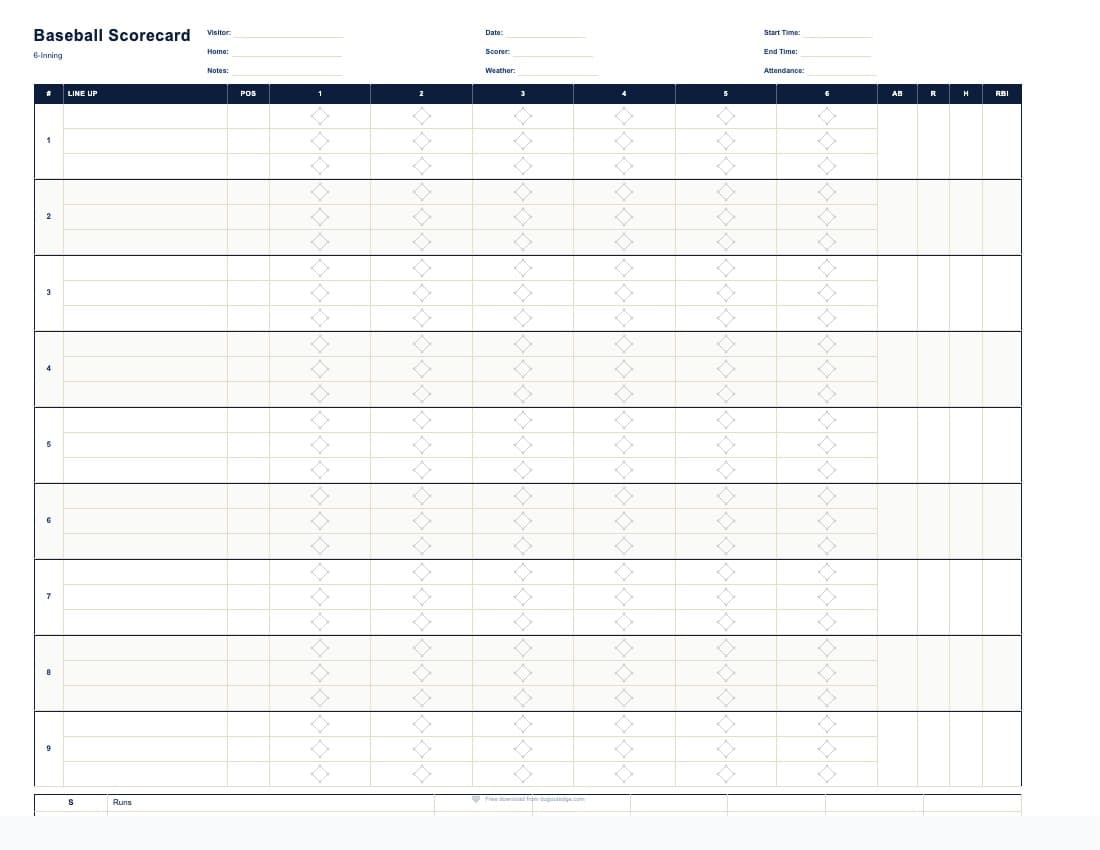
Every baseball scorekeeping symbol you will ever use, in one place. This is the reference you keep in the back of your scorebook for the six times a year someone hits into a rare play and you need to know whether it counts as a hit or an error.
Start with the basics in Part 1. Part 2 covers the situational stuff. Part 3 handles the judgment calls that even experienced scorers argue about.
Our digital scorebook picks the right notation for you automatically. Tap the at-bat result, the app writes the symbols. Join the early-access waitlist.
Do not want to memorize notation? Game Day records the play when you tap the result: runs, outs, baserunners, pitch counts. Free, in your browser. Open the free scoring app.
Want the printable? Download the one-page baseball scorekeeping cheat sheet (PDF), built to fold into the back of a scorebook. Or jump to the same thing as a table. The rest of this page explains what each mark means and when to use it.
Part 1: The Essentials
These are the ~20 symbols that cover 95% of every game. If you learn only these, you can score a complete game cleanly.
Batting Order & Positions
Every defensive position has a number. Write the number in the batting order row for the position each player is playing in that inning.
| Number | Position |
|---|---|
| 1 | Pitcher |
| 2 | Catcher |
| 3 | First Base |
| 4 | Second Base |
| 5 | Third Base |
| 6 | Shortstop |
| 7 | Left Field |
| 8 | Center Field |
| 9 | Right Field |
| DH (or 10) | Designated Hitter |
When you write a play like "6-4-3 DP," you are saying the shortstop fielded the ball, threw to the second baseman for the force at second, who threw to the first baseman for the double play.
Strikeouts and Walks
- K: Swinging strikeout. The batter swung at strike three.
- ꓘ (backwards K): Called strikeout. The umpire called strike three with the batter not swinging.
- BB: Base on balls (walk). Four balls before three strikes.
- IBB: Intentional walk. The pitcher deliberately threw four balls.
- HBP: Hit by pitch. Batter awarded first base.
Hits
- 1B: Single. Write inside the diamond and mark the first-base corner.
- 2B: Double. Write and mark bases 1 and 2.
- 3B: Triple. Write and mark bases 1, 2, and 3.
- HR: Home run. Write and fill in the entire diamond.
Outs on Balls in Play
Format: [play type][fielder number(s)]
- F#: Fly out caught by that outfielder. F7 = fly out to left field.
- P#: Pop out to that infielder or catcher. P2 = pop out to the catcher.
- L#: Line out to that fielder. L4 = line out to second baseman.
- G#-3: Groundout fielded by # and thrown to first base. G6-3 = shortstop to first.
- U#: Unassisted out. U3 = first baseman unassisted. Used when one fielder records the out without throwing.

On-Base via Defense Mistake
- E#: Reached on error by that fielder. E5 = error by third baseman. Does not count as a hit; does count as a time on base.
- FC: Fielder's choice. The batter is safe because the defense chose to get another runner out. Does not count as a hit.
- DFO: Dropped fly, batter out. The fielder dropped it but the umpire ruled intentional, so the batter is still out. Rare.
Base Running
- SB: Stolen base
- CS: Caught stealing (recorded on the runner, not the batter)
- WP: Wild pitch (runners advance because of it)
- PB: Passed ball (catcher's fault; runners advance)
- BK: Balk (illegal pitching motion; runners advance)
- DI: Defensive indifference. Like a stolen base, but the defense chose not to throw. Does not count as a stolen base.
Sacrifices
- SAC (or SH): Sacrifice bunt. Batter out, runner advanced.
- SF: Sacrifice fly. Fly ball out, runner scored from third.
Part 2: Situational and Multi-Play Notations
Multi-Fielder Outs
Write the fielder numbers separated by hyphens, in the order they touched the ball:
- 6-4-3 DP: Shortstop to second baseman to first baseman double play.
- 5-4-3: Third baseman to second baseman to first baseman groundout (sometimes a DP).
- 1-6-3: Pitcher to shortstop to first baseman (common on a ball hit back at the pitcher with a runner on first).
- 3-2-3: First baseman to catcher to first baseman (pickoff or rundown).

Rundowns
- 3-6-3: First baseman to shortstop to first baseman. The batter or runner is caught in a pickle.
- Write the chain until the out or the run scores.
Double and Triple Plays
- DP: Double play (any type). Often paired with the fielder chain: "6-4-3 DP"
- TP: Triple play. Write the fielder chain: "5-4-3 TP."
Rare Results
- IF: Infield fly rule called. Batter automatically out, runners may still advance at risk.
- INT: Interference (by batter, runner, or fielder). Depends on context.
- OBS: Obstruction (fielder impeding a runner). Runner awarded a base.
- RBO: Running bases out of order. Very rare.
Part 3: Judgment Calls and Advanced Rules
These are the plays where two experienced scorekeepers will disagree. The official scorer's call is the one that goes in the book; other scorers record the play as they read it and move on.
Hit vs. Error
This is the most common judgment call. A rough rule of thumb:
- Clean fielding play that the fielder could "ordinarily" have made? → Error if the fielder botches it.
- Ball hit hard enough that a fielder barely touches it? → Usually a hit.
- Ball hit right at a fielder who can't handle it? → Error.
- Ball takes a weird hop? → Usually a hit.
- Fielder has to range unusually far? → Hit, even if they touch it.
When in doubt, most scorers lean toward "hit." It is the more generous call to the hitter and easier to defend in the scorebook.
Wild Pitch vs. Passed Ball
- Wild pitch (WP): The pitch was too high, too wide or too low for the catcher to stop with ordinary effort, or it hit the ground or the plate before reaching him and he did not handle it. Charged to the pitcher. A ball in the dirt that gets by is a wild pitch even if you think the catcher should have blocked it (Official Baseball Rule 9.13(a)).
- Passed ball (PB): A pitch the catcher should have held with ordinary effort, and did not. Charged to the catcher (Rule 9.13(b)).
Score either one only when a runner moves up because of it. A ball to the backstop with the bases empty is just a ball or a strike.
Earned Run vs. Unearned Run
- Earned run: Scored by the offense without the help of an error. Counts against the pitcher's ERA.
- Unearned run: Scored because of a defensive error, muffed play, or catcher's interference. Does not count against ERA.
Rule of thumb: if the inning would have ended without the error, every run that scored from that point on is unearned.
Sacrifice vs. Bunt Single
- Sacrifice bunt (SAC): The batter clearly bunted with the intent of advancing a runner and is out at first. Does not count as an at-bat.
- Bunt single: The batter bunted and reached safely. Counts as a hit (1B).
The judgment: was the batter trying to advance a runner or get a hit? Usually obvious from context (runner on base, bunting stance early). When the bunt is a surprise or no runners are on, it is a bunt single.

The One-Page Cheat Sheet
Here is the whole thing in one table. The printable PDF version is the same content laid out for one page, to clip inside the back cover of your scorebook:
| Result | Symbol |
|---|---|
| Strikeout (swinging) | K |
| Strikeout (looking) | ꓘ |
| Walk | BB |
| Intentional walk | IBB |
| Hit by pitch | HBP |
| Single | 1B |
| Double | 2B |
| Triple | 3B |
| Home run | HR |
| Flyout to [fielder] | F[#] |
| Groundout to first | G#-3 |
| Pop out | P[#] |
| Line out | L[#] |
| Reached on error | E[#] |
| Fielder's choice | FC |
| Sacrifice bunt | SAC or SH |
| Sacrifice fly | SF |
| Stolen base | SB |
| Caught stealing | CS |
| Wild pitch | WP |
| Passed ball | PB |
| Balk | BK |
| Double play | DP |
| Triple play | TP |
| Infield fly | IF |
| Interference | INT |
| Obstruction | OBS |
Learn the Fast Way: Score a Full Game
The fastest way to internalize these symbols is to score a complete televised game. Pause the broadcast between plays, make the notation, then keep going. By the end of a 3-hour game, you will have seen almost every common play type at least once. After 2-3 games, the symbols become automatic.
What to Download
- How to score a baseball game: the full walkthrough these symbols belong to
- Free printable baseball scorebook: the scorecard itself, with room to use every symbol above
- Baseball Scorebook: every format (7-inning, 9-inning, Little League, High School)
- Pitch count chart: Little League rest-day lookup table
Related Guides
- How to Keep Score in Baseball: step-by-step for your first game
- How to Keep Score in Softball: softball-specific version of this guide
- Baseball Scorekeeping Sheet: printable sheet to use alongside this cheat sheet
Tags
Score Your Next Game Free
Game Day scores live from your phone: runs, outs, baserunners, pitch counts. Free, in your browser, no account needed to start.
Try the Free Scoring App