AI Assistant Coaches in Youth Sports: What Works, What Doesn't, and What's Coming
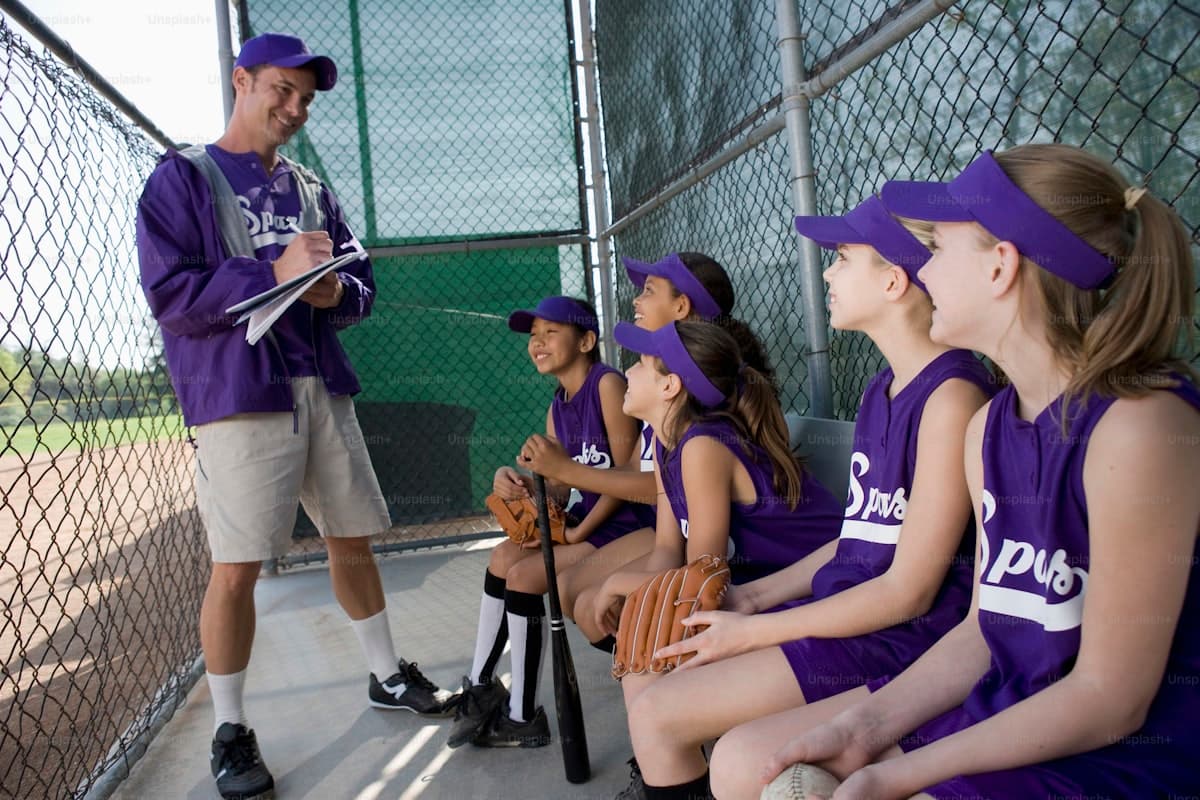
It is 10pm on a Tuesday night. You are sitting at the kitchen table with a napkin, a pencil, and a roster of 13 kids, trying to build a lineup for Saturday's doubleheader. Your shortstop's mom just texted that he has a birthday party during game two. Your best pitcher threw 45 pitches on Sunday so he is probably available, but you need to check the league's rest rules. And you still have not figured out what to do about the kid who cried last week because he played right field two games in a row.
Sound familiar? If you coach youth baseball or softball, this is your life. You volunteered because you love the game and wanted to help kids, and somehow you ended up doing spreadsheet work at 10pm.
Meanwhile, AI is everywhere. It writes emails, generates images, passes the bar exam. Coaches are searching for an AI lineup generator that can handle their Saturday doubleheader or an AI practice planner that can build a drill schedule in seconds. So the natural question is: can AI actually help you coach? Can you ask it to build your lineup, plan your practice, or figure out what to do with a kid who is afraid of the ball?
The answer is more interesting than a simple yes or no. AI is genuinely useful for youth coaches right now, but not in the ways most people expect. And the gap between what AI knows and what it can actually do for your specific team is the most important thing to understand about this technology.
This article is an honest look at AI coaching tools in youth sports. No hype, no fear. Just a practical guide from people who build these tools and coach these kids.
What AI Actually Gets Right Today

Here is something that surprises most coaches when they first try it: AI knows a lot about baseball. Not in a superficial, Wikipedia summary kind of way. In a deep, practical, surprisingly useful kind of way.
Ask an AI like ChatGPT to explain the infield fly rule and you will get a clear, accurate answer. That is expected. But ask it something more nuanced, like "What are three drills to help a 9-year-old who is afraid of ground balls?" and the response is genuinely good. It will suggest starting with rolled balls from close range, using softer training balls, and building confidence through success before adding speed. That is solid coaching advice that many first-year volunteer coaches would not think of on their own.
The same applies to practice planning. Use ChatGPT as an AI practice planner by asking it to design a 90-minute practice for a 10U rec league team that focuses on base running and situational awareness, and it will produce a structured plan with warm-ups, drill progressions, water breaks, and a scrimmage at the end. The drills will be age-appropriate, the timing will be reasonable, and the flow will make sense.
AI is also surprisingly strong on rules knowledge. Youth baseball has a maze of rules that vary by league, age group, and organization. Pitch count limits, courtesy runner policies, batting order requirements, mercy rules. Coaches spend hours reading rulebooks or asking other coaches on Facebook. AI can answer most of these questions instantly and accurately, as long as you specify the league and age group.
Here are some real prompts that produce genuinely useful results:
"I coach 8U rec league baseball. Half my kids have never played before. Give me a practice plan focused on throwing mechanics and catching basics. Keep it to 75 minutes." The response will include a dynamic warm-up, partner throwing progressions, catching drills with proper technique cues, and a fun game to end practice. It will even include coaching tips like "use verbal cues like 'point your glove at the target' instead of explaining arm angles."
"My 12U team struggles with situational hitting. What are three drills to practice hitting behind the runner and moving runners over?" You will get specific drills with setup instructions, the coaching points to emphasize, and variations to make them harder as the team improves.
"Explain the difference between a balk at the 14U level vs. the MLB rule." AI will correctly note that most youth leagues are more lenient on balk calls and will explain the specific differences in how the rule is applied.
This is where general AI tools like ChatGPT genuinely shine today. The raw baseball knowledge is impressive, and for quick questions or brainstorming ideas, chatbots are a real advantage for volunteer coaches who may be learning the game alongside their players.
But here is the catch: a chatbot is a conversation, not a tool. It does not save your roster. It does not remember last week's practice. It does not know your league's rules unless you tell it every single time. Every session starts from zero. That is fine for one-off questions like "explain the infield fly rule." It falls apart fast when you need something you can use week after week, like a lineup tool that remembers your players or a practice planner that builds on your drill history.
The Context Gap: AI Does Not Know Your Team

Here is where things get honest. Everything in the previous section is true. AI is great at general baseball knowledge. But general knowledge is only half the coaching equation, and for most day-to-day decisions, it is the less important half.
The most critical coaching data does not live in any database or rulebook. It lives in your head.
You know that your shortstop freezes on hard grounders because he took a bad hop to the face in practice three weeks ago. You know that two of your outfielders are best friends who goof off when they are in the same group. You know that half the team skips Thursday practices because of soccer conflicts, which means your Thursday lineup looks nothing like your Saturday lineup. You know that one parent will complain if their kid plays catcher and another parent will complain if their kid does not pitch.
AI knows none of this. And without this context, every answer it gives you is generic.
Ask any AI lineup generator to build a lineup for your team and it will ask for positions and batting order preferences. But it will not know that your cleanup hitter had a meltdown last game and you want to take some pressure off by moving him down in the order. It will not know that your fastest runner is also your most unreliable fielder and you are trying to balance playing time with competitive positioning.
This is the context gap, and it is the single biggest limitation of AI in youth coaching today. AI without context is like an assistant coach who has read every coaching book ever written but has never met your players. The knowledge is impressive but the advice is impersonal.
Watch what happens when a coach tries to use ChatGPT for lineup building:
Coach: "I need a lineup for my 10U team. Here are my players and their positions."
AI: Produces a reasonable looking lineup based on standard baseball logic.
Coach: "Actually, move Tyler to the bench for the first three innings. He was late to practice twice."
AI: Adjusts the lineup.
Coach: "And I need to make sure Sophia pitches the first two innings because she has to leave early."
AI: Adjusts again.
Coach: "Oh, and Jake and Marcus can't bat back-to-back because they both swing at everything and I need someone with plate discipline between them."
By the fourth or fifth adjustment, the coach has done more work going back and forth with ChatGPT than they would have done just writing the lineup by hand. The chatbot is capable of following each instruction individually, but it cannot anticipate any of them because it does not know the team. It has no memory of your roster, no history of your previous lineups, and no understanding of your league's playing time rules.
This is the fundamental problem with using general purpose chatbots for coaching tasks. They are brilliant at answering questions, but they are terrible at doing the actual work. A chatbot can explain what makes a good lineup. It cannot build one that accounts for your team's specific dynamics, at least not without you manually entering every detail every single time.
Purpose-built coaching software with AI capabilities solves this differently. Instead of a blank conversation that starts from scratch, the tool already has your roster, your preferences, and your league's rules loaded in. The intelligence is built into the software itself, not into a chat window you have to manage.
The coaches who share this article with other coaches will probably be sharing it because of this section. It articulates the feeling most coaches have after their first ChatGPT experiment: "This is cool, but it does not know my team." The next realization is usually: "I need a tool that already knows my team."
The Data Bridge: When AI Meets Your Roster
The context gap is a real problem. But it is also a solvable one. And the solution is not a better chatbot. It is purpose-built coaching software that already knows your team.
The difference matters. ChatGPT and other general chatbots are like calling a baseball hotline staffed by someone who has read every coaching book ever written. They will give you solid general advice. But they do not know your team, they will not remember your conversation next week, and they cannot actually do the work for you. You are still copying and pasting, reformatting, and manually entering your roster every time.
Coaching software built specifically for youth sports works the other way around. Your roster, your players' positions, their preferences, their attendance history, and your league's rules are already in the system. The intelligence is embedded in the tool itself, not in a conversation you have to manage. Instead of explaining everything from scratch every time, the software already has the context and makes decisions that account for your specific situation.
This is the difference between asking a stranger on the street for coaching advice and having an assistant coach who has been at every practice and every game.
Consider the lineup building example from the previous section. When a lineup tool already knows your 13-player roster, knows that five of them pitch, knows each player's position preferences, and knows who played where in the last three games, the output is immediately more useful. It can rotate positions automatically so no kid plays right field three games in a row. It can track pitch counts and rest requirements. It can balance playing time across the season, not just one game.
Dugout Edge's lineup generator works this way. You enter your roster once with each player's position preferences, and it builds fair lineups that account for playing time balance, position rotation, and your league's specific rules. It is not a chatbot or a language model: it is a rules engine that applies your rules the same way every time, and it does in seconds the inning-by-inning bookkeeping a coach would otherwise do by hand. The difference between this and asking a general chatbot for a lineup is night and day, because the context is built in.
The same principle applies to practice planning. Ask ChatGPT for a practice plan and you will get a decent template, but it will be generic. It will not know which drills you ran last week, how many players you have, or that you only have 75 minutes because you are sharing the field. A dedicated practice planner that knows your team's roster size, your available field time, and your drill history can build a plan that avoids repeating last week's workout, groups players by skill level, and fits your actual time constraints.
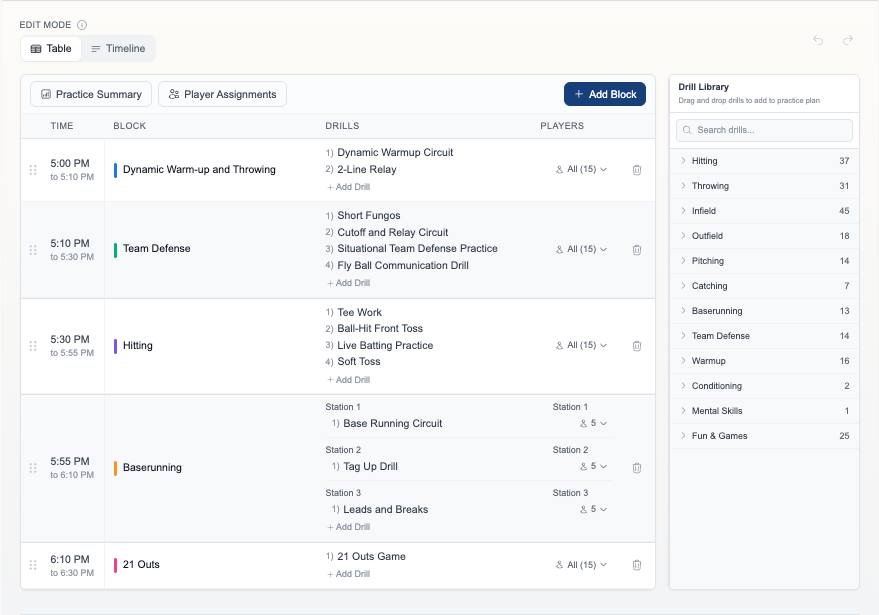
Dugout Edge's practice planner follows this approach. Instead of starting from a blank page every time, coaches build on a library of categorized drills and generate structured practice plans customized to their team's needs. The tool assigns time blocks, balances skill categories, and lets you drag and drop to adjust on the fly.
The key insight is that chatbots and purpose-built software are solving different problems. ChatGPT is great for answering questions. It is not great for doing the repetitive, data-driven work that eats up a coach's time every week. A dedicated lineup generator does not just tell you what a good lineup looks like in theory. It builds one that works for your specific team on a specific Saturday when three kids are missing and your best pitcher needs rest. A practice planner does not just suggest drills. It structures an entire practice around your available time, your players, and the skills you need to develop.
This is not unique to baseball. Across every industry, the pattern is the same: general chatbots are impressive but limited. Software built for a specific job, with intelligence woven into the workflow, is what actually saves people time.
What AI Still Cannot Do
Honesty about limitations builds more trust than hype about capabilities. So here is what AI cannot do for youth coaches, and some of these limitations are not going away anytime soon.
AI cannot watch your practice. It cannot see that a player's swing has a hitch, that a pitcher is dropping their elbow, or that your catcher's footwork on throws to second base is costing a full second. Video analysis technology exists and is improving rapidly, but the reality is that most youth coaches are not recording practice reps from multiple angles. Even if they were, the gap between "AI can analyze video" and "AI can watch your practice and give real-time feedback" is enormous. Your eyes and your presence on the field remain irreplaceable.
AI cannot read body language. A huge part of coaching kids is noticing the nonverbal signals. The player who is dragging their feet during warm-ups because they had a bad day at school. The kid whose shoulders drop every time they make an error. The outfielder who keeps looking at the parking lot to see if their dad showed up. These observations drive coaching decisions that matter far more than batting order optimization. AI has no access to any of this.
AI cannot navigate parent dynamics. Every youth coach knows that managing parents is half the job. The dad who thinks his kid should pitch every game. The mom who tracks playing time on a stopwatch. The parents going through a divorce who both want to be the one picking up after practice. These are human relationship challenges that require emotional intelligence, diplomacy, and sometimes a thick skin. AI cannot help you here, and you would not want it to.
AI cannot feel the energy of a team. There are moments in a game or practice when you can feel the team's confidence building, or feel it draining away. A good coach adjusts in real time. You call a timeout not because of strategy but because your kids need a reset. You put in the backup catcher not because the starter is playing poorly but because you can see he needs a break from the pressure. These are instinct-level decisions built from knowing your players as people, not data points.
AI cannot replace presence. At the youth level, the most important thing a coach does is show up. Be consistent. Be encouraging. Make kids feel safe to fail. None of this can be automated, delegated, or optimized by technology. A perfectly built lineup means nothing if the coach is not there to high-five the kid who strikes out and tell them they will get it next time.
These limitations are not temporary gaps that better technology will fill. They are fundamental aspects of coaching kids that require a human being in the moment. The coaches who understand this will use AI tools effectively precisely because they understand what the tools are for and what they are not for.
The Assistant Coach You Do Not Have
Here is the reframe that makes everything click: AI is not trying to be the head coach. It is the assistant coach that most volunteer coaches never had.
Think about what a good assistant coach does. They handle logistics so you can focus on coaching. They build the lineup while you run warm-ups. They plan the practice schedule while you work with a kid who needs extra reps. They track pitch counts so you do not have to keep a running tally in your head during the game.
Most rec league and youth travel teams do not have that person. The head coach does everything: planning, logistics, communication, instruction, lineup building, equipment management, and actual coaching. AI tools are best understood as filling the assistant coach role, handling the administrative and analytical work so the head coach can focus on what only a human can do.
The beauty of this framing is that it correctly scopes what AI should and should not be doing. An assistant coach does not make the final call on who pitches. They do not decide whether to pull a struggling player or leave them in for the learning experience. They do not navigate the postgame conversation with a frustrated parent. The head coach does all of that. The assistant coach handles the homework so the head coach shows up prepared.
What You Can Try Right Now
You do not need to wait for the future to arrive. There are practical things you can do today to get AI working as your assistant coach. Think of it as two levels: chatbots for quick questions, and purpose-built tools for the real work.
Level 1: Use Chatbots for Quick Answers
ChatGPT and similar tools are genuinely useful for one-off coaching questions. They are free, fast, and surprisingly knowledgeable about baseball. Use them the way you would use a coaching encyclopedia.
Get practice ideas. Type: "I coach a 10U rec league baseball team with 12 players. We practice for 90 minutes on a full field. Design a practice focused on [topic]. Include warm-up, drills, water breaks, and a scrimmage." The plan you get back will be a solid starting point, but you will need to copy it, reformat it, and adapt it to your team manually.
Feed it your GameChanger data. Export your team's stats and paste them into an AI conversation. Ask it to identify which players are struggling at the plate or how your team's on-base percentage has trended. Useful analysis, but you will need to do this from scratch every time.
Ask for drill variations. "Give me five variations of a ground ball drill for 8-year-olds, starting easy and getting progressively harder." Great for brainstorming. The limitation is that the chatbot does not know which drills you have already used or what equipment you have available.
Plan your season structure. "I have a 12-game season with two practices per week. My 10U team needs to improve throwing accuracy, base running awareness, and situational hitting. Give me a week-by-week practice focus plan." The output gives you a roadmap, but it will be generic because the chatbot does not know your team's actual strengths and weaknesses.
The pattern with chatbots is consistent: the first answer is impressive, but the tool does not remember anything, does not know your team, and requires you to start over every time. For quick questions, that is fine. For the tasks you repeat every week, it gets old fast.
Level 2: Use Purpose-Built Coaching Software
This is where the real time savings happen. Instead of having a conversation with a chatbot and then manually doing the work, purpose-built software does the work for you because your team's data is already in the system.
Use a lineup generator that knows your roster. Instead of building lineups by hand or going back and forth with ChatGPT, use a tool that already has your team's data. Dugout Edge's lineup generator takes your player roster, position preferences, and league rules, then generates fair lineups that balance playing time and rotate positions. You enter your roster once and generate lineups all season, instead of rebuilding the same grid by hand before every game.
Build practices from a real drill library. ChatGPT can suggest drills, but it cannot structure a practice around your available time, assign players to stations, or track what you ran last week. Dugout Edge's practice planner lets you build from a library of categorized drills with time blocks, player assignments, and station rotations built in. The difference between copying a chatbot response into your notes app and using a tool designed for the job is significant.
The progression from chatbot to purpose-built software is natural. Most coaches start by asking ChatGPT a few questions, realize the limitations, and then look for something that actually does the work. The chatbot was the introduction. The software is the solution.
Where This Is Heading
The category of "AI assistant coach" does not really exist yet. There is no app you can download called "AI Baseball Coach" that does everything described in this article. But the pieces are falling into place faster than most people realize.
The pattern follows what happened with analytics in baseball. Sabermetrics started in Major League front offices in the early 2000s. Within a decade, it had trickled down to college programs. A few years after that, travel ball organizations started using data-driven approaches for player development and game strategy. Today, even some rec league coaches reference OPS and launch angle, concepts that were barely known outside MLB analytics departments 20 years ago.
AI is following the same curve, but faster. The professional level is already using AI for video analysis, opponent scouting, pitch design, and training optimization. College programs are adopting it for recruiting analysis and practice efficiency. The question is not whether AI tools will reach youth sports. It is when, and what they will look like when they get there.
Here is what the near future probably looks like for youth coaches:
Lineup generators and practice planners become the norm. The days of building lineups on napkins or in generic spreadsheets are numbered. Lineup generators that connect to your roster and practice planners that build from real drill libraries will become standard coaching tools. Many coaches are already using tools like Dugout Edge's lineup generator and practice planner, and adoption is accelerating.
Natural language becomes the interface. Instead of clicking through menus and filling out forms, coaches will be able to talk to their tools. "Build me a lineup for Saturday. Tyler is out, Sophia needs to pitch the first two innings, and make sure everyone gets at least three innings in the field." The tool will know your roster, understand the request, and produce the result. The technology for this exists today. It is a matter of connecting it to the right data.
Coaching intelligence accumulates over time. The most exciting development is tools that learn from your coaching patterns. If you always move a struggling hitter down in the order rather than benching them, the tool learns that preference. If you never schedule live pitching drills on the day before a game, it remembers. Over a season, the tool gets better at anticipating what you want because it has been paying attention to what you do.
Video analysis becomes accessible. Today, video analysis in youth sports is mostly parents recording games on their phones and posting highlights to social media. But the technology to analyze swing mechanics, pitching form, and fielding technique from standard video is improving rapidly. Within a few years, coaches will be able to upload a short clip and get feedback on a player's mechanics that previously required an expensive private instructor.
The AI assistant coach gets smarter. Each of these developments adds a new capability to your AI coaching toolkit. It starts with a lineup generator that handles the math and a practice planner that structures your workouts. Then it adds roster awareness and scheduling intelligence. Then natural language interaction and accumulated preferences. Then video analysis and performance tracking. Each layer makes the tools more useful, but the fundamental relationship stays the same: AI handles the homework, the coach handles the kids.
The Coaches Who Will Use This Best
The coaches who get the most out of AI tools will not be the most tech-savvy. They will be the ones who understand what coaching is actually about.
Coaching youth sports is about showing up for kids. It is about teaching them that striking out is not the end of the world. It is about making sure every kid gets a chance to play the position they are excited about, even if it is not optimal for winning. It is about noticing when a player is having a rough day and knowing when to push them and when to back off.
None of that is going away. None of that can be automated. And the coaches who understand this will use AI tools the way they are meant to be used: as a way to reclaim the time and mental energy that logistics and planning consume, so they can invest that time and energy where it actually matters.
The 10pm napkin lineup session does not have to be a permanent fixture of youth coaching. The busywork that eats into your evenings and your attention on game day can be handled by tools that are specifically built for it. That does not make you a less dedicated coach. It makes you a smarter one.
The best coaches will not be replaced by AI. They will be the ones who use it to focus on what they signed up for in the first place: helping kids fall in love with the game.
Dugout Edge builds tools that help youth baseball and softball coaches save time on game prep and practice planning. Try the lineup generator to build fair lineups in seconds, or use the practice planner to create structured practices from our drill library. Stop spending your evenings on spreadsheets and start spending them on your team.
Tags
Build Your Practice Plan Now
Use the Dugout Edge Practice Planner to build a time-blocked practice with drills, concurrent stations, and a printable PDF — in about 5 minutes.
Open the Practice Planner