Free vs Paid Baseball Scorebook: Which One Should You Actually Buy?
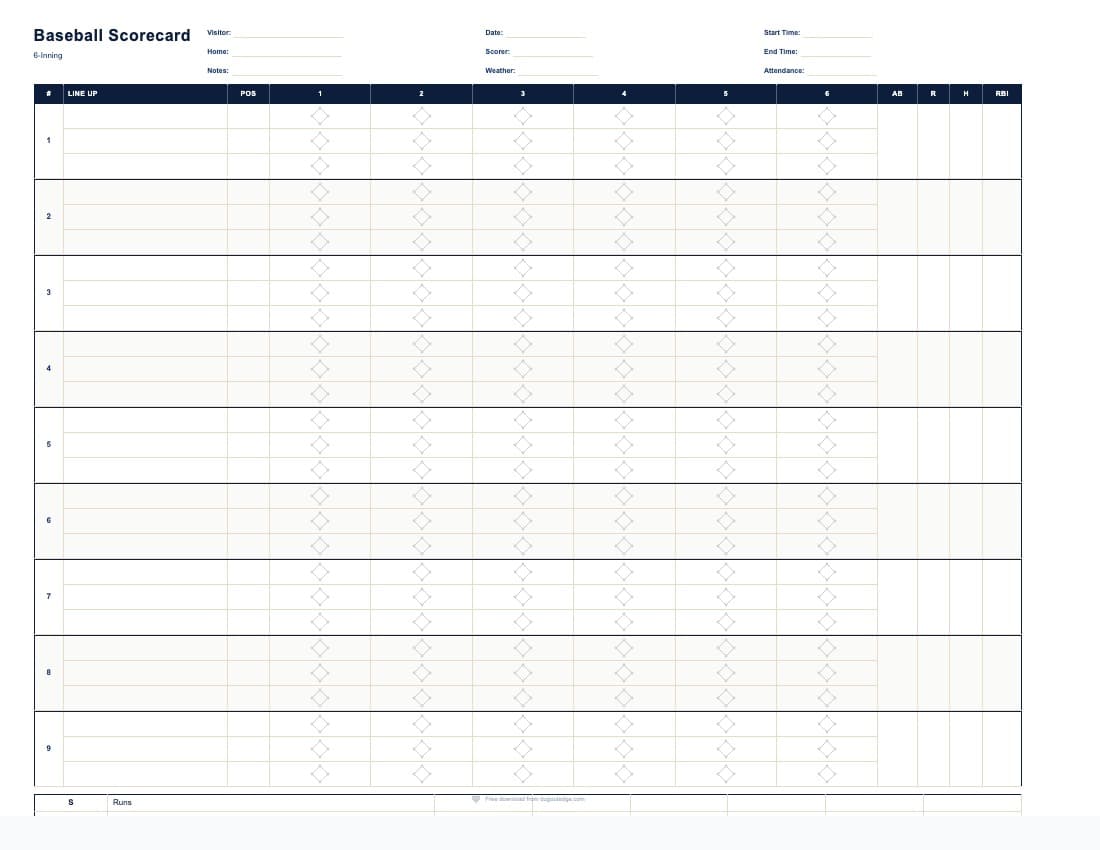
Walk into any youth baseball dugout and you will see three kinds of scorebooks: a stack of printable PDFs someone prints fresh each Saturday, a $15 paperback from Amazon, and the classic $25 Rawlings hardcover that has been the high school standard for decades. All three work. None is the obviously right answer. This guide is for the coach who does not want to spend 90 minutes comparing 14 Amazon listings.
The Short Answer
- Score one or two games a season as a favor → free printable PDF. Anything else is overkill.
- Score every game of a rec season → $15 Franklin or Murray paperback. Real book, low price, low stress.
- Score every game through high school or travel → $25 Rawlings System-17. Built for the official scorekeeper role.
- Want scoring connected to lineups and practice plans → skip paper, join the Dugout Edge waitlist.
Free Printable PDFs
The case for free: zero cost, you can print exactly what you need, and if the kid spills Gatorade on it you print a new one next Saturday. A good printable scorecard is indistinguishable from a good paperback in terms of the actual grid quality. Dugout Edge has 16 templates: 7-inning, 9-inning, high school, tournament, coaches-stats, and digital-scan variants for baseball and softball.
The case against: there is no binding, so 20 loose scorecards will live in your trunk until the printer-paper corners curl. If you score every game, you end up doing more organizational work than a real scorebook would cost you.
Best for: coaches who score occasionally, parents pulled into the role once a season, tryouts, or coaches who want to test a format before buying a book.

See all 16 free scorecard PDF templates.
The $15 Paperback: Franklin Sports or Murray
Both are basically the same product. 25 to 30 games per book, paperback cover, clean grid. The Franklin often ships with a pencil. The Murray has a slightly roomier batting grid if you have larger handwriting.
The case for: it is a real book with a binding, so the pages stay in order all season. Low enough cost that you can afford to lose one. The grid is as good as the Rawlings in terms of what you are actually filling in.
The case against: the cover will not survive a wet tournament Saturday in the same way a hardcover does. If you are the official scorekeeper for a travel team, the Rawlings looks more professional.
Best for: rec league coaches, assistants who also score, and dads drafted into the role. The practical choice for 80% of youth coaches.
See the Franklin Sports MLB Baseball Scorebook or the Murray Sports Scorebook on Amazon.
The $25 Rawlings System-17
The book you will see in 9 of 10 high school dugouts. Hardcover, 17 games, with the stat columns official scorekeepers expect (strikeouts per position, pitcher performance by type of out, umpire sign-off lines).
The case for: built to last through a season of abuse. The pages are designed by someone who has actually scored a game. The book looks like a scorekeeper's book, which matters if you are an assistant coach pulled into a tournament scorekeeping role and want to be taken seriously.
The case against: $25 when $15 would have worked. 17 games is short for a full season if you also score fall ball. Overkill for a coach who scores a handful of games.
Best for: travel and high school coaches, league official scorekeepers, and the dad who is going to score every game through 12U travel and wants the book to hold up.
Rawlings System-17 Scorebook on Amazon.
What About Going Digital?
A lot of the coaches asking this question are really asking whether paper scorebooks are obsolete. They are not, yet. Paper still wins on battery life, glare, and the ability to hand the scorebook to a parent at the end of a tournament as a tangible artifact.
The thing digital has on paper is math. Post-game stat math is a real tax on a coach's Sunday morning. Batting averages, OBP, pitch counts, earned runs per pitcher. All of that either happens in a spreadsheet or it does not happen.
The digital scorebook Dugout Edge is building opens early access in 2026. It connects to the lineup generator most of our members already use, pulls at-bat data into the practice planner, and does the math for you. No streaming subscription upsell, no standalone pricing.
Join the early-access waitlist here.

The Setup Most Coaches End Up With
After a couple of seasons, most coaches settle into the same combination.
- A Rawlings or a Franklin scorebook for the games they actually score.
- A small stack of printable PDFs in the equipment bag for the game where an assistant steps in or the scorebook went missing.
- A phone-based scoreboard on the fence for parents in the bleachers. The free virtual scoreboard handles that without any app install.
When the digital scorebook opens, most of that stack collapses into one tool. Until then, this is the setup.
Related Guides
Tags
Ready to Generate Your Perfect Lineup?
Try our free softball and baseball lineup generator to create balanced, fair lineups in minutes.
Try Free Lineup Generator