Reading Your Season Batting and Pitching Stats
Where the numbers live after the game, and what each column means
Every game you score with stat tracking on adds to your season totals. Nothing to export, nothing to re-enter: end the game and the numbers are there.
This guide covers where to find them and what each column means, which matters more in youth ball than it does in the big leagues. A .250 hitter who walks a lot is doing more for your lineup than a .300 hitter who never does.
Where the stats live
- •Team page, Stats tab: the season totals for everyone on the roster.
- •Player Stats view: the batting table and the pitching list, sortable by any column.
- •A player page: that one player, with their playing time and their performance side by side.
- •The game itself: the box score for that day, in the post-game view.
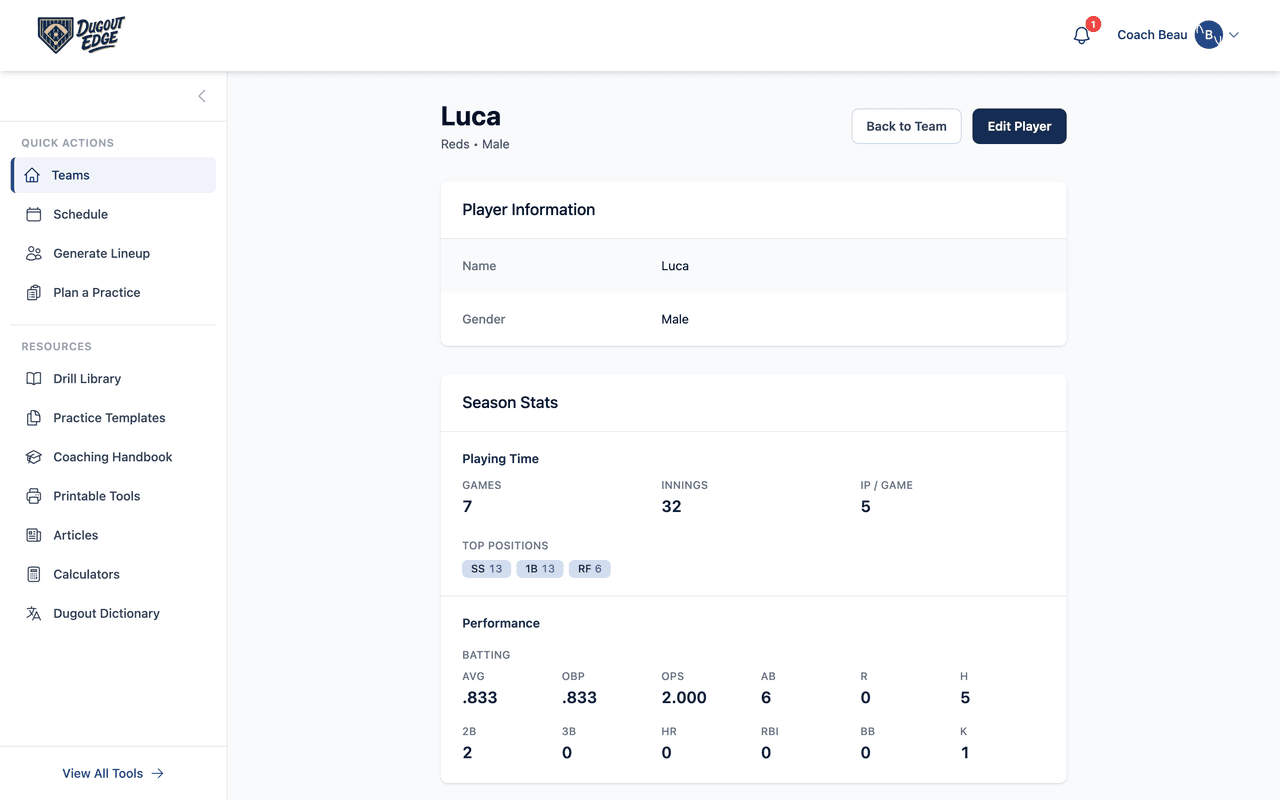
Playing time and performance are separate on purpose
Innings played, positions, and bench time answer a fairness question. Hits and RBI answer a different one. Mixing them into a single table makes the fairness conversation with a parent harder, not easier, so they live in separate views and always will.
The batting columns
- •G: games the player appeared in.
- •AB: at-bats. Walks and hit-by-pitches are not at-bats, which is why they do not lower an average.
- •R: runs scored.
- •H: hits, then 2B, 3B and HR break out the extra-base ones.
- •RBI: runs batted in.
- •BB: walks. In youth ball this is often the most useful column on the page.
- •K: strikeouts.
- •AVG: hits divided by at-bats.
- •OBP: how often the player reaches base at all, walks included.
- •OPS: on-base plus slugging, a single number for total offensive contribution.
The pitching columns
- •Pitches: total thrown across the season, which is what league rest rules key on.
- •Appearances: games the player pitched in.
- •IP: innings pitched, counted in thirds, so two outs reads as two thirds of an inning.
- •ERA: earned runs per nine innings.
Why a player might have no batting line
Games scored in Basic mode, or from the quick score buttons, record no at-bats: they count toward games played and contribute nothing to the batting table. A team that scored its whole season that way sees playing time and pitch counts but an empty batting line, and that is expected rather than broken.
To start filling it in, choose stat tracking when you set up your next game.
Finding your season stats
- 1
Open your team from Teams.
- 2
The Stats tab is where you land.
- 3
Choose Player Stats to see batting and pitching for the season.
- 4
Tap any column heading to sort, for example by hits or by average.
- 5
Tap a player to open their page and see their playing time and performance together.
Softball
The columns and the math are identical. ERA is still computed per nine innings even in leagues that play six or seven, which is the standard convention and keeps the number comparable.
Track your game for free
The Dugout Edge Game Day tool keeps the score, outs, runners, pitch count, and batting order in one place. No account needed, and it works right in your browser.
Open the free scorekeeperFrequently asked questions
Why is my batting table empty?
Almost always because the games were scored in Basic mode, which keeps the score, pitch counts, and playing time but records no at-bats. Score a game with stat tracking on and the table fills in. If you did score with stat tracking and the table is still empty, check that the game was ended rather than left in progress.
What is the difference between AVG and OBP?
Average counts hits per at-bat. On-base percentage counts every way of reaching base, walks included, per plate appearance. In youth baseball OBP is usually the more honest measure of a hitter, because taking a walk is a skill and a nine-year-old who draws them is helping you win.
Why does a walk not count as an at-bat?
By rule a walk is a plate appearance but not an at-bat. It keeps a batting average from being punished for something the batter arguably did right. The tool handles it automatically: walks land in BB and stay out of AB.
How is ERA calculated when innings are fractions?
Innings are counted in outs, so one out is a third of an inning. ERA is earned runs times nine, divided by innings pitched. A pitcher who recorded five outs and gave up one run shows one and two thirds innings and an ERA around 5.40.
Can parents see these stats?
Not yet. The share link shows your lineup and playing time. Sharing batting and pitching stats with families is coming separately.
Keep learning
Coming 2026
Score every game by hand. Digitally.
A digital scorecard that works the way you already keep score: pencil in the 6-4-3, advance the runner, mark the backwards K. The same notation you know by heart, with nothing to store in a closet and nothing lost to a rained-out dugout. Built for coaches and fans who love the craft of scoring a game by hand. Launching in 2026. Join the waitlist and we will send early access the week it goes live.
Want to see it in context? Read what the digital scorekeeper does.