How Should a Baseball Glove Fit? A Coach's Fit Check for Kids
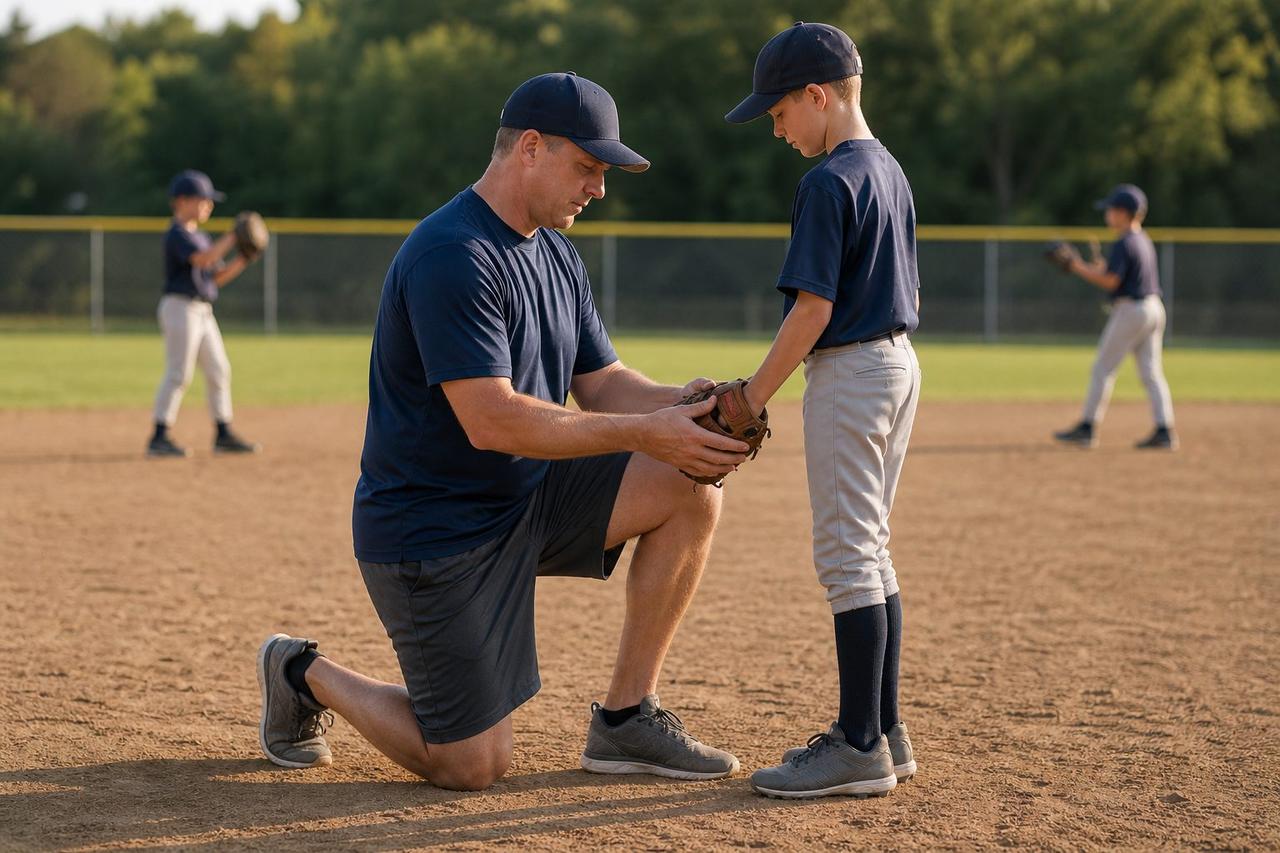
A baseball glove fits when it stays on the hand with the arm hanging relaxed at the side, the player can squeeze it shut with the glove hand alone, and the fingers can still move inside it. Snug at the wrist, comfortable in the fingers.
Glove size is the length from the heel of the glove to the tip of the index finger. The size you start from depends on age and position, and the fit checks below decide the final call.
The most common fit problem at a youth practice is a glove that is too big. It looks harmless in the store. On the field it flops open, the ball pops out, and the player starts trapping the ball against the chest. If a glove is on the gift list this month, the checks below take about a minute in the aisle.
The Four Fit Checks
Put the glove on the player's hand and run these four. Each one takes a few seconds, and all four work in a store aisle.
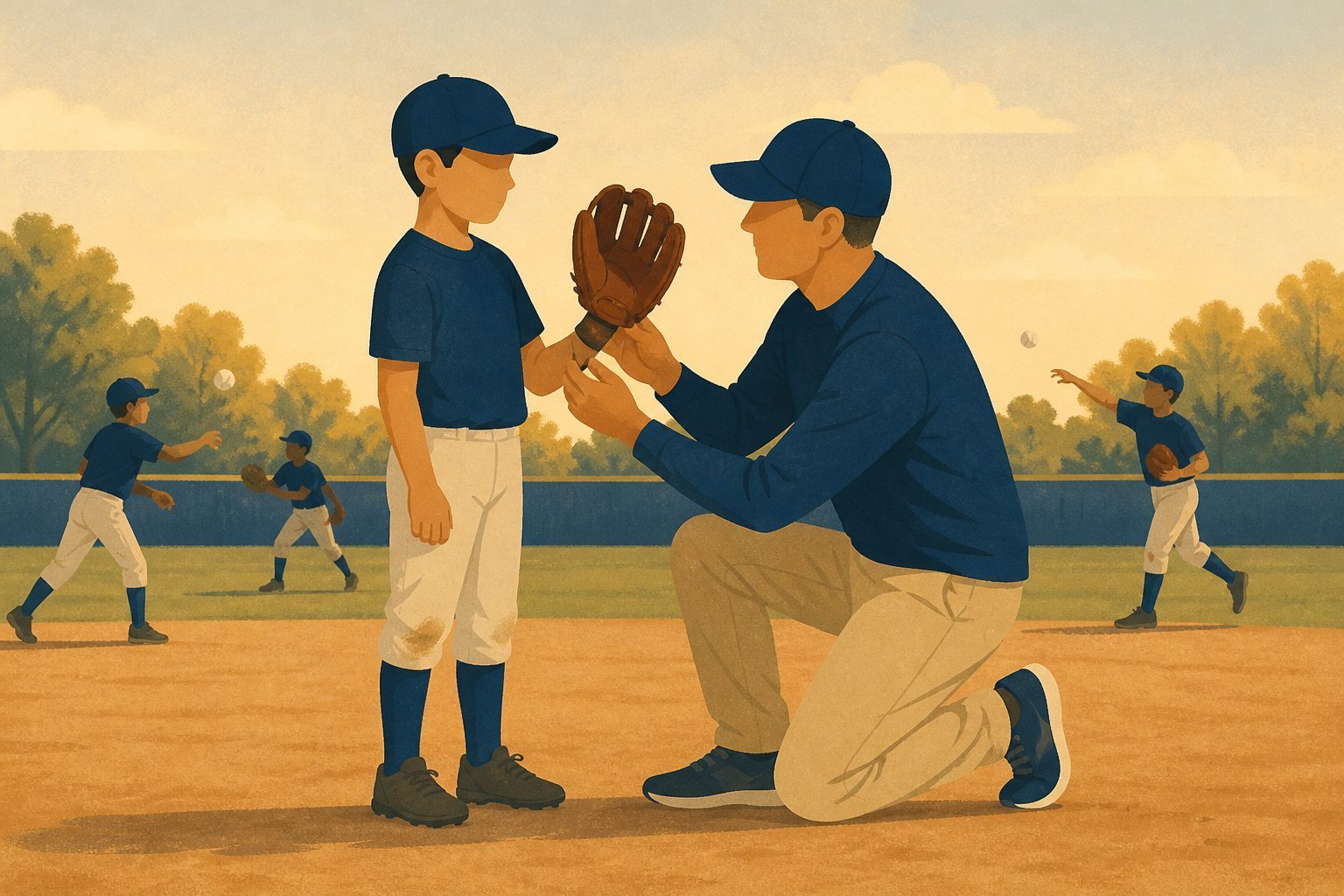
- The hang test. Have the player let the glove arm hang relaxed at the side. If the glove feels like it is going to slide off, the glove, or at least its hand opening, is too big (Wilson).
- The squeeze test. Ask the player to close the glove with the glove hand only, no help from the other hand. A player who can squeeze it shut can use it. A player who struggles needs a smaller glove (Wilson).
- The finger test. The fingers should move inside the glove and the hand should feel normal. Size up when the glove keeps the fingers from moving or the hand goes numb (Academy).
- The wrist check. Tighten the strap or lacing at the back of the wrist and look at the gap. The glove should sit snug against the wrist and feel comfortable. A big gap here is the usual reason a glove fails the hang test.
A glove that passes all four fits. A glove that fails the hang test or the squeeze test is the wrong glove, however good it looks on the shelf.
How to Measure a Baseball Glove
Before you reach for a tape measure, check the leather on the thumb or the pinky. Most gloves have the size stamped there. Glove sizes run from 8 to 15 inches, and catcher's mitts go up to 35 inches because they are measured a different way (Baseball Monkey).
When the stamp has worn off, measure it yourself (Academy):
- Lay a soft tape measure at the heel of the glove, the padded part below the palm.
- Run it up along the glove to the tip of the index finger.
- Write the number down. That is the glove's size.
Catcher's mitts are measured around the outside, from the heel all the way around and back to the heel. The usual range for a baseball catcher's mitt is 29.5 to 34.5 inches (Baseball Monkey).
A hand measurement tells you less than you would think. Position and age decide the size more than the hand does (Baseball Monkey). Use the size chart to find a starting range, then let the four checks settle it.
What Size Glove by Age
Retailer charts agree on the broad strokes. One common chart puts T-ball players, ages 5 to 7, in a 9- to 11-inch glove, youth players ages 8 to 12 in a 10- to 12-inch glove, and players 13 and up at 11 inches and up (Hibbett).
The glove size calculator narrows that range using the player's age, height, weight and position. Here are its starting ranges for a typical-size baseball player:
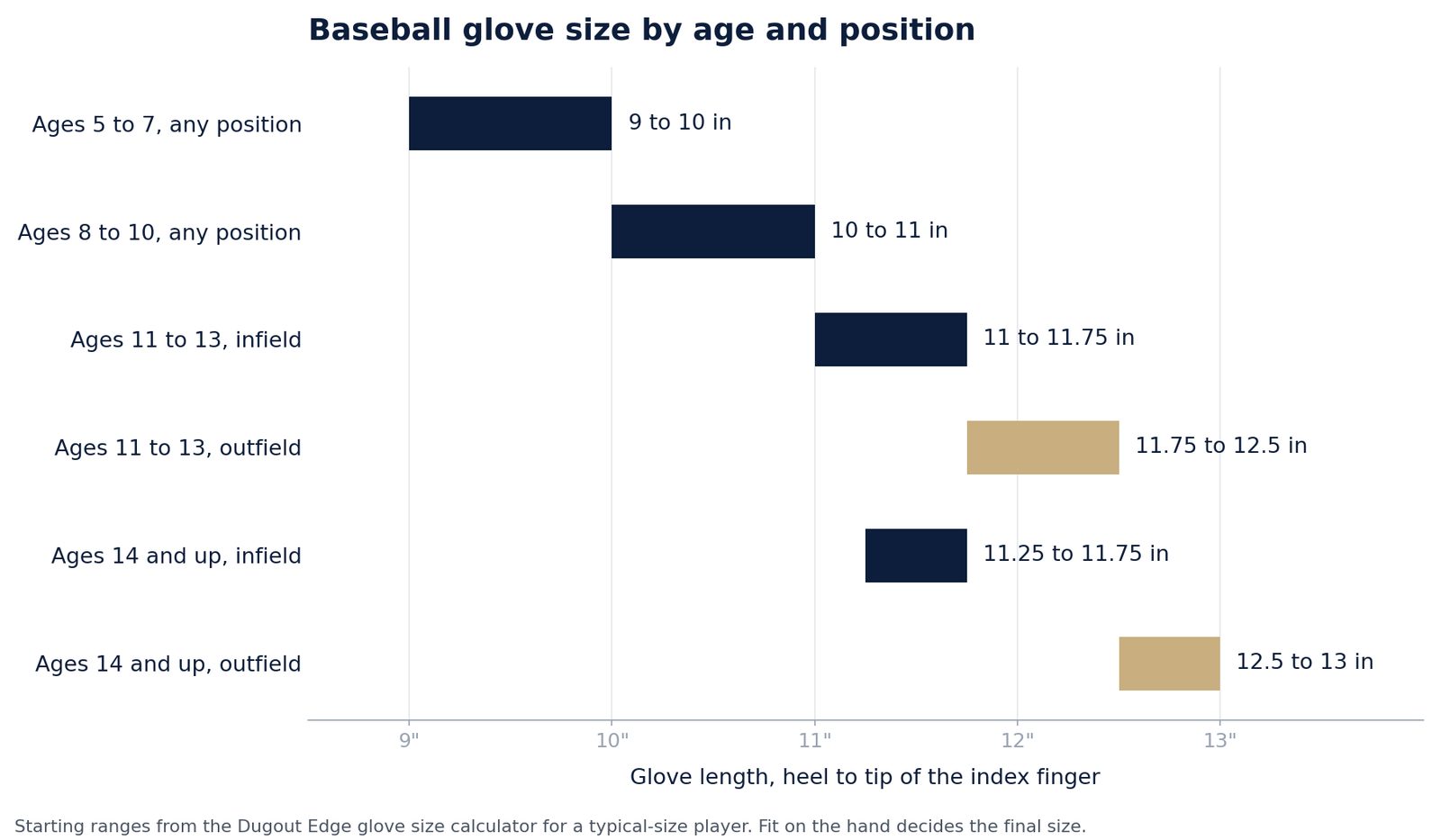
Two things jump out of the chart. Up to about age 10, one glove covers every position, and that is the right call because kids at that age should be trying every spot on the field. From 11 on, the infield and outfield ranges split. Infielders want a smaller glove for a quick transfer to the throwing hand. Outfielders want the reach of a longer one.
Use the range as a place to start in the store. Then put the glove on the player's hand.
Why "Room to Grow" Backfires
Parents buy big for a good reason. Gloves cost money and kids grow. A glove one size up looks like it will last two seasons.
Coaches disagree on how far to take that. The case for fitting the player now is simple. A glove that is too large feels heavy and awkward, and a smaller glove gives a young player more control while their hands develop (Wilson). If you do buy ahead, go up a small step, and make sure the player still passes the squeeze test.
Here is what a too-big glove looks like at practice:
- The player catches with the glove hand stiff and the fingers of the glove bending back.
- The ball hits the pocket and pops out, because the player cannot close the glove around it.
- The player traps every throw against the chest with the glove.
- The glove slides off the hand when the player picks up a grounder or dives.
- The player shakes the glove loose between throws and pushes it back on.
Fit is one cause of those habits. A brand new, stiff glove causes the same ones, and so does a kid who is still learning to catch. Run the four checks on that glove first. If it passes, look at how stiff it is, then at the catching itself.
There are fixes when the glove is close. Some gloves are built for small hands with a smaller wrist opening and shorter finger stalls (Wilson). The back of an adult glove can also be tightened for a younger player, with the strap on many softball gloves or a small re-lacing on a baseball glove (Baseball Monkey).
Fit by Position
For most youth players, one all-position glove is the right glove. Position gloves start to matter around 11 and 12, when players settle into spots on the field.
| Position | What changes | Typical range |
|---|---|---|
| Infield | Shorter glove, shallow pocket, quick transfer to the throwing hand | 11.25 to 12 inches for a standard baseball infield glove (Baseball Monkey) |
| Outfield | Longer glove and deeper pocket for reach and fly balls | Bigger than the infield glove at the same age (Glove size calculator) |
| First base | Mitt with stiff fingers for scooping throws, usually worn from about age 10 because younger kids struggle to close it | 11.5 to 13 inches (Baseball Monkey) |
| Catcher | Fingerless, heavily padded mitt, measured around the outside | 29.5 to 34.5 inches around (Baseball Monkey) |
One rule to check before you buy a pitcher a glove. MLB's rulebook bars a pitcher's glove that is white or gray, apart from the piping, or that an umpire finds distracting (MLB Rule 3.07). Youth rulebooks set their own glove rules, so read your league's before a white glove goes under the tree for a kid who pitches.
Finger Placement and Break-In
Players put their fingers in a glove in a few different ways, and all of them are fine. Some put one finger in each stall. Some put two fingers in the pinky stall, which changes how the glove closes (Baseball Monkey). Some slide the index finger out the back of the glove for a little padding on hard throws. Let the player try each one during catch and keep the one that lets them squeeze the glove shut.
A new leather glove will feel stiff and a little tight. That is expected, and it loosens with use (Academy). Some youth gloves, Wilson's among them, are made with game-ready materials that need little break-in (Wilson). That is a real advantage for a young player.
The best break-in is catch. A glove a player uses every day forms around that player's hand and closes the way that player closes it. If a glove arrives as a gift in December, a few minutes of catch in the driveway every few days gets it ready for the first practice.
A Five-Minute Glove Check at Your Next Practice
Run this during warm-up catch at the first practice of the season. It catches the glove problems before they turn into catching problems.
- Line the players up with their gloves on and arms hanging at their sides. Look for gloves that slide down the hand.
- Have every player squeeze the glove shut with the glove hand only, three times. Note anyone who cannot.
- Walk the line and check the wrist strap or lacing on each glove. Tighten the loose ones on the spot.
- Watch five minutes of catch. Note who traps the ball against the body or drops balls that hit the pocket.
- For each player you noted, check the fit first, then whether the glove is still stiff, then the catching technique.
- Send a short note to the families of any player whose glove is far too big, with the player's starting range from the glove size calculator.
After the check, run a catch drill that rewards closing the glove. Pair players up at a short distance and have them catch with the glove hand only, throwing hand behind the back. The partner throws soft, chest high. Use soft-core balls for younger players. After ten good catches each, the pair backs up a few steps. Players with a glove that fits will feel the pocket close around the ball. The drill library has more one-hand catching and receiving drills to build into a practice plan.
A glove that fits is the cheapest coaching win of the season. Check them all at the first practice.
Tags
Gear Sorted? Now Set Your Lineup
Generate fair batting orders and defensive rotations for every game of the season in a few minutes.
Try the Free Lineup Generator