Setting Up Your First Youth Baseball or Softball Team? Here Is What 800+ Coaches Actually Do
Your first season as a youth coach starts with a stack of questions nobody gives you straight answers to. How many kids should be on the team? How often do I move players around? Does everyone bat? Am I allowed to just leave my best pitcher at pitcher?
Ask three veteran coaches and you will get three confident, contradictory opinions.
I coach youth baseball and co-ed softball, and I run Dugout Edge, a free lineup tool coaches have used to build more than 14,000 lineups in the 2026 season alone. That gives us something better than opinions: a record of what real coaches actually do. For this guide I analyzed the nearly 5,000 game lineups saved by more than 800 real youth teams, all aggregate and anonymous, with no names or teams attached.
So instead of another opinion, here is your setup guide, backed by what the coaching community has already voted on with their lineups.
First: Who Are These Teams?
Advice is only useful if it comes from teams like yours, so here is who we are learning from. Most of these teams are ages 7 to 10, which is coach pitch through minors: the exact seasons where a first-time volunteer coach usually gets handed a roster and a bucket of balls. About two thirds are baseball and one third softball, mostly rec and Little League rather than travel ball.
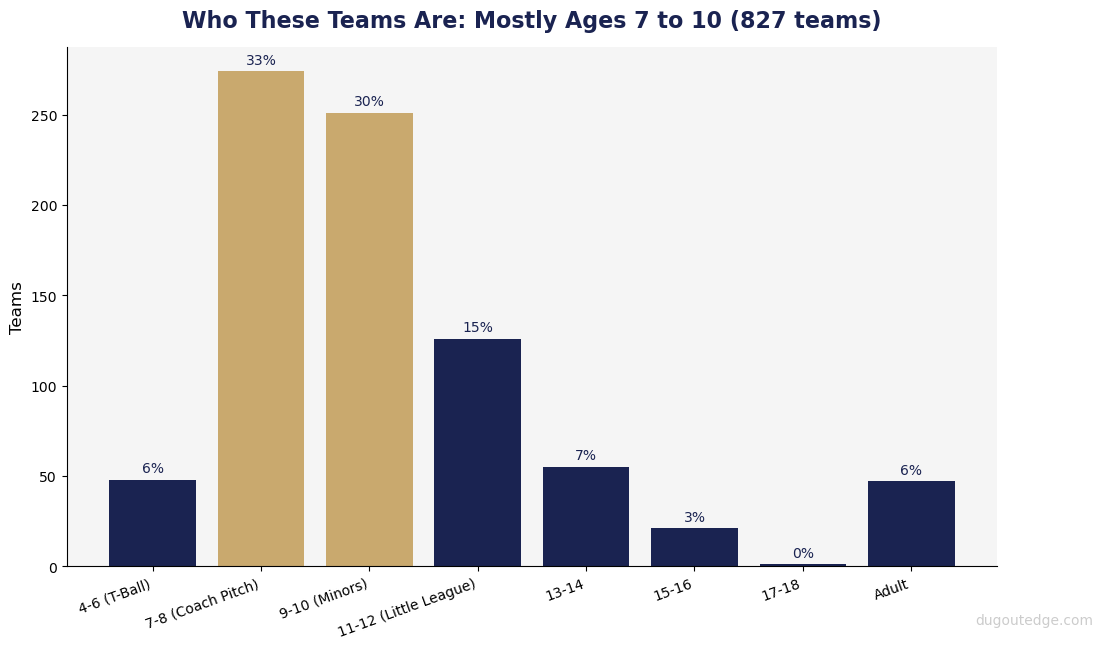
In other words: if you just got talked into coaching your kid's team, these are your people. Here is what they do.
How Many Players Should a Youth Baseball Team Have? Aim for 10 to 13
The sweet spot is 10 to 13 players, and that is not a guess: 8 out of 10 real lineups fall in that range, with 11 or 12 the most common by far. So if you are wondering how many players a Little League or rec team usually carries, the practical answer is 11 or 12.
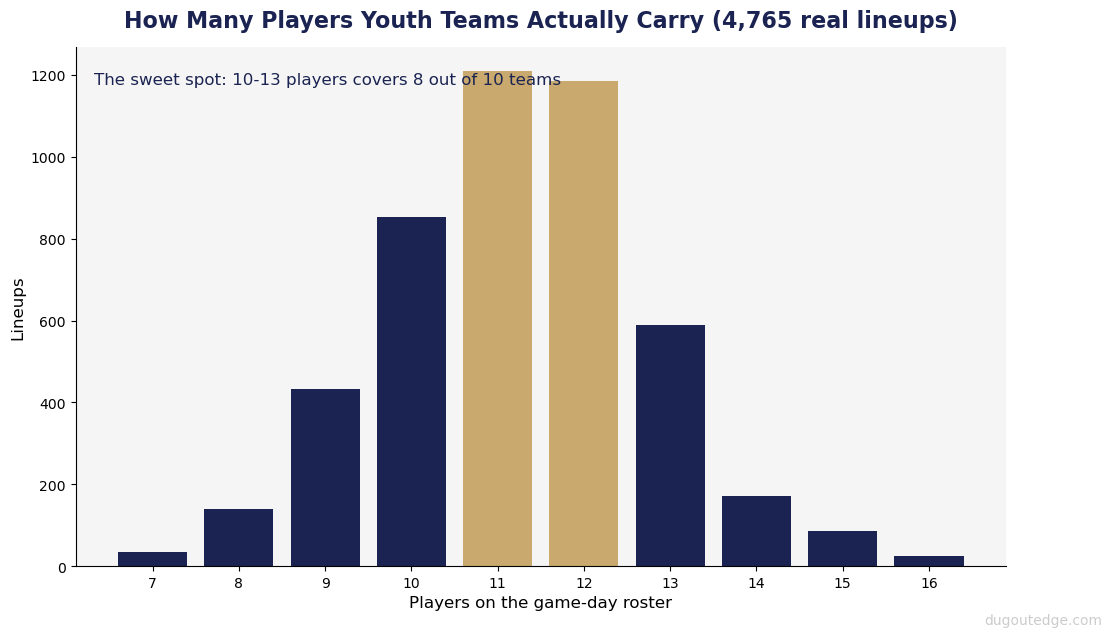
The logic shows up in the data from both directions. Below 10, one sick kid and a birthday party leave you scrambling to field a defense. Above 13, the bench gets crowded: with 9 or 10 fielding spots, a 14-player roster means four or five kids sitting every inning, and that is when parents start doing math in the stands.
Even at the ideal size, someone sits. Across all these games, about two players are on the bench in a typical inning. So do not treat bench innings as a failure. The standard that keeps everyone happy is simpler: nobody sits twice before everybody has sat once. Track that one rule and you can answer any playing time question with a clear conscience.
Stop tracking bench innings on a napkin
The free lineup generator tracks bench time, positions, and the batting order for you, then prints a dugout-ready card. No sign-up required.
Build a fair lineup in 2 minutesHow Many Positions Should Each Kid Play? Three or Four Per Game
This is the one that surprises most new coaches. In a typical six-inning game, the average kid plays 3 to 4 different positions. More than 9 out of 10 players change positions at least once per game, and about 7 in 10 play both infield and outfield in the same game.
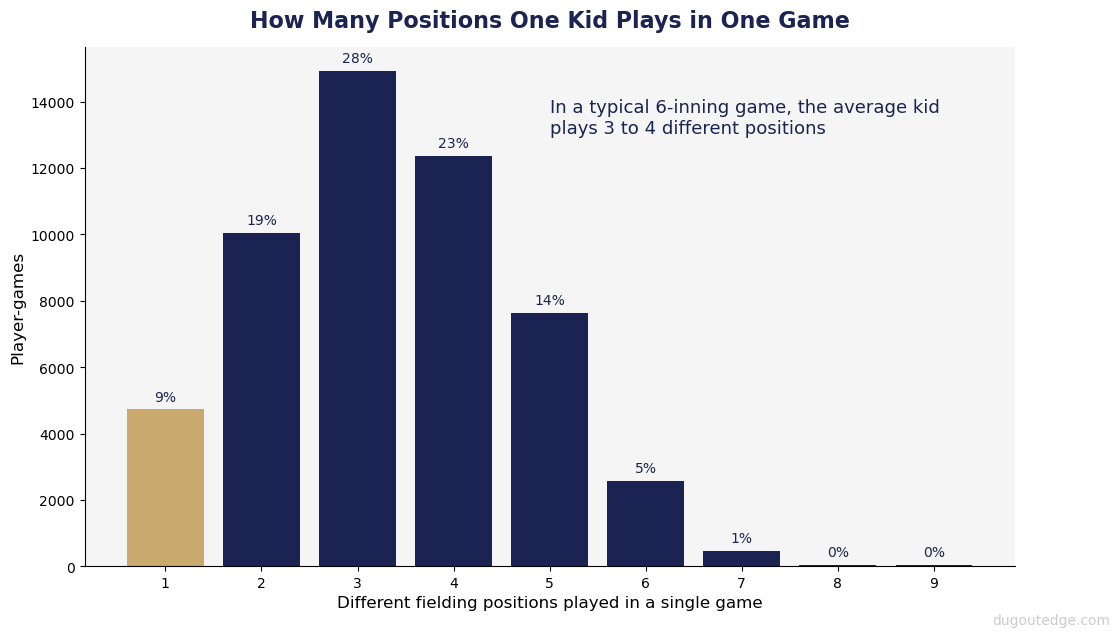
The kid who plays one position all game is a 1-in-11 exception, and it is usually a short game or a late arrival, not a plan.
So if you were wondering whether moving kids around every inning or two is normal, or whether it will look like you do not know what you are doing: it is normal. It is what nearly everyone does. Rotating through the field is how eight-year-olds find out they love catching, and it is also the fairest way to share the good spots. A practical rhythm that matches what the data shows: change most kids' positions every inning or two, and make sure everyone gets infield time and outfield time before the game ends.
This holds in baseball and softball almost identically, so coach either sport the same way.
Should Everyone Bat? Yes: The Continuous Batting Order Has Won.
97.8% of teams bat every player in a continuous batting order, no matter who is on the field that inning. If your league allows it (nearly all youth leagues do), bat the whole roster. It is simpler to manage, kids get more at-bats, and you will never have a conversation about who got benched at the plate.
You probably suspected this one already. Consider it confirmed: you are not being soft, you are doing what essentially every youth team does.
Which Positions Can Stay Fixed? Pitcher and Catcher.
Here is the permission slip every rookie coach needs: you do not have to rotate everybody through everything. Sometimes a coach decides one kid stays at one position for part or all of the game while everyone else keeps rotating. When experienced coaches make that call, the data shows exactly where they make it: pitcher and catcher.
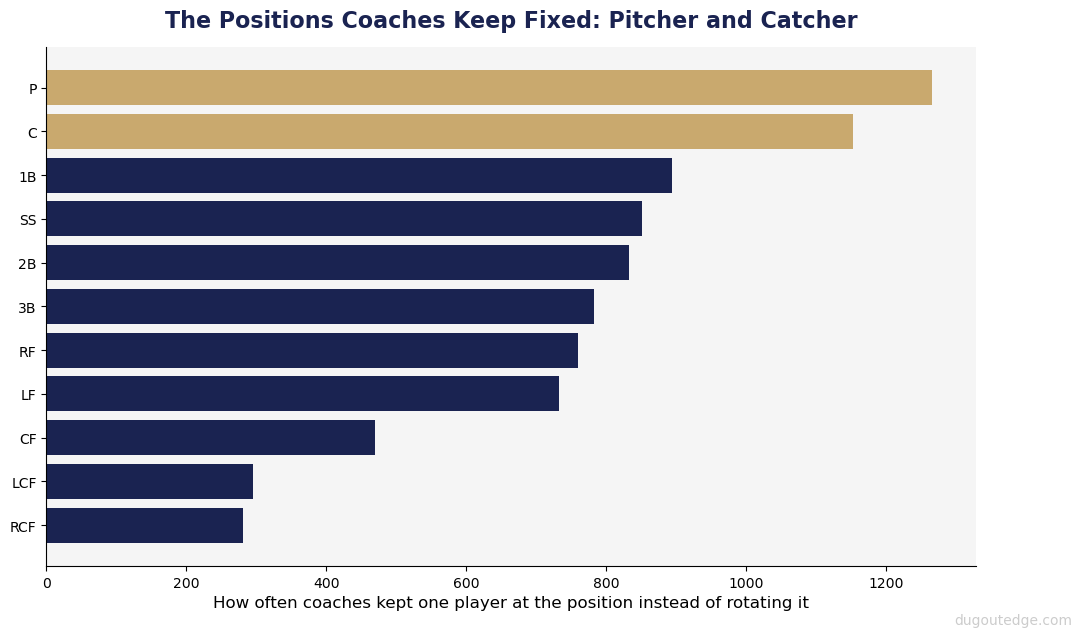
Pitcher is the position coaches keep fixed most often, catcher is right behind it, and everything else falls off fast. That reflects two things every coach learns quickly: those are the two spots where the game breaks if the wrong kid is standing there, and (especially at catcher) the two spots where safety and equipment actually matter.
So it is fine to keep your pitcher and catcher in place when the game calls for it. Rotate the other seven or eight positions freely and you are coaching exactly the way the field does.
What Does a Standard Game Setup Look Like?
A few more defaults you can copy instead of guessing, straight from how real teams configure their games:
| Setting | What most teams do |
|---|---|
| Innings | 6 (most common by far), 7 for older kids, 4-5 for the littles |
| Fielders | 9 for baseball; about a third of teams field 10 (common in softball and rec leagues) |
| Batting order | Everyone bats, every game |
| Bench | About 2 kids per inning at normal roster sizes |
| Rotation | 3-4 positions per kid per game, infield and outfield |
Your First-Game Checklist
Pulling it all together, here is the whole playbook in five lines:
- Roster 10 to 13 kids (11 or 12 if you can choose).
- Bat everyone, every game, continuous order.
- Rotate positions so every kid plays 3 to 4 spots per game, with infield and outfield time for each.
- Nobody sits twice until everyone has sat once.
- Anchor pitcher and catcher when it matters. Rotate everything else.
That is genuinely it. Everything else (snack schedules included) is details.

The hard part is not knowing these rules, it is doing the bookkeeping every game: who has sat, who has pitched, who has been stuck in the outfield. That is the part I built the free lineup generator to handle. Enter your roster, set your league's innings and positions, and it builds a batting order and inning-by-inning fielding rotation that follows every rule above, then prints a card for the dugout fence. No account needed, and it is the same tool the 800+ coaches in this data use.
Set up your team like the 800+ coaches in this data
Fair playing time, position rotation, and a printable lineup card, all handled automatically. Free, no account needed.
Try the free lineup generatorWhere These Numbers Come From
Everything above comes from 4,765 saved lineups created by 827 real teams in the Dugout Edge lineup generator between September 2025 and July 2026. All figures are aggregates: no team or player is identifiable, and our own test accounts are excluded. One honest caveat: these are coaches who use a lineup tool, so the most organized end of the coaching spectrum is overrepresented. Treat these numbers as what intentional coaching looks like.
One thing in the data made me smile. The tool lets coaches rate each player's skill and tune a slider between "competitive" and "everyone plays." Almost nobody touches either. Coaches will happily configure innings and league rules, but they will not put a number on an eight-year-old. Honestly, that might be the best finding in here.
Data: aggregate anonymized lineup data from the Dugout Edge lineup generator, September 2025 through July 2026. 4,765 saved lineups, 827 teams. Analysis run July 22, 2026.
About the Author
Former Stanford baseball player and professional in the Seattle Mariners organization. Founder of Dugout Edge and an active youth baseball and co-ed softball coach.
Tags
Ready to Generate Your Perfect Lineup?
Try our free softball and baseball lineup generator to create balanced, fair lineups in minutes.
Try Free Lineup Generator