Baseball and Softball Position Chart and Depth Chart Templates (Free and Fillable)

It is five minutes before the first pitch, a parent is asking why their kid sat two innings in a row last week, and your fielding plan is three arrows and a coffee stain on the back of a lineup card. Every youth coach has been there. A position chart fixes it. It is one page that shows who plays where in every inning, so the field is set before you get to the park and every kid can see they are moving.
This guide gives you two things you can use today: a blank position chart you fill in by inning, and a season depth chart that tells you who is ready behind each starter. If you would rather not fill anything in by hand, our free lineup generator builds a full game of fielding positions that already balances playing time, then prints or pulls up on your phone.
Quick answer: Use a position chart on game day (who plays each spot, inning by inning) and a depth chart across the season (your starter and backups at each position). Fill the position chart by column, one inning at a time, and track who sits so no player benches twice in a row.
The position chart template (by inning)
A position chart is a grid. Down the left side are the field positions. Across the top are the innings. In each cell you write the player who covers that spot that inning. The power of it is the empty Bench rows at the bottom: when you fill by column, you can see instantly if the same three kids are sitting again.
Download the free, branded template below. Print the PDF for the dugout, or share the PNG straight to your team chat.
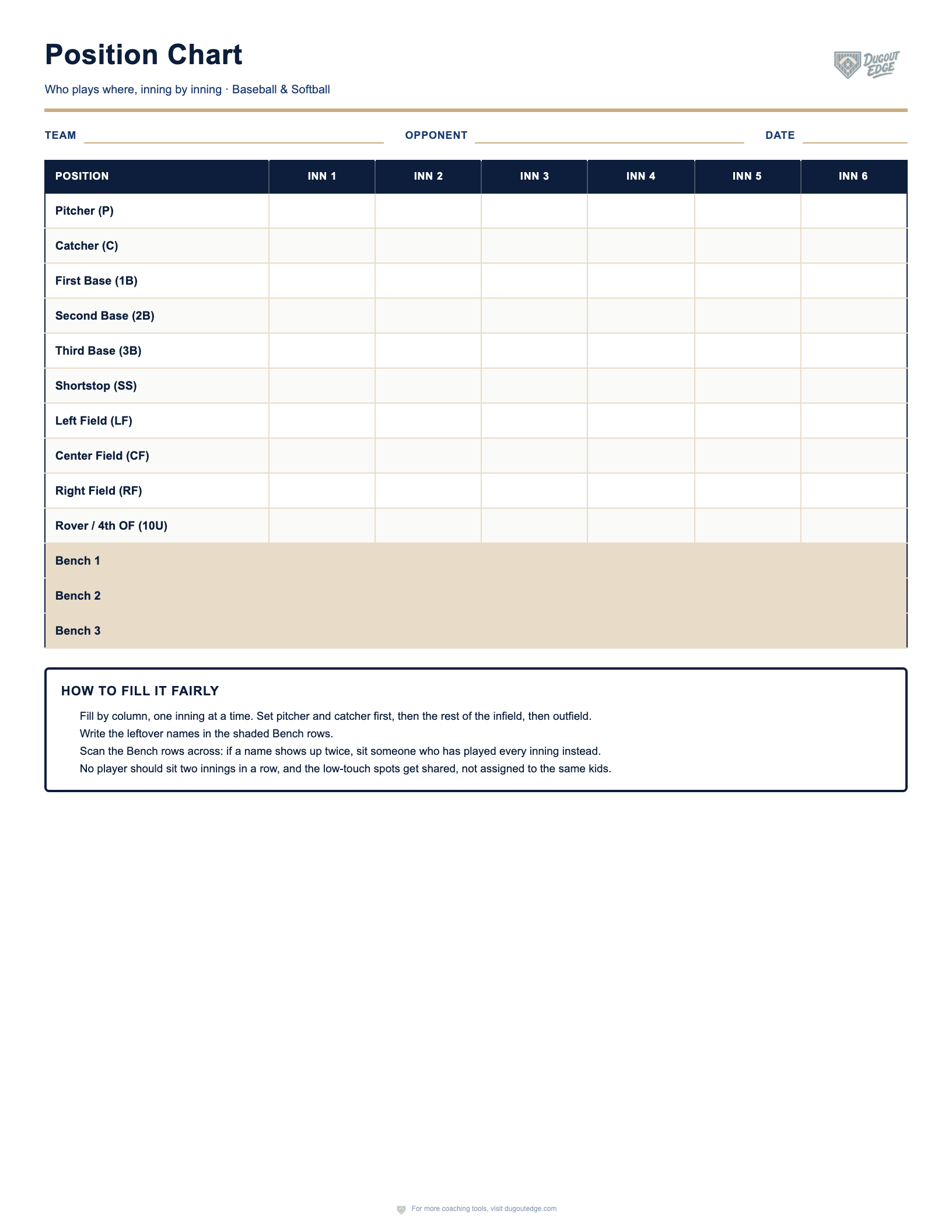
The tenth row matters for youth ball. Most coach-pitch, machine-pitch, and 8U to 10U leagues put ten defenders on the field, adding a fourth outfielder or a rover in short center. Keep the row even if your league plays nine, so the same template works all season.
How to fill it fairly
Fill it by column, inning by inning, not player by player. For each inning:
- Set the battery first (pitcher and catcher), since those are your constrained spots.
- Place the rest of the infield, then the outfield.
- Write the leftover names in the Bench rows.
Then scan across the Bench rows. If a name shows up twice, swap them into the field next inning and sit someone who has played every inning. The goal is simple and it is the whole reason the chart exists: no player sits two innings in a row, and the low-touch spots (right field, bench) get shared, not assigned to the same kids every week. That fairness math is tedious to do by hand for twelve players over six innings, which is exactly what the lineup generator was built to handle.
The depth chart template (by season)
The position chart answers "who plays where today." The depth chart answers "who is ready to play here at all." It is how you plan across a season: develop backups on purpose, and know before an injury or a vacation who slides in.
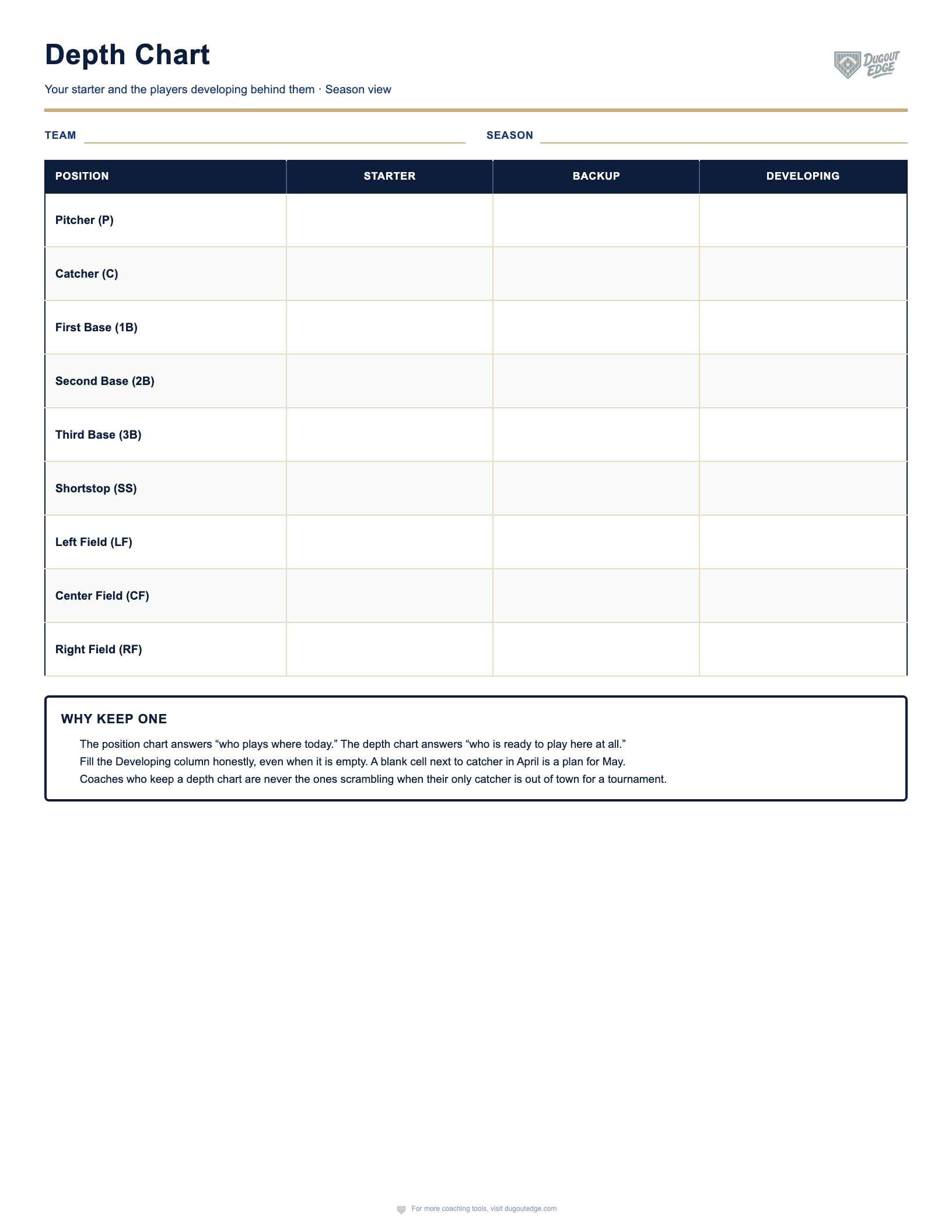
Fill the Developing column honestly, even when it is empty. A blank cell next to catcher in April is a plan for May: it tells you to get a second kid reps behind the plate before you actually need one. Coaches who keep a depth chart are never the ones scrambling when their only catcher is out of town for a tournament.
Nine players, ten players, and the short fielder
If your league plays nine in the field, use the top nine rows and ignore the rover. If it plays ten, the tenth defender is usually one of two things:
- A fourth outfielder, splitting the outfield into four shorter zones so more balls get caught.
- A rover or short fielder, standing in short center or behind second base to cut off ground balls up the middle.
Decide which your league uses before you fill the chart, because it changes who you can hide and who has to make plays. A rover touches the ball far more than a fourth outfielder, so it is not a low-demand spot the way right field can be.
Print it or generate it
You have two honest options, and neither is wrong:
- Download the templates above and fill them in with a pencil in the dugout. Cheap, fast, no phone needed, and they survive a rain delay.
- Generate it with the free lineup generator. Enter your roster once, set any position locks (your one real shortstop, the kid who only catches), and it builds every inning with playing time already balanced. Print the result or keep it on your phone, and use the season depth chart view to plan development.
The takeaway
A position chart is the cheapest piece of coaching insurance there is. Spend five minutes setting the field before you leave the house and you walk into the park with an answer for every parent, a fair rotation for every kid, and one less thing to improvise. Download the position chart above for this week, keep a depth chart for the season, and let the tool do the fairness math when your roster gets big enough that a pencil cannot keep up.
About the Author
Youth and high school baseball and softball coaches focused on player development, fair playing time, and helping coaches run better games.
Tags
Ready to Generate Your Perfect Lineup?
Try our free softball and baseball lineup generator to create balanced, fair lineups in minutes.
Try Free Lineup Generator