Complete Guide to Softball Practice Plans
Printable Softball Practice Plan Templates (PDF)
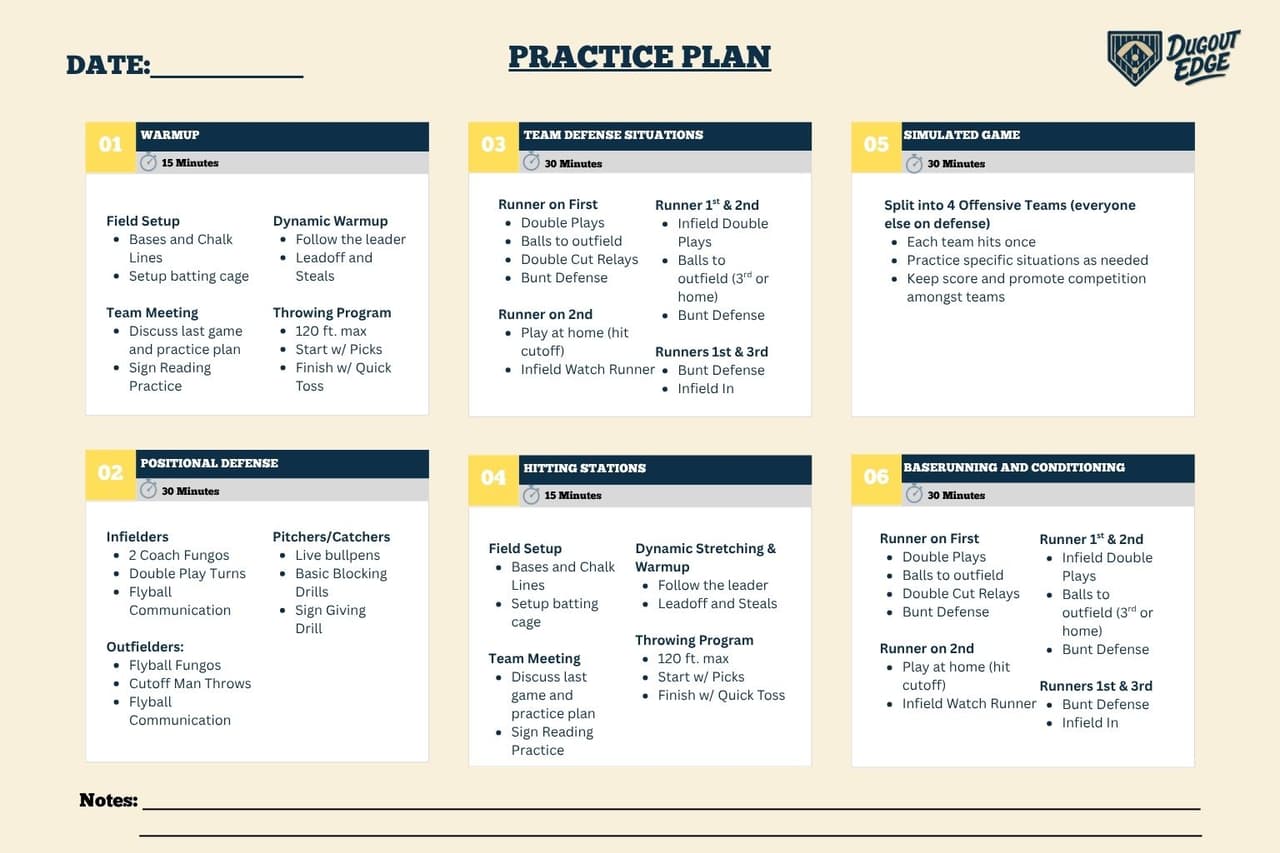
Every softball practice plan template on this page is free to download as a printable PDF. Print one out, write in your drills, and bring it straight to the field. The blank templates give you a clean structure to plan your own session, while the age-specific plans come pre-filled with drills and timing for tee ball through high school.
If you would rather not start from a blank page, the free practice planner builds a complete, timed softball practice plan for you in minutes and lets you save it for your team.
How to Run Effective Softball Practice Sessions
Successful softball practices require thoughtful organization and energy management. The goal is to keep every player engaged and active throughout the session. Research shows that athletes who get more quality repetitions during practice improve faster and enjoy the sport more. Your job as a coach is to create an environment where learning happens through action, not just watching.
Begin each practice by sharing your plan with the team. When players understand the session's focus and structure, they're more mentally prepared to learn. Divide practice into clear segments: dynamic warm-up (10 minutes), individual skills (25-30 minutes), team defense or offense (20 minutes), and live game situations or conditioning (remaining time). This predictable structure helps players transition smoothly between activities.
Eliminate idle time by using stations and small groups. If you see players standing in line for more than a minute, reorganize. Create multiple batting stations, set up separate infield and outfield drills, or split pitchers and catchers for specialized work. The more active touches each player gets, the faster they develop muscle memory for skills.
Strike a balance between instruction and action. Young athletes learn kinesthetically, through movement and repetition. After demonstrating proper technique and providing 2-3 coaching cues, let them practice while you circulate offering individual corrections. This keeps energy high and prevents the glazed-over look that comes from too much talking.
Finish practices with something positive and fun. Whether it's a baserunning relay, hitting competition, or team cheer, send players home feeling accomplished and excited. This positive ending builds enthusiasm for the next practice and strengthens team bonds throughout the season.
Age-Appropriate Practice Structure for Softball
Tee Ball (Ages 4-6)
Tee ball practices should feel more like organized play than rigid training. At this age, attention spans last only 5-8 minutes, so plan for frequent activity changes. Focus on fundamental movements: underhand throwing, catching with two hands, hitting off a tee, and running to the correct base. Use games and imagination to make skills fun: "monster catches" for ground balls, "rainbow throws" for arcing tosses. Keep practices under 60 minutes, as fatigue leads to frustration for this age group.
Coach Pitch (Ages 6-8)
This age group can handle slightly more structured drills but still requires variety and movement. Introduce basic defensive positions and teach players to back up throws. Work on hitting moving pitches, judging fly balls, and making throws to specific bases. Station-based practice works well: one group hitting, another practicing infield work, a third on baserunning. Practices can extend to 75-90 minutes with water breaks every 20-25 minutes.
Player Pitch (Ages 9-12)
Players at this level can understand game strategy and execute more complex plays. Introduce situational softball: relay throws, first-and-third defense, slap hitting, and bunting. Begin position specialization, giving pitchers and catchers extra practice time. These practices should last 90-120 minutes and include live batting practice, comprehensive infield/outfield work, and at least 20 minutes of game-situation scrimmaging. This is the critical age for building strong fundamental mechanics that will last throughout their softball careers.
Advanced Softball (Ages 13+)
High school-age players benefit from intensive, focused practices lasting 2-2.5 hours. Include strength and agility training, advanced defensive schemes, extensive live hitting against pitching, and mental preparation. Players should master 1-2 primary positions while staying proficient at others. Incorporate film study when possible, discuss game strategy, and emphasize competitive, game-speed repetitions that prepare them for actual competition.
Common Softball Practice Planning Mistakes
One of the biggest practice-planning errors is creating situations where players stand around waiting. If you scan your field and see girls sitting in long lines or standing idle, you're losing valuable development time. Combat this by breaking your team into smaller groups, creating multiple practice stations, or using assistant coaches to run simultaneous drills.
Another common mistake is selecting drills that don't match your team's developmental level. An intricate double-play drill has no value for 8-year-olds who are still mastering basic catches. Choose drills appropriate for your players' age and skill level. If players look confused or disengaged, simplify the activity rather than spending precious time explaining complicated rules.
Failure to adapt to conditions can derail an otherwise good practice. Extreme heat demands shorter drills, more water breaks, and shade time. Wet fields require adjusting your plan. Move to dry areas for throwing and hitting, skip sliding drills, and have a rain-out backup plan. Experienced coaches prepare flexible practices that can adjust to weather, field availability, and unexpected circumstances like missing equipment or low attendance.
Many coaches over-emphasize strategy while under-emphasizing fundamentals. While team plays and situations are important, young players need constant reinforcement of basics: proper throwing mechanics, batting stance and swing, ready position for fielding, and smart baserunning. Regardless of age level, dedicate at least half your practice time to fundamental skills. They're the foundation everything else builds upon.
Finally, resist the urge to over-coach. Constant corrections and frequent stoppages can drain enthusiasm and confidence. Pick 1-2 focus points for each practice, give players time to practice and make mistakes, and offer encouraging feedback along with corrections. Athletes learn best in positive environments where errors are treated as natural parts of the learning process.
Drill Selection and Timing Strategies
Smart drill selection begins with assessing your team's needs. After games, note specific weaknesses: poor cutoff throws, weak ground ball fielding, struggles with off-speed pitching. Your next practice should target these areas. Balance your focus between offense (hitting, baserunning, bunting) and defense (fielding, throwing, positioning), typically allocating 40% to each with 20% for conditioning and team concepts.
Always start with a proper warm-up (10 minutes minimum) including dynamic stretching, light jogging, arm circles, leg swings, and progressive throwing from short to long distances. This injury prevention time also helps players mentally transition into practice mode. Never skip warm-up, even when time is limited. Preventing injuries is always more important than squeezing in extra drills.
Station rotations maximize practice efficiency and keep players engaged. Set up 3-4 stations with 3-5 players each, rotating every 12-15 minutes. Example stations: hitting (tees or soft toss), infield grounders, outfield fly balls, and baserunning or throwing mechanics. This format keeps everyone active and allows you to move between stations providing individual coaching.
Timing discipline is essential for maintaining engagement. Younger players (under 10) need station changes every 10-12 minutes. Older players can stay focused for 15-20 minute blocks. Use your phone timer and stick to the schedule. Even if a station is going well, moving on time maintains structure and prevents boredom. Predictability helps players stay mentally engaged.
Conclude every practice with a cool-down and team meeting (5-10 minutes). This wind-down time allows players to catch their breath while you recognize individual improvements, reinforce key teaching points, and preview upcoming practices or games. It's a critical moment for building team culture and ensuring players leave feeling positive about their progress.
Making the Most of Practice Plan Templates
These free softball practice plan templates provide proven structures for practices at every competitive level. Each template includes timing recommendations, detailed drill explanations, and coaching tips to help you run organized, productive sessions. While the templates work well as written, feel free to modify them based on your team's specific needs, available equipment, field limitations, and practice duration.
The most effective coaches continuously refine their practices based on player development and team progress. Use these templates as your starting point, then build a personalized library of drills and practice plans that work for your coaching style and team. The more intentional and well-organized your practices, the more your players will improve, and the more everyone will enjoy the process.
Softball Practice Plan FAQs
What should a softball practice plan include?
A good softball practice plan includes a dynamic warm-up, a fundamentals block for throwing, fielding, and hitting, a team or situational segment, and a short scrimmage to finish. Giving each block a set amount of time keeps the practice organized and keeps every player moving.
How long should a softball practice be?
Practice length depends on age. Tee ball (ages 4 to 6) works best at 45 to 60 minutes, coach pitch (ages 6 to 8) at 75 to 90 minutes, player pitch (ages 9 to 12) at 90 to 120 minutes, and advanced softball (13 and up) at 2 to 2.5 hours.
Are these softball practice plan templates free and printable?
Yes. Every template on this page is completely free, and each one downloads as a printable PDF you can print and bring to the field. No account or payment is required.
What is the best softball practice plan template for beginners?
New coaches should start with the simple blank template or an age-matched plan for their team. The blank templates give you a clean, ready-to-print structure, while the age-specific plans include drills and timing already filled in.
How do I create my own softball practice plan?
Download a blank template and fill in each time block with drills that match what your team needs to work on. You can also build and save a custom plan automatically with the free Dugout Edge practice planner.
How many softball practice plans can I download?
All of them. The full library of softball practice plan templates is free to download, with new plans and age groups added regularly.
Want a complete softball practice plan built for your team in minutes?
Try the Free Practice Planner