Complete Guide to Baseball Practice Plans
Printable Baseball Practice Plan Templates (PDF)
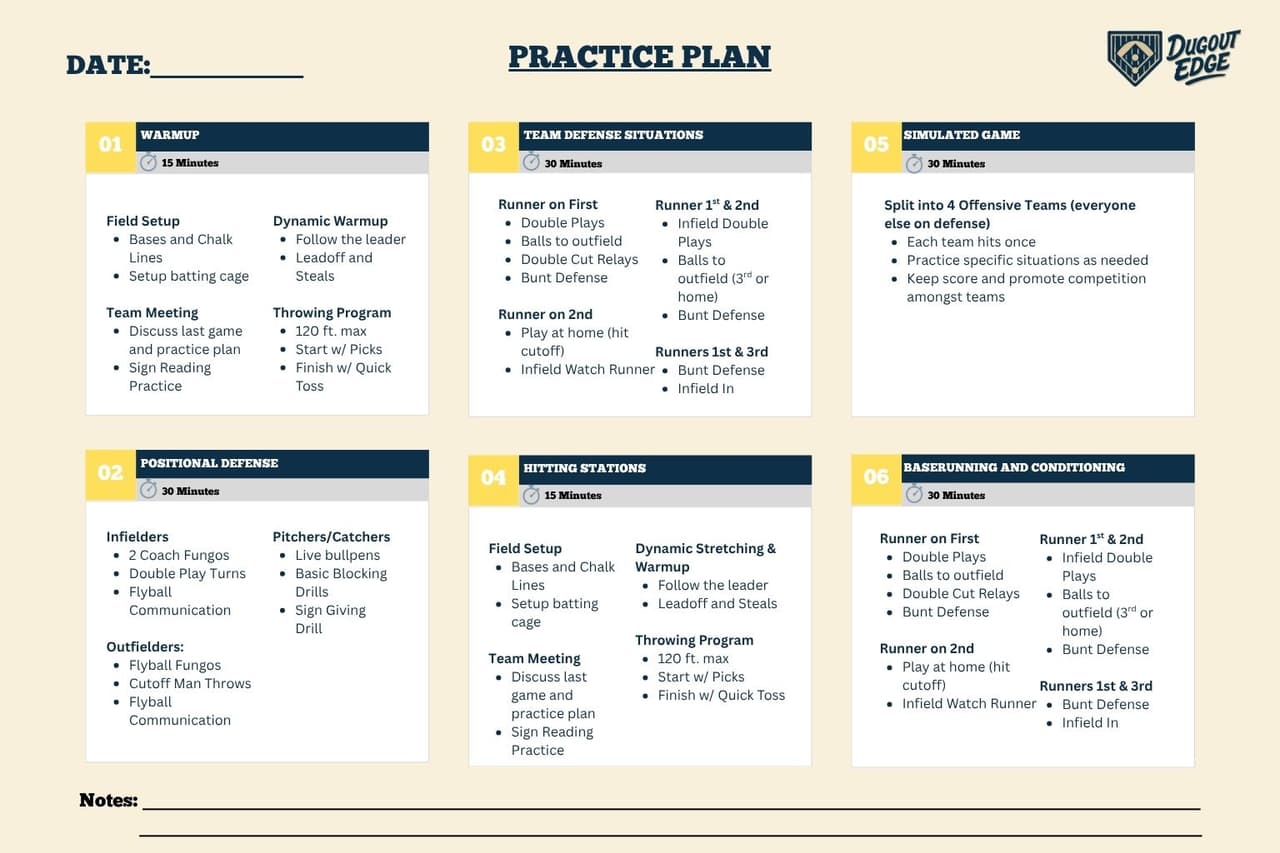
Every baseball practice plan template on this page is free to download as a printable PDF. Print one out, write in your drills, and bring it straight to the field. The blank templates give you a clean structure to plan your own session, while the age-specific plans come pre-filled with drills and timing for tee ball through high school.
If you would rather not start from a blank page, the free practice planner builds a complete, timed baseball practice plan for you in minutes and lets you save it for your team.
How to Run Effective Baseball Practice Sessions
Running an effective baseball practice requires careful planning and organization. The key is to maximize engagement while minimizing downtime. Every player should be active and involved, whether they're hitting, fielding, running, or learning. Studies show that players who spend more time actively participating in drills develop skills faster and have more fun.
Start each practice with a clear plan and communicate it to your team. Players perform better when they know what to expect and understand the purpose of each drill. Break your practice into distinct segments: warm-up (10 minutes), fundamental skills (20-30 minutes), team concepts (15-20 minutes), and scrimmage or game situations (remaining time). This structure keeps practices organized and ensures you cover all essential skills.
Keep drills moving at a brisk pace. If players are standing in long lines waiting for their turn, you're losing valuable development time. Use stations where small groups rotate through different skills, or set up multiple hitting areas so more players can practice simultaneously. The more repetitions each player gets, the faster they'll improve.
Balance instruction time with active play. While coaching points are important, young players learn best by doing. Demonstrate a skill, provide key teaching points, then let them practice while you offer individual feedback. This approach maintains engagement and prevents players from tuning out during lengthy explanations.
End every practice on a positive note. Whether it's a fun relay race, a quick scrimmage, or recognition of individual improvements, send players home excited to return. This positive reinforcement builds team culture and keeps motivation high throughout the season.
Age-Appropriate Practice Structure for Baseball
Tee Ball (Ages 4-6)
At this age, practices should be high-energy, fast-paced, and fun-focused. Attention spans are short—typically 5-10 minutes per activity—so plan for frequent transitions. Focus on basic movements like throwing, catching with large gloves, hitting off tees, and running bases. Incorporate games and imaginative play to teach fundamentals. For example, "alligator catches" help teach ground balls, while "rocket throws" encourage proper throwing mechanics. Keep practices to 60 minutes maximum, as younger players tire quickly.
Coach Pitch / Machine Pitch (Ages 6-8)
This age group can handle slightly longer drills but still needs variety. Introduce basic positions and teach the concept of backing up throws. Focus on hitting moving balls, catching fly balls, and making accurate throws to bases. Use stations extensively—one group hitting, another fielding, a third doing baserunning drills. Practices can extend to 75-90 minutes, but include water breaks every 20 minutes.
Kid Pitch (Ages 9-12)
Players at this level can handle more complex concepts and longer drill sequences. Introduce situational baseball: cutoffs and relays, first-and-third situations, and bunt defense. Begin specialized position work, especially for pitchers and catchers who need extra practice. These practices can run 90-120 minutes. Include live batting practice, infield/outfield work, and at least 20 minutes of game-situation scrimmages. This is the perfect age to emphasize fundamentals that will carry through their baseball careers.
Teen Baseball (Ages 13+)
Advanced players benefit from intensive, focused practices lasting 2-2.5 hours. Incorporate strength and conditioning, advanced defensive strategies, and extensive live pitching work. Players should specialize in 1-2 positions while maintaining proficiency elsewhere. Include mental preparation, strategy discussions, and film review when possible. Emphasize game-speed repetitions and competitive situations that mirror actual games.
Common Baseball Practice Planning Mistakes
Even experienced coaches fall into practice planning traps. The most common mistake is too much standing around. If you look across your practice field and see players sitting in long lines or standing idle, you're wasting development time. Break large groups into smaller stations or create multiple practice areas to keep everyone active.
Another frequent error is choosing drills that are too complex for the age group. A fancy double-play drill means nothing to 7-year-olds who are still learning to catch the ball. Match your drill complexity to your players' developmental stage. If kids look confused or frustrated, simplify the drill rather than spending 15 minutes explaining rules.
Failing to adapt to conditions can ruin a practice. If it's extremely hot, reduce running drills and increase water breaks. If your field is wet, move hitting and throwing drills to dry areas and skip sliding practice. Smart coaches have a backup plan for weather, field conditions, and missing players or equipment.
Many coaches also neglect fundamentals in favor of advanced strategies. While practicing plays and situations has value, young players need constant reinforcement of basics: proper throwing mechanics, batting stance, fielding position, and base running. Dedicate at least 50% of practice time to fundamental skills, regardless of age level.
Finally, avoid the trap of over-coaching. Giving too much feedback or constantly stopping drills for corrections can kill momentum and confidence. Choose one or two focus points per practice, give players time to practice, and offer positive reinforcement along with corrections. Kids learn better in an encouraging environment where mistakes are seen as learning opportunities.
Drill Selection and Timing Strategies
Effective drill selection starts with identifying your team's needs. After each game, note which skills need improvement—missed cutoffs, weak groundball fielding, or poor at-bat approaches. Your next practice should address these gaps. Balance offensive and defensive work, typically spending 40% on hitting/baserunning, 40% on defense, and 20% on conditioning and team concepts.
Always begin with a dynamic warm-up (5-10 minutes) that includes light jogging, arm circles, leg swings, and playing catch at increasing distances. This prevents injuries and prepares players mentally for practice. Never skip the warm-up, even when time is tight—a pulled muscle will cost you far more than 10 minutes.
Use station rotations to maximize efficiency. Set up 3-4 stations with 3-4 players each, spending 12-15 minutes per station. For example: Station 1 (hitting tees), Station 2 (fielding grounders), Station 3 (fly ball practice), Station 4 (throwing mechanics). This keeps all players active and allows you to move between stations offering coaching.
Timing is crucial for maintaining engagement. Younger players (under 10) need to rotate every 10-12 minutes. Older players can handle 15-20 minute segments. Set a timer on your phone and stick to it—even if a station is going well, keeping on schedule prevents boredom and maintains structure.
Don't forget the cool-down and team huddle (5-10 minutes). This is when players catch their breath, you recognize effort and improvement, and you preview the next practice or game. It's a critical time for building team culture and ensuring players leave feeling accomplished.
Making the Most of Practice Plan Templates
These free practice plan templates provide a proven structure for baseball practices at every age level. Each template includes timing recommendations, drill descriptions, and coaching tips to help you run organized, effective sessions. While you can use them as-is, feel free to adapt them to your team's specific needs, available equipment, and practice time.
The best coaches continuously evaluate and adjust their practices based on player development and team progress. Use these templates as a foundation, then build your own library of successful drills and practice plans. The more organized and purposeful your practices, the more your players will develop, and the more fun everyone will have.
Baseball Practice Plan FAQs
What should a baseball practice plan include?
A good baseball practice plan includes a dynamic warm-up, a fundamentals block for throwing, fielding, and hitting, a team or situational segment, and a short scrimmage to finish. Giving each block a set amount of time keeps the practice organized and keeps every player moving.
How long should a baseball practice be?
Practice length depends on age. Tee ball (ages 4 to 6) works best at 45 to 60 minutes, coach pitch (ages 6 to 8) at 75 to 90 minutes, kid pitch (ages 9 to 12) at 90 to 120 minutes, and teen baseball (13 and up) at 2 to 2.5 hours.
Are these baseball practice plan templates free and printable?
Yes. Every template on this page is completely free, and each one downloads as a printable PDF you can print and bring to the field. No account or payment is required.
What is the best baseball practice plan template for beginners?
New coaches should start with the simple blank template or an age-matched plan for their team. The blank templates give you a clean, ready-to-print structure, while the age-specific plans include drills and timing already filled in.
How do I create my own baseball practice plan?
Download a blank template and fill in each time block with drills that match what your team needs to work on. You can also build and save a custom plan automatically with the free Dugout Edge practice planner.
How many baseball practice plans can I download?
All of them. The full library of baseball practice plan templates is free to download, with new plans and age groups added regularly.
Want a complete baseball practice plan built for your team in minutes?
Try the Free Practice Planner